



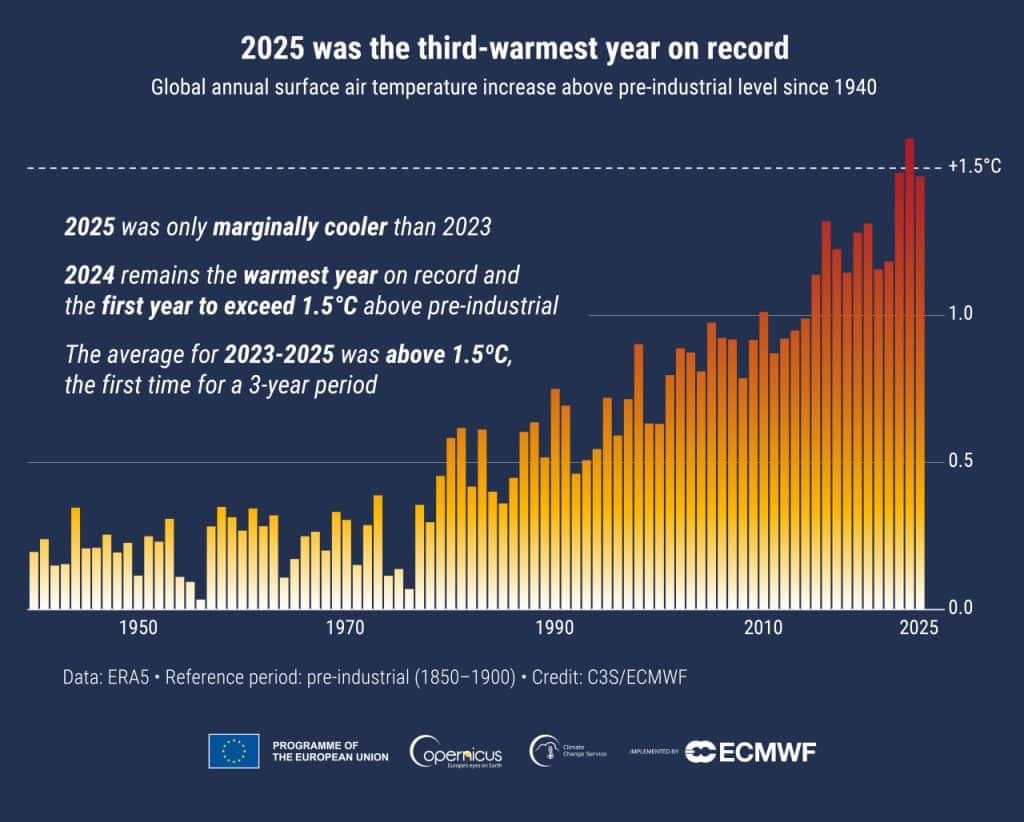
2025 was just 0.01C cooler than 2023 and 0.13C cooler than 2024, the warmest year on record, according to the European Centre for Medium-Range Weather Forecasts (ECMRW).
—
2025 was the third warmest year ever recorded, continuing a long-term trend of abnormally high temperatures that has heightened the frequency and intensity of extreme weather occurrences across the globe.
With a global average temperature of 14.97C, last year was just 0.01C cooler than 2023 and 0.13C cooler than 2024, the warmest year on record, according to data from several dataset providers, including the European Center for Medium Range Weather Forecasts Copernicus Climate Change Service (ERA5) and Berkley Earth.
Compared to pre-industrial levels, the global surface air temperature was 1.47C higher, according to the ERA5 dataset. While the average for 2023-2025 was above 1.5C for the first time for a three-year period, the current long-term global warming level lies at around 1.4C above pre-industrial levels. Only in 2024 did the temperature surpass the critical global warming limit agreed by nearly all countries in 2015 with the Paris Agreement.
Beyond 1.5C of global warming, experts warn that critical tipping points will be breached, leading to devastating and potentially irreversible consequences for several vital Earth systems that sustain a hospitable planet, such as rising sea levels, more intense heatwaves, stronger storms, and disruptions to ecosystems and biodiversity.
The burning of coal, natural gas, and oil for electricity and heat is the single-largest source of global greenhouse gas emissions, the primary drivers of global warming as they trap heat in the atmosphere, raising Earth’s surface temperature. While global fossil fuel consumption has more than doubled in the last 50 years, scientists have long warned that curbing fossil fuel extraction and consumption is the only way to halt global warming and secure a liveable future.
‘Unmistakable Trend’
A significant portion of the world experienced warmer-than-average temperatures in 2025. This included the Arctic and Antarctic, which saw their second-highest and highest value on record. Record-high annual temperatures were also recorded in the northwestern and southwestern Pacific, the northeastern Atlantic, far eastern and north-western Europe and central Asia.
The past 11 years have been the 11 warmest on record. This “provides further evidence of the unmistakable trend towards a hotter climate,” according to Carlo Buontempo, Director of the Copernicus Climate Change Service. “The world is rapidly approaching the long-term temperature limit set by the Paris agreement. We are bound to pass it; the choice we now have is how to best manage the inevitable overshoot and its consequences on societies and natural systems.”
Ocean Heat
Ocean temperatures in 2025 were also among the highest on record, according to a study published in Advances in Atmospheric Sciences last week.
“Regionally, about 33% of the global ocean area ranked among its historical (1958–2025) top three warmest conditions, while about 57% fell within the top five, including the tropical and South Atlantic Ocean, Mediterranean Sea, North Indian Ocean, and Southern Oceans, underscoring the broad ocean warming across basins,” the World Meteorological Organization said in its annual bulletin, also published on Wednesday.

Oceans act as Earth’s primary heat sink, absorbing over 90% of the excess heat generated by human-caused greenhouse gas emissions, This makes ocean heat content a critical indicator of climate change.
Extreme Weather Events on the Rise
Extreme weather events affected all continents last year, with notable record heatwaves and storms affecting Europe, Asia and North America, and catastrophic wildfires destroying infrastructure and claiming dozens of lives in Spain, Canada and southern California. 2025 was one of the costliest years for climate disasters globally, and the third-highest year for billion-dollar disasters in the US, after 2023 and 2024.

Global warming, caused primarily from human-induced greenhouse gas emissions, has led to an increase in both the frequency and intensity of some extreme weather events since pre-industrial times, including flooding, extreme rainfall and storms, and droughts. Emissions of all three principal greenhouse gases continued to increase in 2025.
You might also like: Year in Review: The Biggest Climate Headlines of 2025
Featured image: Kyle Lam/hongkongfp.com
This story is funded by readers like you
Our non-profit newsroom provides climate coverage free of charge and advertising. Your one-off or monthly donations play a crucial role in supporting our operations, expanding our reach, and maintaining our editorial independence.
About EO | Mission Statement | Impact & Reach | Write for us