

Iceland’s waters are shifting. Species are disappearing. Ecosystems are becoming unstable. And while it is easy to say that this is just a problem for Iceland, that is far from reality. Because what is happening here is a microcosm of what is happening everywhere.
—
By Andi Cross
When it comes to the waters surrounding Iceland, one landmark (or seamark) stands out above the rest: Silfra Fissure. This massive crevice sits at the junction of two tectonic plates, and is filled with glacial melt so clear it feels like fiction more than reality. Inside Thingvellir National Park, a UNESCO World Heritage Site, this fissure has become the country’s most photographed aquatic space. Cold, beautiful, and simply unmistakable, most people suit up, drift through, and move on to the rest of the tourist trail along the iconic Ring Road.
But this is just one element of what lies beneath Iceland’s waters, and the full scope of the aquatic ecosystems here is far more complex than one might imagine. Beneath the surface, this island is very much alive, with constant tectonic activity, melting glaciers, and ancient species that have adapted to extremes most of us cannot even fathom. Conditions are rough, even at the best of times. The weather turns fast, and the cold is a driving force that governs life here. But this is exactly what makes these high-latitude waters so fascinating. And the changes happening here are bound to affect all of us.

I first explored the island back in 2017, taking the well-worn road that circles around the country through lava fields, around glacial lagoons, and past dozens of waterfalls. The sun barely dipped below the horizon, giving us endless daylight to explore. But while the surface was captivating, I kept thinking about what was happening beneath, in the sub-arctic ocean that surrounds Iceland in all directions.

On my second visit to Iceland — this time as part of the Edges of Earth expedition trail — we made our way north to Akureyri, a small city perched at the edge of a vast fjord. While it seemed relatively straightforward to reach via the Ring Road, getting from A to B is rarely simple or convenient in Iceland. September’s weather had its own plans for us. One moment we were peeling off layers in the sun, the next we were detouring around flooded roads and a volcanic eruption that briefly shut down the highway near the airport. Gale-force winds pummeled the coastline as we worked our way north.
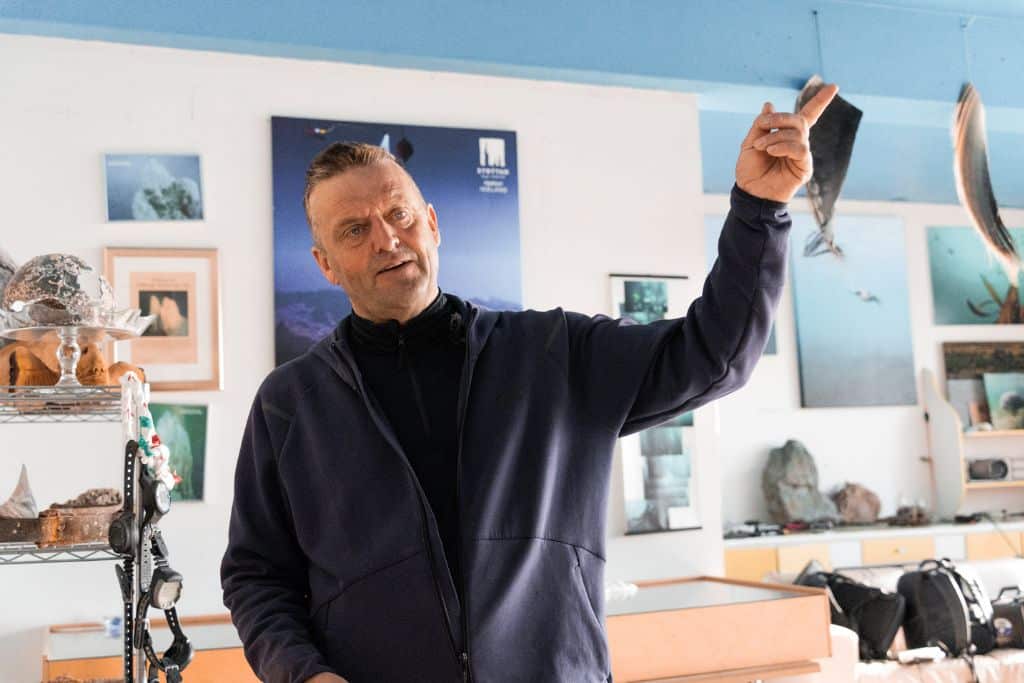
The ocean looked angry. The clouds dropped fast. And the possibility of getting into the water was slipping away rapidly. Still, we pressed on, motivated not by scuba diving itself, but by the opportunity to understand this place through the eyes of someone who has spent a lifetime immersed in it. Erlendur “Eli” Bogason is known as Iceland’s leading ocean expert, not only for the sites he has documented as the first, but also for the deep, almost surreal relationships he has fostered with the creatures who live there.
We had first heard about Eli from Byron Conroy, a technical diver and longtime explorer of Iceland’s rugged coastline. Byron spoke of Eli with reverence, especially his rare connection to the Atlantic wolffish, a species as tough and strange as the waters it calls home. These fish, with their gnarled teeth and expressive faces, had become something of a personal obsession for Eli. Few know the creatures like he does. Even fewer have seen them up close.
When we finally reached Eli’s home base, a dive center found on the town’s harbor, we were not met with tourists or gear racks. Instead, we were met with maps. Dozens of them, covering the walls like a never-ending record. On the top floor of the space, one chart in particular stood out: a detailed layout of Iceland’s coastline, marked with pins for every site Eli had explored. Each pin carried a story — some for research, some for reconnaissance, others simply to see what was there before it disappeared.

We realized rather quickly that we had stepped into an archive. A museum of firsthand knowledge, built from decades of paying close attention to what sits below the waterline. Among the seabird eggs, old bones, and field notes scattered throughout the space, you could feel an urgency to document this wild. Together, each artifact formed a portrait of a man shaped by nature’s extremes.
Eli grew up on the Westman Islands, where volcanic activity was a natural phenomenon just as much as a knocking neighbor. Pointing to an old photo, he told us about the eruption of Eldfell in 1973, when a lava-spewing fissure opened just 500 meters from his family’s home. “I remember my father waking the families next door while I stood at the window, watching this incredible force of nature,” he said. The storytelling did not seem dramatized, rather incredibly vivid, still after all these years.

That experience stayed with him and is ultimately what started his journey obsessed with Iceland’s nature. As an adult, Eli turned his attention from the fire to the water, as he felt it was just as volatile and full of mystery. Since the mid-1990s, he has spent decades documenting marine life across the country’s shifting coastlines. His mission has always been to reveal what most people never think to look for.
“There is so much we do not know about Iceland’s underwater life,” he said, gesturing toward a glass case filled with labeled specimens, each one part of a bigger ecological puzzle. Which is how the Atlantic wolffish became his primary focus.
Fierce, prehistoric looking but misunderstood, wolffish are a keystone species in these northern waters. Along Iceland’s rocky seabed, they carve out hidden nests in crevices and under boulders. But what makes them extraordinary is their parenting approach. In an unusual role reversal, the males take on full-time nest duty, guarding the eggs for months without feeding. They fan the cluster with their tails to keep it oxygenated, clean away debris, and never stray far, even when threatened. This intense, solitary commitment makes them especially vulnerable to disturbance, and cements them as a clear indicator species for broader environmental stress.

Over years of careful observation, Eli has not only mapped wolffish behavior but even built real relationships with individual fish. One wolffish in particular — originally named Stephanie — became a regular on his dives. It was not until much later that Eli realized Stephanie was, in fact, male. “So now he is Stefan,” Eli said with a grin. “One day, Stefan grabbed my spare regulator and took a breath. Like he was trying to mimic me.”
In these cold, volatile waters, Eli is coming face-to-face with personalities. And more than that, he sees signs. These encounters, especially with Stefan, shifted something fundamental in his perspective: the underwater world is not a static system to be studied from a distance. It is alive, highly responsive, and always changing. And in ways we were only just beginning to understand.
Eli has witnessed stark shifts in wolffish behavior over the years — changes he links to overfishing and mounting environmental stress. “I have been mapping their nests since 2016,” he said, holding up a hand-drawn map of the northern coast. “In one location, there were nine pairs of wolffish when I started. Today, there are none.” He described sightings of aggressive males attacking eggs, which is something he never had seen before. “It is like the balance in their ecosystem is unraveling, and we do not fully understand why.”

The disappearance of the wolffish reflects a wider breakdown.
Kelp forests along the coast, once thriving, are being overharvested for commercial use, stripping away vital habitat for countless species. Red calcium algae, a slow-growing organism that forms the bedrock of many marine ecosystems, is being mined, disrupting its essential role in stabilizing biodiversity. These are examples of compounding pressures that weaken the entire system. Eli is quick to point out that what might appear isolated — one species declining, one site degraded — is actually connected. “These are stress signals,” he said. “The whole ecosystem is under pressure.”
That pressure comes from both sides: global climate shifts altering currents and water temperatures, and local industry accelerating extraction and habitat loss. The result is an underwater world less resilient, less stable, and increasingly pushed to the brink.Eli has also documented the effects of human activity on Iceland’s underwater hot springs, such as the famed hydrothermal cone at Strýtan that he helped put on the nautical map. This remarkable geological formation, rising 50 meters from the seafloor, is one of the only accessible underwater hot springs in the world. “Strýtan is like nowhere else on Earth,” Eli said. “It’s an estuary, where freshwater and seawater mix, creating a habitat for species you will not find anywhere else.” However, even this protected area has not been immune to the impact of geothermal drilling – used to power the cities of Iceland, which has disrupted the delicate balance of hot and cold water flows.

Because of these systemic changes, he has and continues to collaborate with scientists, government agencies, and international researchers to better comprehend this connected ecosystem and what is at stake. “I am working with researchers to restore the hot water flow,” he said, pointing to underwater photographs of the site we sadly did not get to see firsthand. “Without it, the entire system, and everything that depends on it, is at great risk.”
In many ways, Eli has become the north’s unofficial archivist of Iceland’s underwater.
This is largely why his dive center has grown into a gathering point for photographers, filmmakers, and journalists who recognize this is a world of its own. One of his current projects is a short film on wolffish with Byron, aimed to capture what is left, and what might soon be lost. “We have so much to learn from these creatures,” he told us. “And so much to lose if we do not act.”

Iceland’s waters are shifting. The signs are there, for those who stay long enough to see them. Species are disappearing. Ecosystems are becoming unstable. Even places like Strýtan are being altered by the choices we make on land. And while it is easy to say that this is just a problem for Iceland, that is far from reality. Because what is happening here is a microcosm of what is happening everywhere. These seemingly invisible changes, hidden out of our plain line of sight, can often compound until they are simply too far gone to reverse.
So, what can we do?
For starters, we can find and listen to people like Eli who have been paying attention for decades. Bt also support science and conservation rooted in local knowledge; push for policies that protect marine ecosystems, not just the coastlines we can see; and if you are a diver able to visit a place like Iceland, go beyond the fissure. Look beneath the surface. Because the ocean is speaking. The only question now is whether we are ready to listen.
Featured image: Bryon Conroy.
—
This story is part of an editorial collaboration between Earth.Org and Edges of Earth Expedition, a team dedicated to uncovering powerful stories from the frontlines of the climate crisis. Leading the charge is Andi Cross –an expeditionist, impact strategist, writer, and SSI divemaster –who has spent over two years traveling the world, immersing herself in the realities of environmental change.
This story is funded by readers like you
Our non-profit newsroom provides climate coverage free of charge and advertising. Your one-off or monthly donations play a crucial role in supporting our operations, expanding our reach, and maintaining our editorial independence.
About EO | Mission Statement | Impact & Reach | Write for us