



“Two years after the hottest July on record, the recent streak of global temperature records is over – for now. But this doesn’t mean climate change has stopped,” said Carlo Buontempo, Director of the Copernicus Climate Change Service.
—
A months-long streak of global temperature records came to an end last month, although experts have warned that continued greenhouse gas emissions will bring more temperature records and catastrophic extreme weather events.
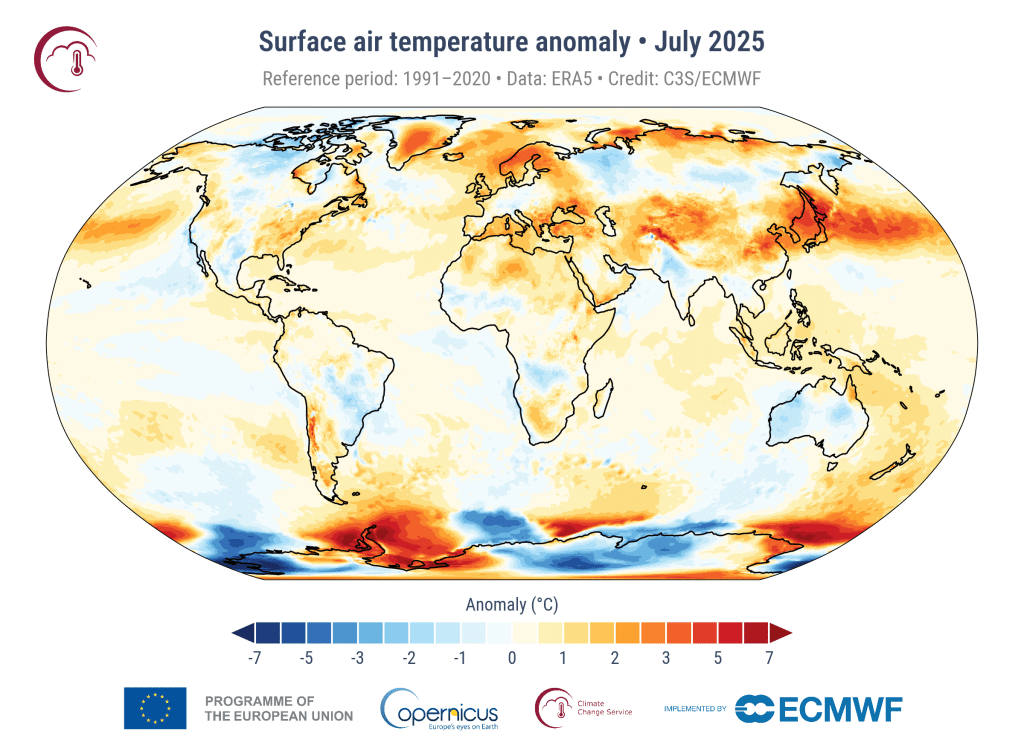
The global average temperature last month was 16.68C, the third-warmest ever recorded for the month, behind only July 2023 and July 2024, according to the Copernicus Climate Change Service. It was also 1.25C above the pre-industrial average, marking only the fourth month in the last 25 with a temperature less than 1.5C above that average. The last 12 months, when taken together, were still 1.53C above the pre-industrial level.
The critical 1.5C threshold was established at the 2015 COP21 climate summit, when 196 parties signed the legally binding Paris Agreement. They agreed to keep limiting long-term global warming to below 1.5C or “well below 2C” above pre-industrial levels by the end of the century. Beyond this limit, which can be considered permanently breached if surpassed for 20 to 30 decades, experts warn that critical tipping points will be breached, leading to devastating and potentially irreversible consequences for several vital Earth systems that sustain a hospitable planet.

“Two years after the hottest July on record, the recent streak of global temperature records is over – for now. But this doesn’t mean climate change has stopped,” said Carlo Buontempo, Director of the Copernicus Climate Change Service.
“We continued to witness the effects of a warming world in events such as extreme heat and catastrophic floods in July. Unless we rapidly stabilise greenhouse gas concentrations in the atmosphere, we should expect not only new temperature records but also a worsening of these impacts – and we must prepare for that,” he added.
Record-Breaking Temperatures
Some countries still saw record temperatures last month.
Japan had its warmest July on record, with the monthly average temperature 2.89C higher than the 1991-2020 average for the same month. The nation recorded its highest temperature ever – 41.2C – on July 30 in the western region of Hyogo. That record was surpassed on Monday, when 41.8C were recorded in Isesaki City, Gunma Prefecture.
South Korea experienced a record-breaking streak of “tropical nights” for 22 consecutive days last month, the country’s second-warmest on record.
High nighttime temperatures are detrimental to human health, as they prevent the body from recovering from daytime heat. This not only disrupts sleep, which can negatively affect physical and mental health, cognitive function, and life expectancy, but it also increases the risk of illness and mortality. A 2020 study by the Chinese University of Hong Kong found that five consecutive “hot nights,” defined as when temperatures rise above 28C (82F), would raise the risk of death by 6.66%.
In Europe, Finland, Sweden and Norway all saw the mercury surpass the 30C mark for several consecutive days, which is unusually high for Nordic countries.
“Global warming isn’t going away, …and it will get stronger in the decades ahead, so the summer of 2025 is a clear illustration of how things will be,” said Bjørn Samset, a researcher at the Norwegian climate research institution Cicero. Norway saw its hottest day on record on July 16, with temperatures in Meråker in the Stjørdalen region, close to the Swedish border, reaching 34C.
July was also Iceland’s warmest on record, equaling 1933. On July 14, 70% of weather stations recorded temperatures above 20C, with Hjarðarland in the Southwest reaching a high of 29.5C, the highest temperature since 2008. Iceland’s average July temperature ranges between 10-15C, occasionally reaching 20-25C.
“Such jumps in temperature records are highly unusual and demonstrate just how warm it was today,” said Kristín Hermannsdóttir, Head of Weather Services at the Icelandic Meteorological Office.
Featured image: Kyle Lam/hongkongfp.com.
You might also like: Silent Killer: Understanding the Risks of Extreme Heat
This story is funded by readers like you
Our non-profit newsroom provides climate coverage free of charge and advertising. Your one-off or monthly donations play a crucial role in supporting our operations, expanding our reach, and maintaining our editorial independence.
About EO | Mission Statement | Impact & Reach | Write for us