

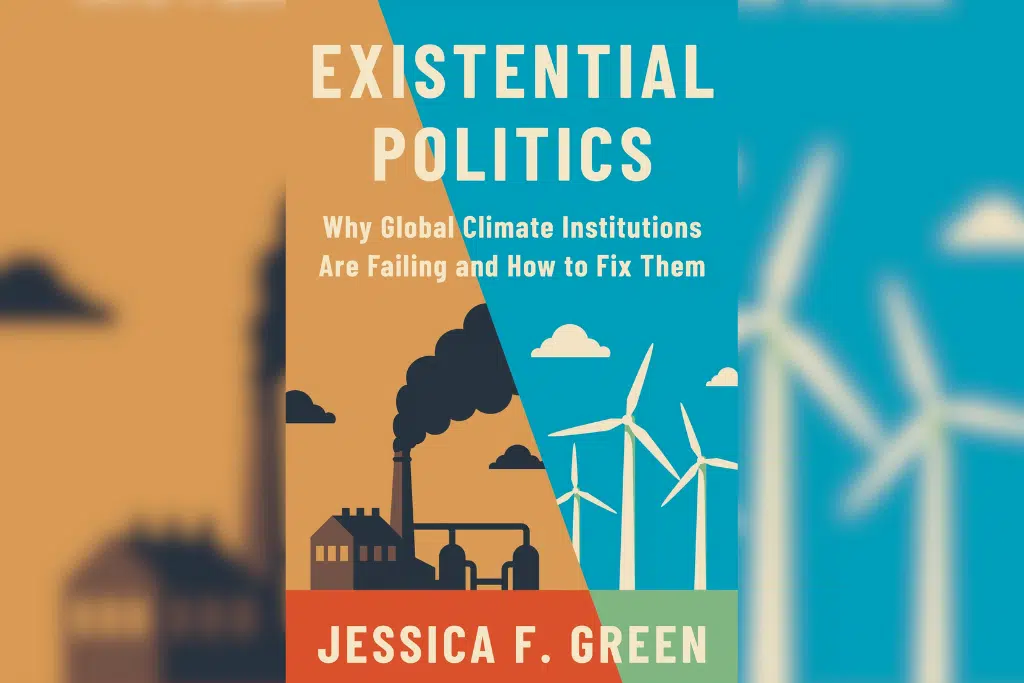
The existing model of managing climate change via tons of carbon dioxide is an outright failure, and should be replaced by financial tools that act directly on corporate (especially fossil fuel) interests: this is the thesis of a grim new book by Jessica F. Green, a political science professor at the University of Toronto. Within these pages, Green sets out the reasons for her conclusions, sheds light on the causes of the problem, and makes recommendations for how to move forward.
—
Existential Politics: Why Global Climate Institutions Are Failing and How to Fix Them is a straightforward volume. In the first chapter, the author states bluntly that “The climate crisis is evidence of an incredible governance failure.” She blames it on a basic conceptual flaw – attempting to “manage tons” of carbon dioxide (CO2) emissions instead of creating policies to “manage assets”. The remainder of the book provides ample evidence to support these points.
Several chapters in the first half of the book detail this history of the failure. This is not new ground, but when described through the lens of “managing tons”, it takes on a different nuance.
Most importantly, the book repeatedly asks the question: does it work? And in almost every case, the answer is negative. Emissions trading schemes and carbon taxes come under fire for the enormous effort and focus placed on them, with little evidence that they are effective; overdependence on anticipated results and leakage to other jurisdictions were among the key problems. At most, the author’s own research shows, ambitious carbon pricing can reduce the growth rate of emissions (and even that by just 0.3%), but not the growth itself.
Indeed, several moments in the chapter focusing on society’s many attempts to reduce emissions in this way are punctuated by a wry refrain: “And yet emissions continue to rise.”
It stings.
Overall, the book takes a hardline stance against offsets, including the projects themselves (afforestation does not work), their quantification (beset by greenwashing, leakage, and the impossibility of data verification), and international dependence on offsets to the exclusion of other tools. It also excoriates voluntary carbon markets, dismisses the European Union’s new Carbon Border Adjustment Mechanism (CBAM), and criticizes the entire concept of “net zero”.
Instead, it is argued in the second half of the book, fundamental financial reform is needed to tackle climate change. This is framed as “a political contest between different kinds of asset owners.” These are fossil assets such as oil and gas, green assets such as renewables, and assets vulnerable to climate change such as agriculture.
While the author acknowledges the existence of other analyses that call for the wholesale destruction of the capitalist system as the only way to address climate change, she finds this unrealistic and instead proposes “radical pragmatism”.
“Global climate governance isn’t working because it is overly focused on the wrong problem,” Green states. And indeed, instead of focusing on carbon dioxide emissions directly, she goes after more fundamental financial and political structures.
The solutions she proposes are institutional reforms which, on the surface, appear to be unrelated to climate change. These include the ramping up of new OECD rules on a corporate minimum tax as a way to address offshoring of corporate profits, and changes to the Investor-State Dispute Settlement (ISDS) system. However, she shows, for example, how tackling income inequality is a vital step towards reducing the staggeringly high emissions of the world’s one percent.
Overall, this book provides a fascinating departure from conventional wisdom on how to address climate change, and delves into areas that many climate specialists are unlikely to be familiar with – it is more concerned with ISDS than CBAM, and argues that the UN Framework Convention on International Tax Cooperation will have a greater impact on the climate than the UN Framework Convention on Climate Change – best known as the UNFCCC.
For those interested in multilateral politics, it is a solid and well-structured book with a well-set-out argument and an absolutely comprehensive set of references that could serve as the reading list for a PhD in the subject. To a certain extent, it suffers from over-summarizing – each section begins with a chapter that summarizes the next several chapters, which are then also summarized at the beginning and end. One wonders if it would have been enough simply to read the first chapter (a summary of the rest of the book).
Additionally, like all political books that deal with present-day issues, it is somewhat hobbled by the fact that current events can overwhelm any attempt to contextualize what might happen next. The book was completed just after Donald Trump took power in the United States, meaning, for example, that analysis of the Biden-era Inflation Reduction Act is hampered by uncertainty as to its future.
However, for anyone seeking to understand the bigger picture around climate politics in the global socioeconomic context, this is a coherent set of facts and recommendations to consider and a lucid outline of what might actually create change.
Existential Politics: Why Global Climate Institutions Are Failing and How to Fix Them
Jessica F. Green
2025, Princeton University Press, 209pp
—
Check out more Earth.Org book reviews here.
This story is funded by readers like you
Our non-profit newsroom provides climate coverage free of charge and advertising. Your one-off or monthly donations play a crucial role in supporting our operations, expanding our reach, and maintaining our editorial independence.
About EO | Mission Statement | Impact & Reach | Write for us