

Acupuncture has been used to relieve pain and other maladies in humans for roughly 3,000 years. However, few know that it has also been used to benefit other animal species.
—
By Nikki Sharp
Although acupuncture is not commonly used in elephant medicine, a series of events led Wildlife SOS, an Indian conservation non-profit organization, to delve into the potential benefits for elephants needing care. This is where the story begins.
In the winter of 2024, a baby Asian elephant – just about a year old – arrived at our sanctuary in India. She came in the back of a van, wrapped in blankets, unnervingly still. Her half-open eyes held none of the spark of youth – only a quiet resignation, as if she were preparing to slip away from the life she had barely begun. The veterinary team traveling with her avoided the word “grave”, but their hushed tones told us everything: her condition was critical.
In time, we would give her a name: Bani.
Some weeks earlier, Bani had survived a devastating train collision. Her herd had been crossing the tracks when the impact struck, killing her mother instantly and flinging the calf down a steep embankment. The force left her paralyzed. Disoriented and terrified, the remaining elephants fled into the forest, leaving the calf alone in the darkness. In a single night, Bani lost her family, the use of her legs, and the wild future that should have been hers.
Bani’s Second Chance
In the weeks following Bani’s arrival, her condition changed little, but small breakthroughs offered hope. The tiny elephant could not stand or bear weight, but she began to move her tail – a sign her spinal cord was not severed. Her appetite increased, and she eagerly drank her bottles of milk. Most importantly, her inner spirit began to reemerge. Both hind legs, however, remained rigid and showed no voluntary movement, even though X-rays revealed no major fractures.
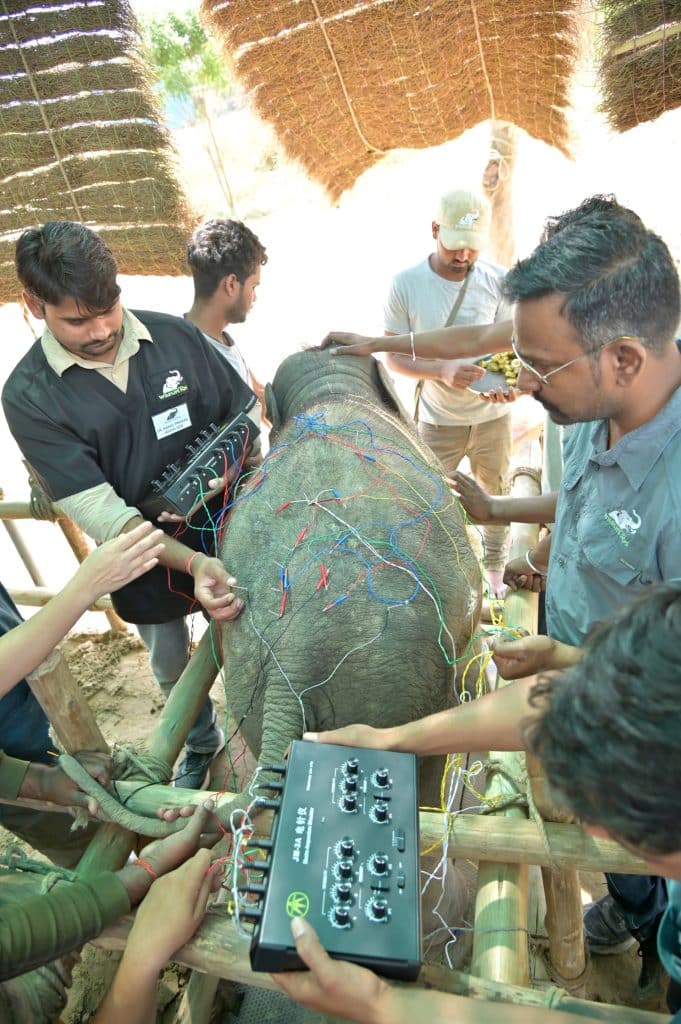
As her recovery stalled, we began exploring alternative therapies, which soon led us to acupuncture, a component of Traditional Chinese Veterinary Medicine (TCVM). Research in TCVM shows that acupuncture can stimulate nerve pathways, improve circulation, and reduce inflammation, leading to improvements in mobility and pain management. Acupuncture is one of the four branches of TCVM, alongside herbal medicine, food therapy and tui-na (therapeutic massage). Together, these approaches aim to support the body’s natural ability to heal.
Acupuncture works by inserting fine needles into specific points on the body to stimulate nerves, muscles and connective tissue. As Dr. Huisheng Xie, founder of Chi University – an international veterinary school specializing in TCVM – explained, acupuncture stimulates “discrete, specific locations on the body to produce a therapeutic effect,” known as acupoints.
When a gentle electrical current is added, the technique becomes electro-acupuncture (EA). Xie, a proponent of research-based outcomes, noted that recent studies suggest EA can “promote the release of natural opioids, including beta-endorphin, which can act in a morphine-like way to relieve severe pain.” He added that EA “may also mobilize the patient’s own stem cells, supporting tissue repair, including recovery from nerve injury, and can produce anti-inflammatory effects.”
Walking Again
No such specialist existed in India – at least not for elephants – so Dr. Poraakote Rungsri, an equine acupuncture expert from Thailand, volunteered to come to India to meet Bani. Her visit lasted only three days, but it was enough to set Bani on a new trajectory. Within a couple of months, Bani was standing on her own, walking short distances and rediscovering the playful spark that defines every healthy calf.
Bani’s progress encouraged our team to explore how these principles might help other elephants. When Chi University offered its first certification course in Mumbai, we enrolled several of our veterinarians.
Treating elephants, the largest terrestrial animals on Earth, presents unique challenges – needle size, anatomical landmarks and even how a practitioner positions themselves must all be adjusted – but the core principles translate remarkably well. These techniques have helped address a variety of conditions.
Arthritis and chronic foot problems are common in captive elephants, often leading to pain and reduced mobility. Raju, a 60-year-old bull, struggled with recurrent colic.
Injured baby elephant Bani is treated with electro acupuncture. Photo: Wildlife SOS
By stimulating acupuncture points associated with digestion, paired with nutritional adjustments, he improved steadily. Holly, another senior elephant, suffered from arthritis in her leg. Using a TCVM technique called circle the dragon – applied around areas of localized pain to promote healing – she regained mobility, allowing her to return to activities she loved, including walking to the pool to swim.

Caring for captive elephants requires veterinary approaches capable of addressing chronic, complex and lifelong ailments. Western medicine remains invaluable, but TCVM cannot be overlooked. Nearly two years after her accident, Bani has grown into a spirited young elephant who runs, plays and explores with confidence. Her gait remains slightly uneven, but it continues to improve, and we remain hopeful it will someday be barely noticeable.
For elephants like Bani, acupuncture is not just a therapy; it is a chance to reclaim the lives they were meant to live.
Featured image: Wildlife SOS.
—
About the author: Nikki Sharp is the executive director of Wildlife SOS USA, bringing nearly three decades of experience in animal welfare and nonprofit leadership. Her career began with national initiatives addressing companion animal overpopulation and puppy mill reform, and she now leads U.S. efforts to support Wildlife SOS’s rescue, rehabilitation and conservation programs in India. Sharp is dedicated to advancing sustainable solutions for wildlife protection, with a particular focus on elephants, bears and other threatened species.
This story is funded by readers like you
Our non-profit newsroom provides climate coverage free of charge and advertising. Your one-off or monthly donations play a crucial role in supporting our operations, expanding our reach, and maintaining our editorial independence.
About EO | Mission Statement | Impact & Reach | Write for us