

A North Dakota judge last week finalized a $345 million judgment in a lawsuit brought by Energy Transfer over Greenpeace’s role in protests against the Dakota Access Pipeline a decade ago. The group says the verdict could bankrupt it.
—
Greenpeace has vowed to fight a $345 million verdict over its role in protests against the Dakota Access Pipeline, a 1,172-mile (1,886-kilometer) underground pipeline transporting crude oil from North Dakota to Illinois.
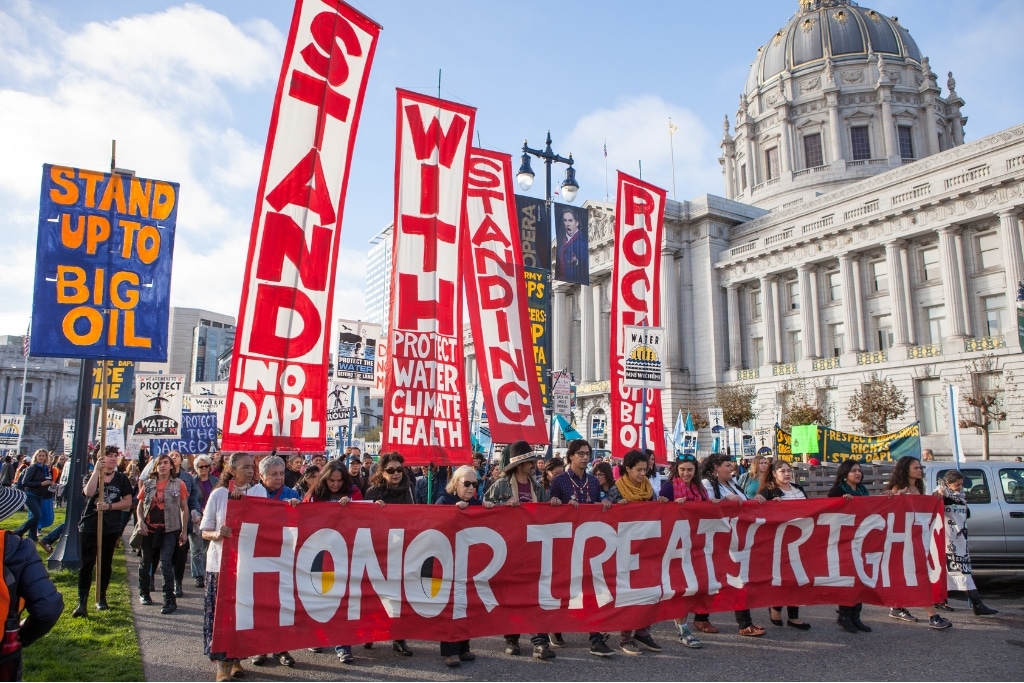
A North Dakota District Court judge on Friday validated a $345 million jury award against the environmental group that was reached last year. The case was brought by the pipeline company, Texas-based Energy Transfer, which accused Greenpeace of hindering construction of the pipeline by galvanizing protests at the site a decade ago. Greenpeace has always denied the accusations, saying that it only played a supporting role in the non-violent protests led by Native American groups.
In October, Judge James Gion, who oversaw the trial, nearly halved the amount initially awarded by the jury months earlier to roughly $345 million from $667 million. Last week, he finalized that judgment despite Greenpeace’s request to overturn or at least further reduce the verdict, saying that the jury “must have found the evidence presented by the plaintiffs to be more credible.”
Greenpeace has warned the sum could bankrupt it. The campaign group works as an independent network funded by individual contributions and funding grants. It does not accept money from governments, corporations or political parties, according to its website. In 2023, Greenpeace USA had just a little over $40 million in revenue and support, and about $38 million in expenses, its financial statement shows.
“It’s a dark day for freedom of expression and the environmental movement. But this battle is far from over,” David Simons, Senior Legal Counsel for Strategic Defence at Greenpeace International, said on Friday. Greenpeace has announced it will seek a new trial and appeal the decision at the North Dakota Supreme Court, if necessary.
In a statement, the group said that Energy Transfer had failed to present evidence in support of its claims and that the court admitted “inflammatory and irrelevant evidence” during trial while excluding evidence in support of the defense, adding that the jury “could not be impartial.”
More on the topic: Human Rights Lawyers Condemn ‘Deeply Flawed’, ‘Biased’ Greenpeace $660 Million Trial
Anti-SLAPP Lawsuit
Greenpeace has repeatedly called the accusations baseless and designed to silence the group. It previously called the lawsuit, first filed in federal court in 2017, “one of the world’s most brazen examples of SLAPP.”
SLAPPs, or Strategic Lawsuit Against Public Participation, have become a common tool to censor, intimidate, or silence critics by burdening them with costly lawsuits, often on grounds that the critiques are defamatory.
In February 2025, in response to “back-to-back, meritless” SLAPP lawsuits filed by Energy Transfer against the group, Amsterdam-based Greenpeace International – a defendant in the case alongside Greenpeace Inc. and Greenpeace Fund – filed a lawsuit in the Netherlands against the company. The case cites Dutch law as well as the European Union’s anti-SLAPP Directive. The EU law, which came into force in April 2024, aims to “protect persons who engage in public participation from manifestly unfounded claims or abusive court proceedings (‘Strategic lawsuits against public participation’).”
In an extraordinary and unusual move, Energy Transfer in November asked North Dakota’s Supreme Court to block the countersuit in the Netherlands. The case remains pending.
“Through appeals in the US, and Greenpeace International’s groundbreaking anti-SLAPP case in the Netherlands, we are exploring every option to hold Energy Transfer accountable for multiple abusive lawsuits, and show all power-hungry bullies that their attacks will only result in a stronger people-powered movement,” Mads Christensen, Greenpeace International Executive Director, said on Friday.
“At every turn, our voices [will] only grow louder as we stand with allies worldwide against the corporate polluters and billionaire oligarchs who prioritise profits over people and the planet.”
This story is funded by readers like you
Our non-profit newsroom provides climate coverage free of charge and advertising. Your one-off or monthly donations play a crucial role in supporting our operations, expanding our reach, and maintaining our editorial independence.
About EO | Mission Statement | Impact & Reach | Write for us
Earth.Org
Free, non-profit and independent environmental journalism.