

The heart-wrenching image of Punch, a rejected baby macaque clinging to a stuffed toy, has captured millions of hearts, but his sudden stardom exposes a troubling paradox in modern media. While viral stories can spark genuine compassion, they often inadvertently mask the systemic stresses of captivity and stoke a dangerous global demand for exotic pets.
—
By Devan Showe
Stories about cute baby animals tend to perform well on social media. Often, all it takes is a handful of compelling photos and a simple narrative hook for a story to spread rapidly across platforms.
At times, that virality can serve a positive purpose: it can raise awareness about animals in distress and potentially inspire advocacy or donor support for conservation efforts. Yet the same viral attention can also have unintended consequences. In many cases, highly shareable animal stories spark interest in the exotic pet trade or reinforce systems that keep wild animals in captivity.
One recent example is the story of Punch, a seven-month-old Japanese macaque born at the Ichikawa City Zoo in Japan. While Punch has become something of an internet celebrity, the attention surrounding his story illustrates how viral fame can produce mixed outcomes for animals.
The Life of Punch
Punch’s story begins with tragedy. Born in captivity, he was rejected almost immediately by his mother. In macaque social structures, maternal rejection can lead to broader social consequences, and Punch soon faced bullying and exclusion from other monkeys in his troop.
The precise reasons for this rejection are difficult to determine. Researchers at the zoo have suggested that Punch’s mother may have been affected by the circumstances of his birth, which reportedly involved a prolonged and difficult labor during a severe heatwave. Although such explanations remain partly speculative, zoologists note that stress during pregnancy and birth can disrupt maternal bonding in primates.
Concerned about Punch’s isolation and safety, zoo staff stepped in to hand-rear him.
For six months, keepers fed and cared for the infant macaque, raising him outside the troop while monitoring his health and development. Eventually, this January, the zoo attempted to reintroduce him to the enclosure.
The transition was not easy. Punch struggled to integrate with the other monkeys and instead showed strong attachment to the zookeepers who had raised him. He often stayed close to them rather than interacting with the troop, reinforcing the sense that he remained socially disconnected from his own species.
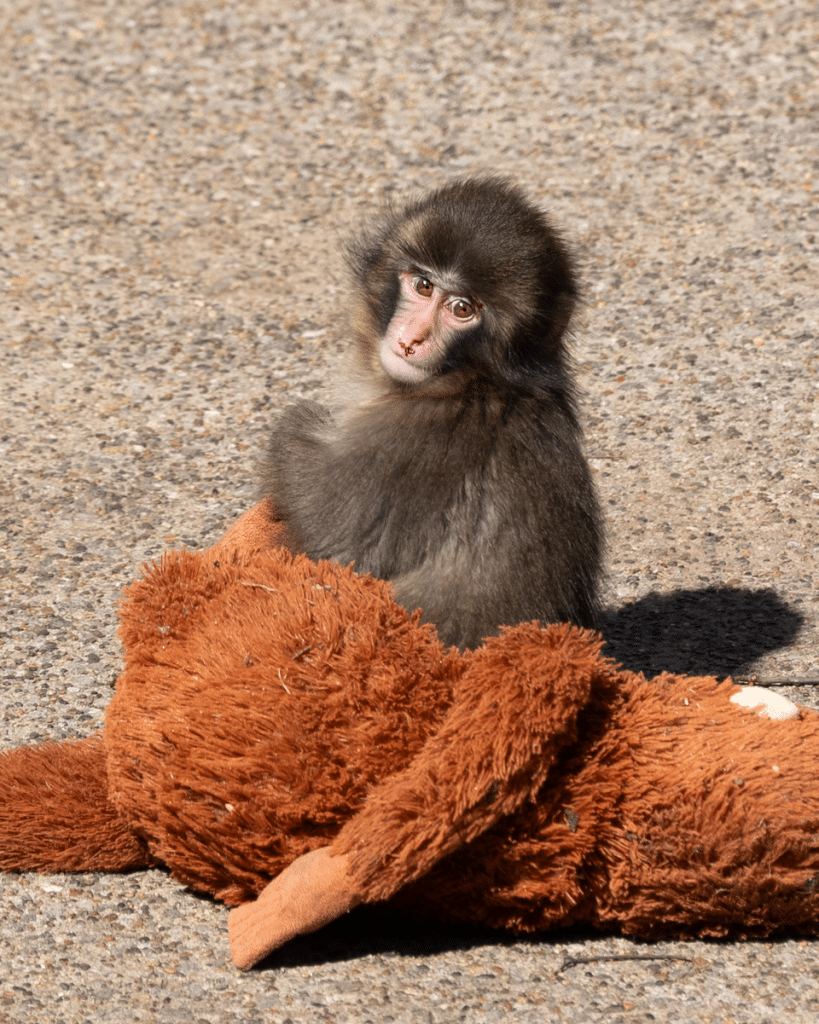
In an attempt to ease his loneliness, zookeepers introduced a stuffed orangutan toy for him. Punch quickly formed an attachment to the plush animal, carrying it around the enclosure and cuddling it in moments of stress. The image was striking: a small macaque clinging to a stuffed toy for comfort, much like the character Linus with his blanket in the classic comic strip Peanuts.
Photos and videos of Punch snuggling his stuffed companion soon began circulating online. Within days, the images spread widely across social media platforms and news outlets. For many viewers, Punch’s vulnerability and reliance on the toy symbolized both innocence and resilience, prompting an outpouring of sympathy from people around the world.
The Long Tail of Virality
While the public response to Punch’s story has largely been compassionate, viral attention can bring complications.
One immediate effect has been a surge in visitors to the Ichikawa City Zoo. Media reports indicate that attendance around the macaque enclosure has doubled since Punch became widely known online. The zoo has even issued public statements warning about capacity limitations as crowds gather to see the now-famous baby monkey.
On the surface, increased attendance may appear beneficial. However, higher visitor numbers can reinforce the economic incentives that sustain animal captivity. Revenue generated from increased traffic may ultimately support the continued breeding and display of animals in zoo environments.

For animals like Japanese macaques, these environments are often far removed from their natural habitats. Wild macaques live in complex social groups and inhabit forests with abundant natural features, including trees, streams and varied terrain. By contrast, zoo enclosures can be crowded and relatively barren, sometimes consisting largely of concrete structures with limited environmental enrichment.
Captivity can also influence social dynamics. While maternal abandonment does occur occasionally in the wild, it is significantly more common in captive populations. Stressors such as overcrowding, limited space and constant human presence can disrupt normal behavioral patterns among primates.
In this sense, Punch’s difficult beginning may be linked in part to the conditions of captivity itself. The same setting that contributed to his troubled start is now benefiting from the attention generated by his story, a dynamic that highlights the complicated relationship between viral storytelling and animal welfare.
There is also another concern associated with viral animal content: the exotic pet trade. When unusual animals gain popularity online, public interest in owning similar animals often increases. Even when viewers mean no harm, viral fame can unintentionally create demand for wild or exotic species as pets.
Punch’s story has already provided an example of this. The Tate brothers, British-American controversial manosphere influencers, reportedly offered $250,000 to take Punch from the zoo. Although the proposal was framed as an effort to “rescue” him, such offers can normalize the idea of privately owning exotic animals.
In reality, the private exotic pet trade is widely criticized by animal welfare organizations for its cruelty and exploitation. Primates raised outside natural social groups frequently suffer from stress and inadequate living conditions. Removing a macaque from a zoo to place them in private ownership would likely create additional welfare concerns rather than solve existing ones.
Given these realities, the most probable future for Punch is that he will remain at the zoo for the duration of his life. Japanese macaques can live up to 40 years in captivity, meaning Punch may spend decades in the same environment where his story began.
One Good Outcome: Awareness
Despite these challenges, Punch’s story could still produce a meaningful positive outcome: greater awareness of how viral animal content intersects with conservation and animal welfare.
Organizations such as Born Free USA operate primate sanctuaries designed to provide rescued animals with more natural living conditions. At the Born Free USA Primate Sanctuary in Texas, monkeys live in large, open-top habitats spanning several acres and filled with real trees, plants and natural structures. These environments allow rescued animals to socialize in ways that more closely resemble life in the wild.
Increased public interest in stories like Punch’s could translate into stronger support for such sanctuaries. Donations, advocacy and public education campaigns can help expand alternatives to traditional captivity and provide lifelong care for animals that cannot be returned to their natural habitats.
Ultimately, Punch’s viral fame illustrates both the power and the complexity of internet storytelling. Images of a lonely baby monkey clinging to a stuffed toy are undeniably moving, and the compassion they inspire is genuine. But the broader impact of that attention depends on how audiences choose to respond.
Photos of Punch by Daiei Onoguchi via Wikimedia Commons.
This story is funded by readers like you
Our non-profit newsroom provides climate coverage free of charge and advertising. Your one-off or monthly donations play a crucial role in supporting our operations, expanding our reach, and maintaining our editorial independence.
About EO | Mission Statement | Impact & Reach | Write for us
Earth.Org
Free, non-profit and independent environmental journalism.