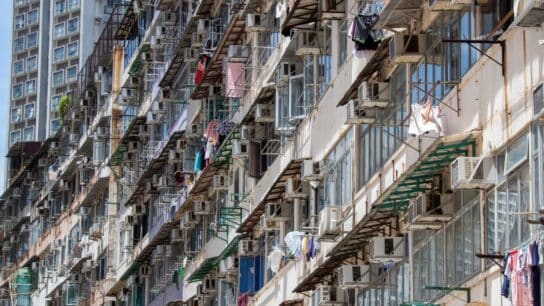



From 40C in Kyoto, Japan, to over 50C in Silopi, Turkey, this summer has cities worldwide trapped in blankets of soaring heat. With temperatures breaking records year after year, the global demand for air conditioners is also on the rise. But are they the solution we are looking for?
—
Extreme heat is the “deadliest of all climate-related hazards.” The World Meteorological Organization (WMO) estimates that around 489,000 heat-related deaths occurred globally each year between 2000 and 2019, of which 45% in Asia and 36% in Europe.
With extreme temperatures becoming more common around the world, cooling solutions have become essential in keeping people healthy and maintaining work productivity during tropical summer months, even in places that are new to extreme heat, such as the UK.
There are roughly 2 billion air conditioners worldwide, with the number set to almost triple to 5.6 billion by 2050. According to a 2018 report by the International Energy Agency (IEA) this growth is mainly driven by upcoming economies with warm climates like China and India, where more people are now able to afford an air conditioner.
But access to cool indoor spaces remains a luxury for communities most vulnerable to extreme heat as ownership of air conditioners is the lowest among them. According to the IEA, the lack of efficient indoor cooling is putting an estimated 2-4 billion people at risk of heat stress, mainly in the Global South.
Environmental Impact
At the same time, air conditioners are increasingly contributing to global warming. By 2050, cooling will account for 10% of global greenhouse gas emissions, according to a UN report.
The warming they generate is mainly linked to the use of hydrofluorocarbons (HFCs) in existing air conditioners. Emissions of these syntactic gases mainly occur when equipment is leaking, for example due to incorrect maintenance or disposal. HFCs are syntactic gases that have a much greater impact on global warming than carbon dioxide.
Furthermore, record-breaking temperatures are also increasing electricity demand as cooling units use a lot of energy. Globally, demand is expected to increase by up to 40% by 2030, according to the IEA. Fully meeting demands during the simmering summer months with renewable energy remains challenging, with fossil fuels still largely filling the gap. Globally, demand for coal increased 1% in 2024, with intense heatwaves in China and India – which pushed up cooling needs – contributing more than 90% of the total annual increase.

While cooling systems’ efficiency and performance are improving, indirect carbon emissions from air conditioning and other cooling systems are rising quickly. These emissions have almost tripled since 1990, reaching over 1 billion tons of CO2 in 2022, a 2% increase from the previous year.
Our current way of cooling indoor environments is causing temperatures to rise even further. In cities, this effect is even more pronounced. Lack of green spaces, building density and an abundance of concrete, in combination with heat waste from transport, industrial processes and air conditioning, is causing cities globally to heat up twice as fast as the global average rate. This phenomenon is known as the urban heat island effect.
Sustainable Alternatives
More sustainable cooling alternatives are already available, but to lower the need for air conditioning, a more holistic approach to cooling is needed.
In cities with warm climates such as Dubai, district cooling is a proven sustainable alternative to keep temperatures down, requiring only half the amount of energy compared to air conditioners. Chilled water is pushed through insulated pipes from a central cooling plant to buildings. The water is then distributed to air-handling units, which cool the building down. After the water absorbs the heat, it flows back to the central cooling plant to be cooled and used again.
In Europe, an increasing number of cities are looking at district cooling to keep temperatures down while keeping emissions low. Paris has one of Europe’s largest district cooling systems. Over 800 sites, including the Louvre, are kept cool with chilled water from the Seine. The city is planning to further expand the system, connecting hospitals, elderly homes, and daycares across the city.
White Rooftops and Green Cities
Nature-based solutions like creating green spaces like parks and urban forests, restoring wetlands, and implementing green infrastructure such as green roofs and walls can help bring temperatures down in overheated urban areas, and mitigate the overall cooling needs of their residents.
Passive cooling solutions such as shading, insulation, and increased natural ventilation can all help reduce indoor temperatures without air conditioning. Passive cooling could help reduce emissions by 1.3 billion tons by 2050, according to some estimates.
Cool roofs are one of the simplest and most cost-effective passive cooling solutions. Community-led initiatives in four Indian cities showed that, compared to traditional roofs, cool roofs lower indoor temperatures by 2 to 5C.

In South Korea’s capital Seoul, many streams running through the city offer cool escapes during the summer. An example is the city’s Cheonggyecheon stream, where temperatures are 3-6C cooler compared to other roads in the same area. This is the result of increasing the stream’s water flow, adding trees and plants, and removing a nearby expressway. The stream’s green transformation also boosted business growth and tourism.
In Medellín, Colombia, 30 green corridors offer cool passage for millions of people on a daily basis. The city’s green corridors program started in 2016, and reduced the city’s urban island effect by 2C in about three years. By 2044, the city expects a reduction of 4-5C.
More on the topic: Silent Killer: How Cities Are Bracing For More Heat
Even with the implementation of passive cooling techniques and greener urban areas, air conditioners will remain an important cooling solution in the foreseeable future. Lowering the footprint of cooling equipment is therefore imperative.
Climate-friendly and more energy efficient refrigerants can replace harmful synthetic gases, and with the Kigali Amendment coming into force in 2019, the use of harmful HFCs in cooling equipment is gradually being phased out. Signatories of the amendment have committed to cut the use of HFCs by more than 80% over 30 years. It is estimated this could prevent a 0.5C increase in global temperatures over this century.
What Can I Do?
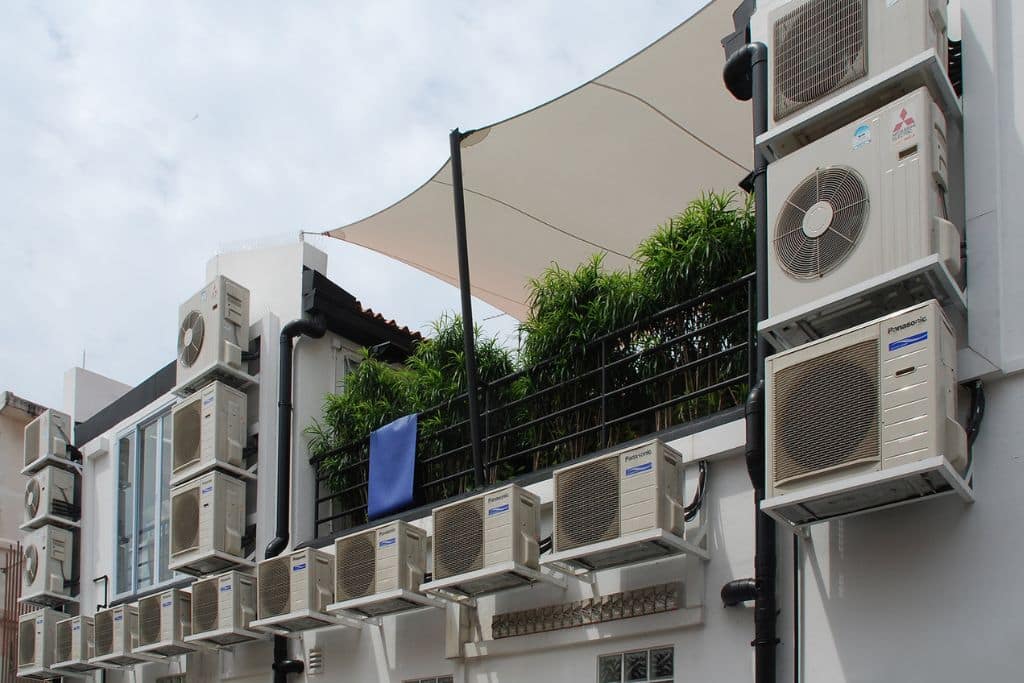
Conscious consumer habits can also make a difference in tempering energy consumption when temperatures are rising. Setting the air conditioner on to 26C instead 24C, for example, consumes some 30% less energy.
A smart thermostat can also be used to automatically adjust temperatures when you are not home, preventing wasted cooling. Regularly cleaning or replacing the air filter to ensure the unit runs efficiently and does not have to work harder than necessary, as well as opting for models with a high Seasonal Energy Efficiency Ratio (SEER) rating – designed to use less energy – are other ways to lower our footprint.
In this respect, governments should do more to help consumers buy the most energy efficient cooling equipment. According to IEA, worldwide consumers tend to purchase air conditioners with only half the efficiency compared to the best performing unit available in stores. In the European Union and the US, the implementation of energy performance standards and energy efficiency labels have helped reduce the energy consumption of air conditioners by 50%.
This story is funded by readers like you
Our non-profit newsroom provides climate coverage free of charge and advertising. Your one-off or monthly donations play a crucial role in supporting our operations, expanding our reach, and maintaining our editorial independence.
About EO | Mission Statement | Impact & Reach | Write for us