



South Korea is one of the biggest exporters of used clothing in the world. The rise of fast fashion has come with new challenges and significant environmental consequences, but initiatives to create a more sustainable and regulated fashion industry are starting to grow.
—
By Janet Doorduin
In the buzzing streets of South Korea’s capital, Seoul, fashion billboards and big shopping malls draw the attention of passersby on every street corner. Between March 2024 and February 2025, Koreans spent almost US$58 billion on fashion products.
“From having a big car to owning many clothes, appearance is very important in Korea,” Juyeon Jung, founder and CEO of Wear Again Lab, told Earth.Org. Jung started her non-profit in 2020 to raise awareness about the environmental impact of fast fashion and to advocate for a more sustainable fashion industry.
“Everything has to look pretty; this is why K-beauty and K-fashion are so popular. Not long ago, people could not afford to buy clothes; now everyone can. However, many people buy fast fashion, which is low quality and thrown away very easily,” Jung explained. According to the Korean Environment Institute, around 800,000 tonnes of clothing and textiles are thrown away every year across the country.
Lack of Regulation
While clothing waste is piling up, South Korea lacks a regulated textile recycling infrastructure. As a result, only around 12% of its textile waste is recycled locally. Most used clothing is exported to India, Malaysia, and Pakistan, from which it is often exported again to other low-income countries.
“The system we currently have is a problem. There are many boxes where you can dispose of used clothing, but most of them are owned by the private sector, and not regulated by the government,” explained Jung. A survey by the Korean Environment Institute showed that 80% of clothing waste management in South Korea is handled by the private sector. This, researchers pointed out, makes for a lack of data on the exact volume and methods of textile waste processing.
“Everyone can buy a box,” said Jung. “Most owners earn a lot of money by exporting textiles and lobby against more regulation.”

Environmental Impact
Globally, the waste crisis is growing, and fast fashion is accelerating the problem. According to the United Nations, every second, a truckload of clothes is dumped or burned, causing environmental pollution and negatively impacting the health of communities in mostly low-income countries. At the same time, the production of new clothes has a significant footprint. The fashion industry is accountable for up to 8% of global greenhouse gas emissions, making it one of the world’s most polluting industries.
In March, the UN Environment Programme stressed the need for a circular economy approach in the fashion industry, focusing on sustainable production, reuse and repair. According to experts, greenhouse gas emissions could be reduced by 44% by doubling the lifespan of clothing.
Moving Towards Circularity
The South Korean government is taking steps to make its fashion and textile industry more circular. For example, the government announced a US$24.7 million investment to support the textile sector in advancing technology for recycling polyester composite fibres. These form the largest portion of discarded textiles and clothes, according to the Korean Ministry of Trade, Industry and Energy.
“We have to deal with our own waste”, said Jung. She recently proposed a plan to create a full circular system for used clothing to the local government in Seoul. On a national level, Wear Again Lab has been advocating for legislation that bans the disposal of unsold stock by retailers and fashion brands since 2023. Globally, around 30% of clothing produced is never sold.
Clothing Swaps
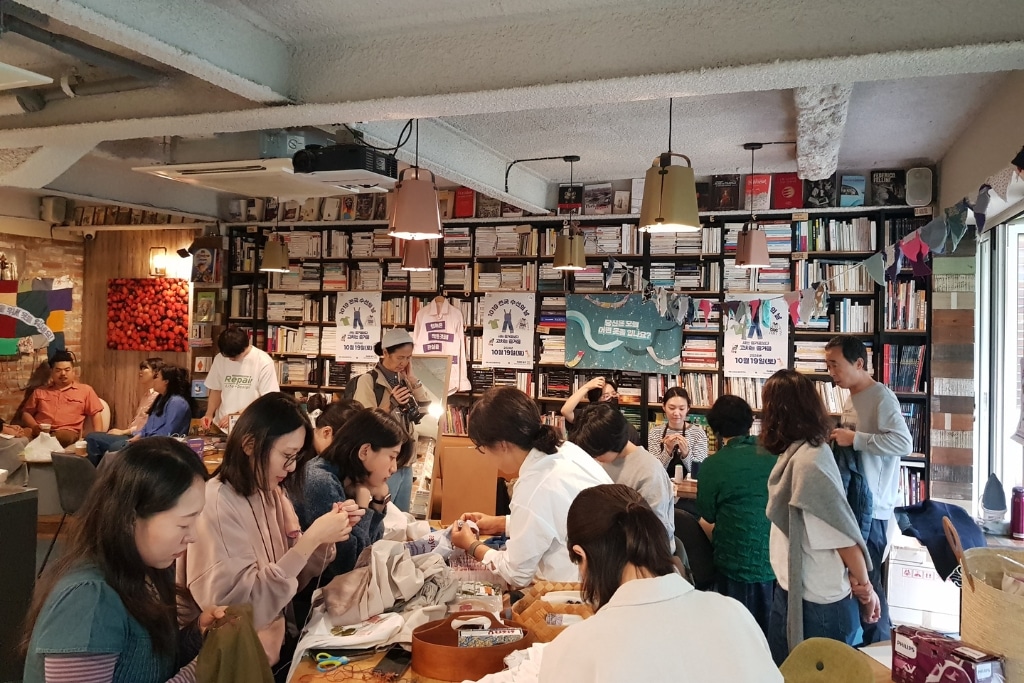
In addition to advocating for more regulation and legislation, Jung and her team organize clothing swaps and mending classes to raise awareness about the negative impact of the fashion industry.
“I started my work for the environment and it is the message we start with. I just try to incorporate elements of enjoyment and fun into our campaigns to break the heavy social atmosphere surrounding environmental discussions. After all, it must be enjoyable to sustain long-term practice,” Jung said.

With over 50 clothing swaps and mending events organized every year across South Korea, the strategy seems to be working. “At first, people who are interested in the environment joined our events, now we also see more and more people who love fashion are joining. So we reach a bigger group of people,” she explained.
Growing the Second-Hand Market
Shopping for second-hand clothing is gaining momentum in South Korea. In trendy areas of Seoul, “retro” shops filled with second-hand clothing, often of expensive brands, are popping up on every corner. Online sales are driving the country’s resale market to new highs. It is expected that the market will reach US$30 billion this year, doubling its market share compared to 2021. Market research indicates that rising prices and a growing preference for sustainable consumption are the main drivers behind this trend.
Jung sees the growing popularity of pre-loved clothing as a positive development, but remains cautious: “Many people buy expensive items and then resell them with a profit. It is a way of earning money.”
She warns that in the end, second-hand is not the solution for a more sustainable fashion industry. “We as consumers have to buy less and keep our clothing longer. And we need a more regulated, circular system in which there is responsibility until the end.”
You might also like: Is Second-Hand Clothing the Solution to Fast Fashion?
This story is funded by readers like you
Our non-profit newsroom provides climate coverage free of charge and advertising. Your one-off or monthly donations play a crucial role in supporting our operations, expanding our reach, and maintaining our editorial independence.
About EO | Mission Statement | Impact & Reach | Write for us