


Rare hybridization between bottlenose and humpback dolphins in the Mayotte lagoon reveals both nature’s adaptability and the urgent need for conservation.
—
In Mayotte, a French territory in the Indian Ocean, researchers and local observers have documented something extraordinary: a dolphin that carries traits from two different species – the Indo-Pacific bottlenose (Tursiops aduncus) and the Indian Ocean humpback dolphin (Sousa plumbea).
Hybridization in cetaceans is exceptionally rare. Its occurrence here raises pressing questions about resilience, survival, and the future of small, isolated dolphin populations. What may look like a curiosity is, in fact, a warning – a glimpse of what happens when ecosystems contract and species are forced into unfamiliar choices.
Mayotte’s Unique Lagoon
Mayotte’s lagoon is one of the largest and deepest in the world, encircled by a double barrier reef system. It provides an extraordinary refuge for marine life, hosting more than 760 species of fish and at least 22 species of marine mammals. For centuries, it has been a natural sanctuary – a place where spinner dolphins (Stenella longirostris) gather daily, and where whales arrive each year to give birth.

Yet beneath the surface lies a story of decline. While spinner dolphins remain relatively abundant, populations of Indo-Pacific bottlenose and Indian Ocean humpback dolphins have collapsed. Local conservationists now estimate that fewer than five humpback dolphins survive in the lagoon, a staggering decline compared to observations just a decade ago.
In such a context, the appearance of a hybrid is not simply a biological quirk. It is a signal emerging from scarcity, fragmentation, and ecological stress.
Hybridization: An Unusual Phenomenon
Most dolphins mate within their own species, guided by genetics, behavior, and social structures. But when habitats overlap and populations dwindle, boundaries blur. Hybridization has been observed in other cetaceans, though rarely in the wild.
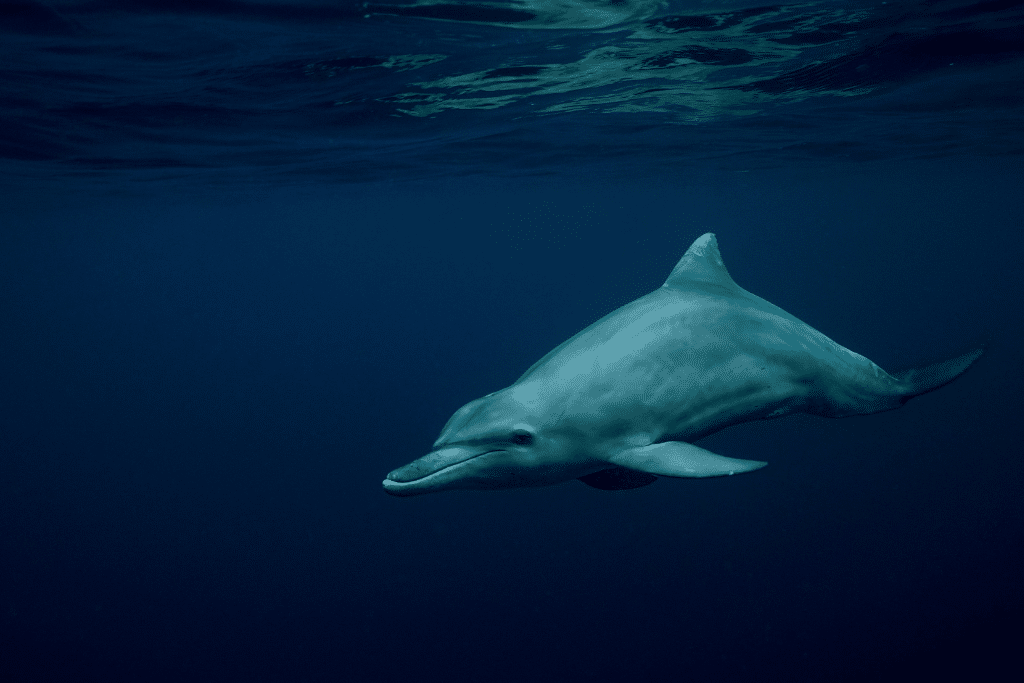
In Mayotte, the hybrid dolphin displays a blend of physical traits: a longer rostrum than a typical Sousa, a dorsal fin shape intermediate between bottlenose and humpback, and a mottled colour pattern. Each encounter confirms that this is not a case of misidentification, but a living example of interspecies convergence.
Such cases are scientifically fascinating as they can even expand our understanding of dolphin evolution and adaptability.
But they may also signal ecological stress. Hybridization often reflects populations pushed to the edge, where individuals are forced to cross species boundaries to find mates.
Global Context: Hybrids Beyond Mayotte
Mayotte’s dolphin is part of a very small club. In Hawaii, a cross between a bottlenose dolphin and a false killer whale – the so-called “wholphin” – was documented in captivity, and shown to be fertile. In the Atlantic, researchers have observed hybridisation between bottlenose dolphins and pilot whales (Globicephala). In the Canary Islands, hybrids between different dolphin species have been confirmed through genetic testing.
A 2023 study off Western Australia revealed that 10.5% of sightings involved mixed groups of bottlenose and humpback dolphins. These encounters were not only frequent, but socially complex: mixed groups were larger and more interactive than single-species pods, suggesting that such associations may offer benefits, from cooperative foraging to predator avoidance.
These examples show that hybridization is not unique, but it is consistently rare, and almost always linked to small or stressed populations. In Mayotte’s case, it is a poignant indicator of fragility.

Social Behaviour and Survival
The success of a hybrid depends on more than genetics. For dolphins, social acceptance, communication, and learned behaviours are crucial to survival. Some cetacean hybrids, like the wholphin, have been fertile, but most wild-born hybrids remain mysteries. Do they integrate into pods? Do they find mates of their own? We do not yet know.
In Mayotte, another anomaly has deepened the intrigue: a humpback dolphin fostering a group of juvenile spinner dolphins. Such interspecies adoption is almost unheard of in the wild. Yet here, it seems to reflect both dolphins’ social intelligence and a population in crisis. When numbers are this low, bonds stretch beyond traditional species lines – survival demands creativity.
A Population on the Brink
The Indian Ocean humpback dolphin is listed as Endangered by the International Union for Conservation of Nature (IUCN). Across its range, from South Africa to India, it faces relentless threats: entanglement in fishing gear, collisions with boats, habitat destruction, and chronic noise pollution.

In Mayotte, the picture is even bleaker. With just a few individuals believed to remain, this is a population on the verge of functional extinction. Once lost, the genetic and behavioral heritage of Sousa in Mayotte will vanish forever.
Alarmingly, there is no ongoing monitoring program for dolphins in the lagoon. The last comprehensive study was led more than a decade ago by marine mammal expert Dr. Jérémy Kiszka. More recent publications by Kiszka and Dr. Lars Bejder have urged conservationists to focus on small, vulnerable cetacean populations – exactly the situation unfolding here.
Conservation in Practice: Lessons from Elsewhere
The tragedy is not inevitable. Around the world, small cetacean populations have been protected through decisive action.
- In New Zealand, Hector’s dolphins (Cephalorhynchus hectori), once in steep decline, benefited from gillnet bans and designated protected zones. Populations are now stabilising.
- In Hong Kong, Indo-Pacific humpback dolphins (Sousa chinensis) are monitored through systematic photo-identification surveys. These studies have informed coastal planning, ensuring that development does not completely erase dolphin habitat.
- In South Africa, local NGOs run citizen science programs where boat operators and divers record dolphin sightings, creating community-driven monitoring efforts.
These models show that conservation works when governments and communities commit resources. For Mayotte, even a modest monitoring program could transform understanding and galvanize protection.

What Needs to Happen in Mayotte
- Baseline monitoring: Establish regular surveys to determine the true population size and distribution of dolphins.
- Protective zones: Restrict boat traffic in critical habitats, especially nearshore areas where humpback dolphins are most vulnerable.
- Noise and bycatch reduction: Implement guidelines for boat operators, and reduce risks of entanglement.
- Integration into regional networks: Africa’s recently formed HuDoNet (Humpback Dolphin Conservation Network) is already coordinating action for Sousa. Mayotte must be included.
- Awareness and education: Stories like the hybrid dolphin can mobilize both local communities and international audiences.
The hybrid dolphin and the foster-parent Sousa in Mayotte’s lagoon are not just anomalies – they are warnings. They show us dolphins’ adaptability, but also the fragility of life when human impacts shrink the margins of survival.
Conservation here is not abstract. It is about choices made today: to monitor, to protect, to value biodiversity in one of the world’s richest lagoons. Without action, these rare stories of interspecies bonds will not be remembered as examples of resilience, but as the last whispers of a disappearing population.
Featured image: Serge Melesan.
This story is funded by readers like you
Our non-profit newsroom provides climate coverage free of charge and advertising. Your one-off or monthly donations play a crucial role in supporting our operations, expanding our reach, and maintaining our editorial independence.
About EO | Mission Statement | Impact & Reach | Write for us