

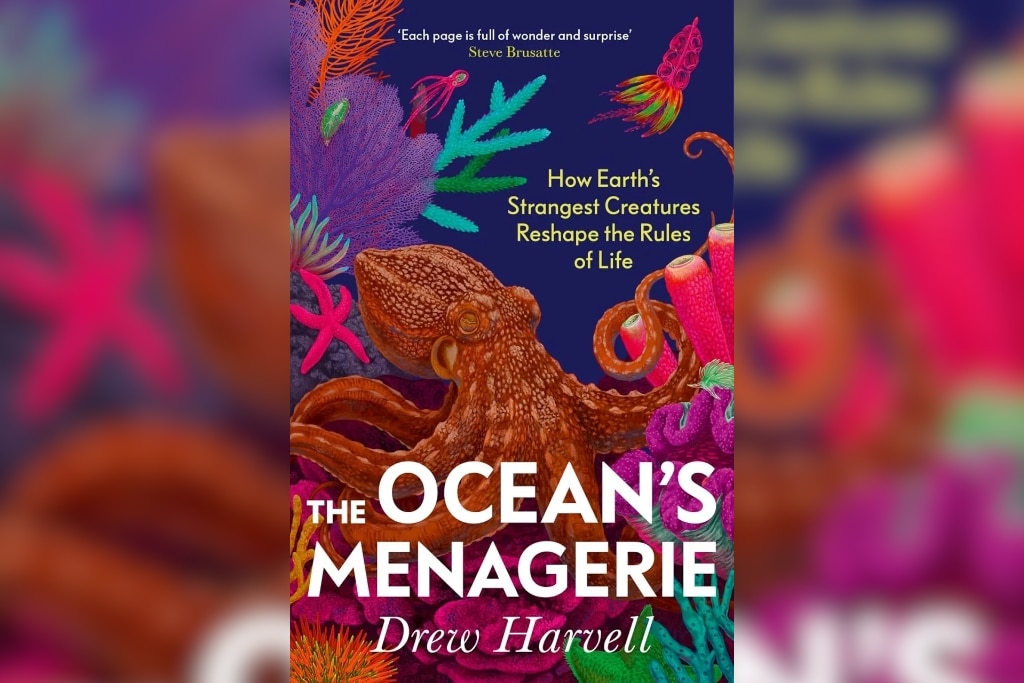
Oceans have hosted life in its primal forms, but a vast majority of the secrets locked within marine biodiversity remain unknown. Among these depths, Drew Harvell finds enchantment in the seemingly simple yet formidable world of invertebrates. Few other books describe sponges, octopuses, corals or clams so charmingly, or easily transform biology into magic tricks, as The Ocean’s Menagerie effortlessly does, gracefully reminding us of all the right reasons for preserving Earth’s oceans.
—
“Grant nature eternity on this planet, and we as a species will gain eternity ourselves,” says biologist E.O.Wilson in a quote standing out at the beginning of the book. It encompasses one of its core messages: there is no saving our own species without saving nature first. Researcher and writer Drew Harvell believes the best path forward is to stop underestimating nature as our most precious teacher, continuously challenging us to the edge of possibility to engender further discovery and innovation.
Harvell has spent most of her life as an ecologist and evolutionary biologist, traveling the world in search of the spineless creatures that have ruled the oceans for far longer than humans existed. Reading her words, you not only grasp her talent and scientific brilliance; you feel the depth of the passion for her work, shown through the most utter admiration for the world of invertebrates, one she communicates openly and vividly, clearly driven by wonder and curiosity.
Each of the book’s eight chapters explores the biology of organisms such as sponges, corals, sea slugs, octopus and sea stars, whose ancestors trace back almost to the dawn of life. Harvell leads readers in her underwater adventures, from a submarine lab in the Caribbean to Fiji’s Great Sea Reef, guiding them through overlooked marvels and biological adaptations that, through her storytelling, become actual superpowers. We descend alongside her in the deep, staring at the menagerie of orange, blue, pink and brown of the corals hosting a quarter of all marine animal species. We share her emotions at meeting the quiet and composed Callistoctopus ornatus in Hawaii, a creature with whom she formed an unexpected bond.
The book translates the science behind Harvell’s research into a heartfelt exploration of the motivations behind these organisms’ extraordinary behaviors and traits, supported by detailed and elegant sketches throughout. Nature, in its apparent complexity, is here praised for its simpler elements. Harvell reveals how bacteria like Streptomyces act as natural chemists inside sponges, forming mutualistic partnerships, and providing them with defensive chemicals useful for their survival, in exchange for food and shelter. She highlights how the brown algae supporting corals – the zooxanthellae – act as formidable solar reactors, and describes the iridocytes cells in clams that bend and reflect light, as well as the cnidophage cells in nudibranchs, which allow them to steal the stinging powers of their anemone prey.
Harvell’s tone is both joyful and mournful. She marvels at nature’s creativity, but is pained at what we are losing to pollution, warming seas and human pressure. Her own bout of dysentery in Borran Lompo, Indonesia – contracted from sewage-polluted water while she was teaching a workshop on coral health – served as a visceral reminder of how closely the health of our ecosystems is intertwined with our own.
Nature-based solutions, Harvell argues, are among the sea’s greatest riches. Sponges’ chemical compounds may help us fight cancer. Coral’s ability to build hardened architectures can inspire new techniques for bone implants. Nudibranch’s molecular “thefts” could shed some insights into organ transplantation, while the resistance of sea stars may help develop new smart materials.
Harvell’s approach puts nature first, while never forgetting how it can help us progress without harming a vital ally. From bioluminescent pigments to the engineering of water channels, invertebrates offer insight that could shape sustainable innovation. The unique partnerships they form underwater mirror the kinds of collaboration needed among communities and stakeholders, to protect our oceans and, consequently, our planet.
By showing how nature adapts and evolves to overcome disadvantages or dangers, Harvell invites us to learn from lifeforms that beat us at mastering their own survival. Sponges overcome their immobility through the partnerships with their host bacteria; corals depend entirely on their algae partners to build reefs, and grow; ctenophores, gelatinous and transparent marine invertebrates, have more chance at survival by generating bioluminescent light through oxygen, pigments and enzymes to repel predators or attract mates.
Each of these evolutionary advantages have allowed invertebrates to thrive, and even defy biological constraints. After reading Harvell’s book, one question lingers: why can’t humans learn from these neglected creatures to help themselves to grow and prosper as they have artfully done for millions of years? Harvell suggests that it is within our grasp, if we pause to observe, learn and collaborate toward a shared purpose. Without forgetting to marvel at nature’s genius.
The Ocean’s Menagerie: How Earth’s Strangest Creatures Reshape the Rules of Life
Drew Harvell
2025, Vintage, 270pp
—
Check out more Earth.Org book reviews here.
This story is funded by readers like you
Our non-profit newsroom provides climate coverage free of charge and advertising. Your one-off or monthly donations play a crucial role in supporting our operations, expanding our reach, and maintaining our editorial independence.
About EO | Mission Statement | Impact & Reach | Write for us