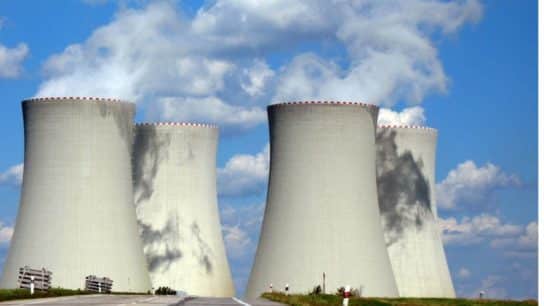



Among the chaos of national pavilions, crowded meeting rooms, and protests, a group of young people stood out for handing a banana to each passerby, seeking acceptance of nuclear power as part of the climate solution.
—
Rafaela Mondadori, an engineer representing Nuclear for Climate, downplayed concerns about the perceived dangers of nuclear power. “We have to lose the misconceptions we have,” she said.
“Eating one banana gives you the same exposure as living next to a nuclear power plant for an entire year. Taking a commercial flight for six hours exposes you to more radioactivity than living next to a nuclear power plant for a year, or even working inside of a nuclear power plant,” Mondadori told Earth.Org.
While it is true to say that a banana contains naturally occurring radioactive isotopes, the dose is not cumulative, as the potassium in foods is excreted naturally. Critics of the so-called “banana equivalent dose” argue that the concept is flawed, as consuming a banana does not increase one’s exposure to radioactive potassium.
Proponents of nuclear energy have long used the banana example to illustrate that radiation is a natural part of our environment, and that the threats it poses depend on the dose, not just the source.
The Nuclear Debate
Nuclear power as a low-carbon emission alternative to fossil fuels has been a bone of contention for decades. Following the Fukushima nuclear plant meltdown in 2011 after the Great East Japan Earthquake, Germany under Angela Merkel was quick to eliminate all nuclear power from its energy mix. Other countries followed.
Greenpeace has been a long-standing foe of nuclear power. “Nuclear energy has no place in a safe, clean, sustainable future. Nuclear energy is both expensive and dangerous, and just because nuclear pollution is invisible doesn’t mean it’s clean,” the activist group’s website states.
However, given increasing energy demands, proponents see nuclear as an inevitable component of any realistic strategy to limit global warming to 1.5C.

At COP30, the International Atomic Energy Agency is hosting the Atoms4Climate Pavilion, a hub for nuclear information, events and networking at COP30. There, topics such as “nuclear techniques that strengthen food security, sustainable water resources and ocean health” are being presented.
From the point of view of climate change, nuclear energy is zero-carbon energy, said Mondadori, adding that it brings “stability to the grid.”
“We are here at COP to demystify misconceptions about nuclear energy, and explain why nuclear energy is needed to have sustainable development,” she told Earth.Org.
More on COP30 from Earth.Org (click to view)
News
- Did COP30 Succeed or Fail?
- COP30 Week 2: Recap
- COP30 Week 1: Recap
- Reactions Pour in After Weak COP30 Agreement
- No Mention of Planet-Warming Fossil Fuels in COP30 Agreement
- Misinformation Becomes a Political Weapon Over Fire at COP30
- Business Coalition at COP30 Urges Transition Away From Fossil Fuels
- 83 Countries Join Call to End Fossil Fuels at COP30
- ‘People’s COP’ Marked By Civil Society Protests and Direct Action Events
- American States, Institutions Scramble to Fill Gap Left by US Absence at COP30
- Disability Activists Seek Official Recognition at COP30
- Brazilian Government Announces Ordinances to Recognize 10 Indigenous Lands
- Six Countries Pledge $58.5 Million to Adaptation Fund As UN Warns of $310 Billion Deficit
- Pope Leo Upholds Environmental Legacy of ‘Green’ Pope Francis, Urging Concrete Action on Climate at COP30
- Brazil to Demarcate Indigenous Territories Following Munduruku Protest at COP30
- COP30 Launches Global Declaration to Combat Climate Misinformation, Fake News
- Brazilian Government Seeks to Advance Discussion on Ending Fossil Fuels at COP30
- COP30: Fossil Fuel Lobbyists Outnumber Every Country Delegation Except Brazil
- COP30: Brazilian Government Puts Owners of the World’s Largest Beef Producer on ‘VIP List’
- Despite Record Turnout, Only 14% of Indigenous Brazilians Are Expected to Access Decision-Making Spaces at COP30
- Countries’ Climate Pledges Put World on Track for 12% Reduction in Emissions, UN Says
- Current National Climate Pledges Fall Far Short of What Is Needed to Limit Warming to 1.5C, Report Shows
Explainers
- COP30 Glossary: What You Need to Know About This Year’s UN Climate Summit in Brazil
- COP30 Volunteers Make World’s Biggest Climate Event Possible
- Navigating COP: A Deep Dive into the UN Climate Conference Process
- Oceans at COP30: Moving Beyond Pledges to Build an Architecture for Change
- Climate Adaptation at COP30: What to Expect
- Climate Finance at COP30: What to Expect
- Explainer: Why Gender Will Be High on the Agenda at COP30
- COP30 Volunteers Make World’s Biggest Climate Event Possible
- COP30 Youth ‘Go Bananas’ for Nuclear
Opinion
- Why COP30’s Success Depends on Comprehensive Food System Action
- Why COP30 Needs Indigenous Voices
- At COP30, Wealthy Nations Must Close the Adaptation Gap – My Home of Bangladesh Depends on It
Pre-COP30
- US Will Not Send High-Level Representatives to COP30, White House Says
- EU Agrees on Weakened Emissions Reduction Target Ahead of COP30
- 40 Elite Athletes Call for Urgent Adaptation Finance at COP30 Amid Climate Threat
- UN Climate Chief Urges Countries to Step Up Climate Action, Finance Ahead of COP30
- COP30 Host Brazil Calls For Bold National Emissions Reduction Plans Ahead of September Deadline
- COP30 Presidency Calls For Initiatives to Promote Information Integrity Amid Rampant Climate Disinformation
- Local Leaders to Tackle Climate Issues in Brazil Prior to COP30
- UN Climate Chief Says Energy Transition ‘Unstoppable’ Despite US Exit From Paris Accord, Urges Countries to Deliver on Climate Finance at COP30
Nuclear power’s safety record has improved dramatically in the past decades.
“The industry we had in the 1970s and 80s is not at all the same industry we have nowadays,” said Mondadori. “It’s like cars: before, we didn’t use seat belts, we liked drinking and driving. These are things we don’t do anymore nowadays. The nuclear industry is the same thing. It has evolved. We have new procedures. We have new security to make sure it’s safe mostly for the environment and also for people.”
The organization she represents, Nuclear for Climate, brings together nuclear professionals and scientists from over 150 societies and associations, with the goal of opening a dialogue with policymakers and the public about the necessity of including nuclear energy among the carbon-free solutions to climate change.
Featured image: Maximilien Struys/Nuclear for Climate.
More on the topic: What Role Does Nuclear Energy Play in the Race to Net Zero?
This story is funded by readers like you
Our non-profit newsroom provides climate coverage free of charge and advertising. Your one-off or monthly donations play a crucial role in supporting our operations, expanding our reach, and maintaining our editorial independence.
About EO | Mission Statement | Impact & Reach | Write for us