In early June, it was widely reported that the Chinese government had banned pangolin scales in traditional Chinese medicine (TCM), and that all pangolin species now had the highest level of protection within China. This news grabbed headlines around the world, and conservationists hailed the move as a positive step toward halting the illegal pangolin trade. But some experts say this celebration was premature.
—
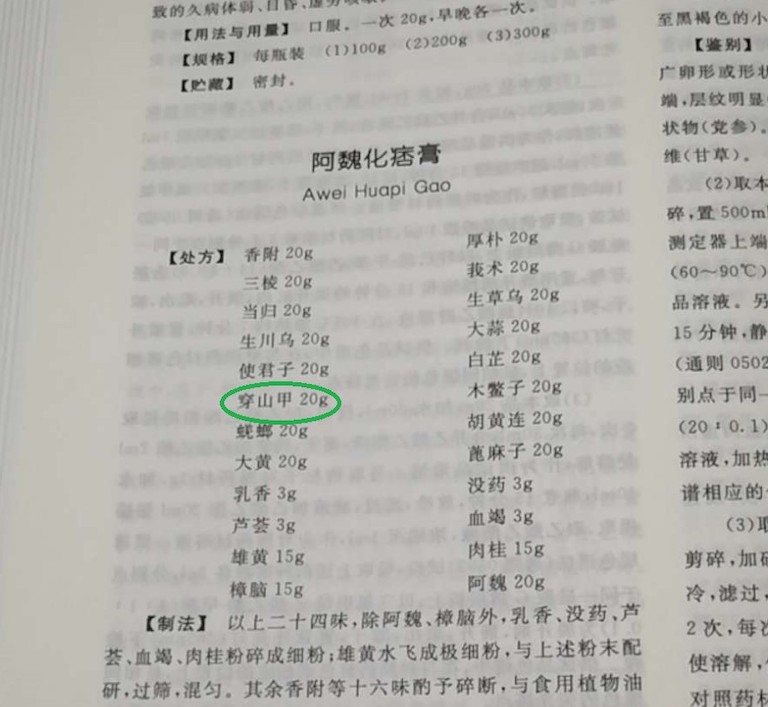
The team at the Environmental Investigation Agency (EIA) recently obtained a copy of China’s 2020 pharmacopoeia, a reference book for TCM practitioners, and found that while pangolin scales had been removed from the list of raw ingredients, pangolin scales were still listed as a key ingredient in various patent medicines.
“We were not surprised to learn that pangolin scales remained in the 2020 pharmacopoeia,” Chris Hamley, senior pangolin campaigner at EIA, told Mongabay. “In fact we had warned soon after the reports started to appear in the international media on 9 June that China’s widely publicized pangolin protections might not mean a total ban on their use in traditional Chinese medicine. This has happened before with leopard bone and bear bile — both were removed as a key ingredient but maintained as ingredients in patent medicine formulations.”
EIA identified eight medicines in the 2020 pharmacopoeia that contain pangolin scales, including Zaizao Wan, a pill said to aid blood circulation, and Awei Huapi Gao, a medicine used to treat abdominal pain. While patent medicines are processed, ready-made products, Hamley said that licensed hospitals and pharmaceutical companies can legally obtain pangolin scales to produce and sell these medicines.
There are also 72 additional TCM products containing pangolin scales that aren’t listed in the 2020 pharmacopoeia, but that can still be legally sold within China, Hamley said.
You might also like: When Planting Trees Threatens Forests
Hamley says the trade may be continuing based on an exemption in Article 27 of China’s Wildlife Protection Law, which specifies that protected wildlife can be sold, purchased and utilized for scientific research, captive breeding, public exhibition or performances, heritage conservation, and other special purposes.
“There are unlikely to be any major changes in demand for pangolin scales,” Hamley said. “The drivers of demand associated with the use of pangolin scales in TCM in China still remain. With licenced companies and hospitals still able to legally produce TCM medicines containing pangolin scales based on formulae in the pharmacopoeia and other national lists, there will continue to be demand for raw pangolin scales from the TCM industry.”
EIA isn’t the only organization to point out the contradictory nature of China’s policy on pangolin scales. TRAFFIC, an NGO that monitors the illegal trade of wild animals and plants, also said pangolin scales were still being promoted as medicinal ingredients.
“The situation is not clear-cut — medicinal use of pangolins is no longer endorsed by the main text of the TCM pharmacopoeia, but pangolin scales are still included in some of the prescriptions listed in the Annex of the printed publication,” TRAFFIC wrote in a tweet to BBC News after it published an article on China’s removal of pangolins from TCM.
There are also concerns about the current government-held stockpiles of pangolin scales, which can be legally used at approximately 700 licensed hospitals and to produce about 70 patented medicines, according to TRAFFIC. Between 2008 and 2015, about 26.6 tons of pangolin scales were used each year. However, it’s not known how many scales are currently in these stockpiles, or the exact source of these stockpiles, and conservationists are worried that pangolin scales will be illegally laundered into these stockpiles if the system isn’t properly managed.
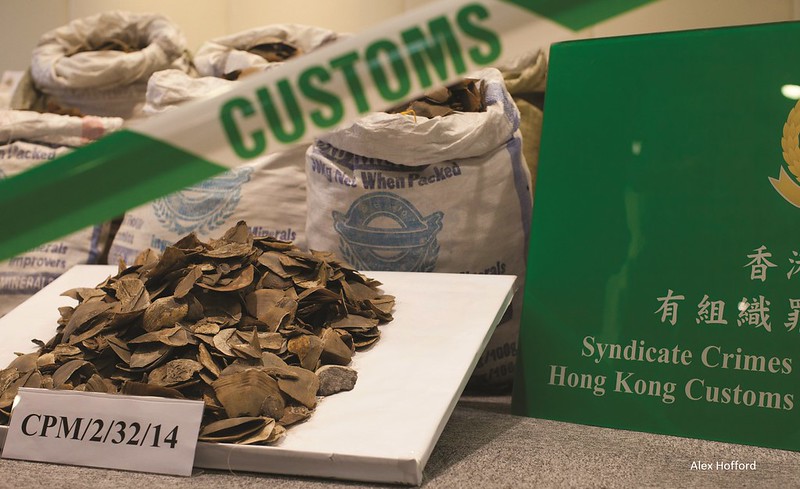
“[A]t the very least, every province needs to have a transparent and standardized system to manage pangolin stockpiles to prevent any laundering of illegally sourced pangolin parts into legal channels,” Richard Thomas of TRAFFIC told Mongabay. “As we have seen in recent years, a number of very large-scale pangolin seizures have been made by Chinese customs, so clearly there is ongoing illegal supply of pangolin products that needs to be shut down. There’s a clear need for wildlife protection management departments to co-operate with the traditional Chinese medicine sector to eliminate potential illegal and unsustainable use of pangolin products.”
The eight species of pangolins are the most widely trafficked animal in the world, with more than a million of these animals poached and illegally traded since the year 2000. In 2016, CITES, an international treaty that protects endangered plants and animals, uplisted pangolins to Appendix I, which bans all international trade. However, CITES regulations do not apply to any domestic trade of the species.
Hamley said the illegal trade of pangolin scales has not slowed down in recent weeks, despite the apparent removal of pangolin scales from pharmacopoeia.
“EIA is currently monitoring the trans-national trafficking and trade of pangolin scales by criminal networks, and we can confirm that large, multiple ton shipments of pangolin scales continue to be trafficked from Africa to southeast Asia for onward shipment into China,” Hamley said. “COVID-19 has had some logistical consequences that have slowed down wildlife trafficking activity, but traffickers in Africa continue to source pangolin scales in significant quantities for export to Asia.”
UPDATE 06/28/2020: In response to this article, a spokesperson for China Biodiversity Conservation and Green Development Foundation (CBCGDF) stated that there is currently no legal procedure to stop the production of patent medicines, which are owned and protected by various companies, and that the Chinese government has done its best to remove pangolins from TCM.
Featured image by: USAID Asia
This article was originally published on Mongabay, written by Elizabeth Claire Alberts, and is republished here as part of an editorial partnership with Earth.Org.