

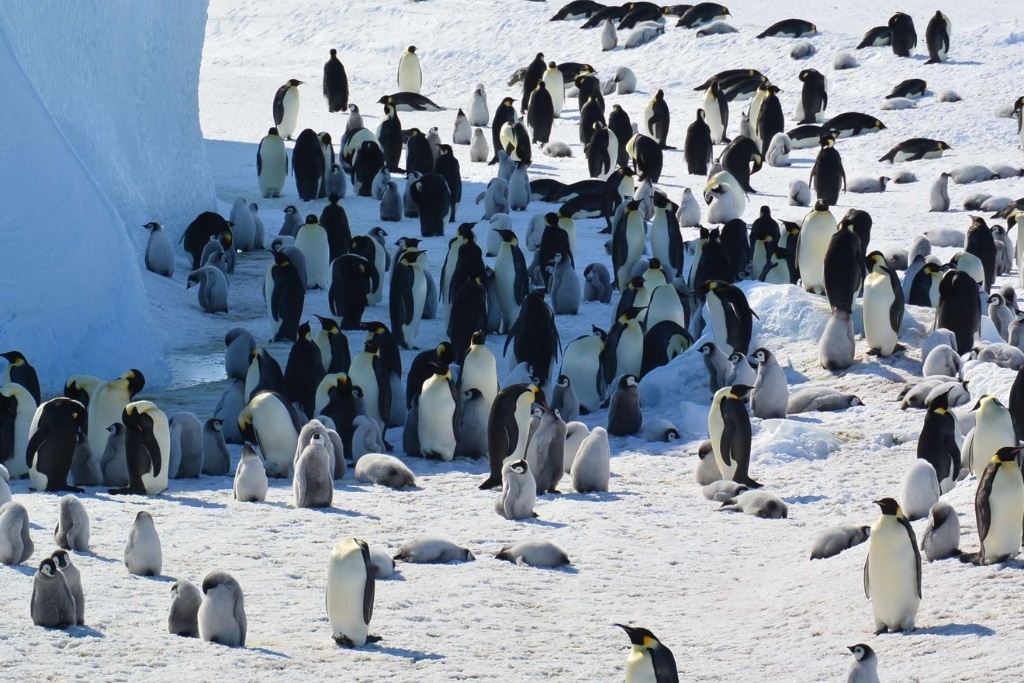
The emperor penguin was downgraded from “Near Threatened” to “Endangered” on the International Union for Conservation of Nature (IUCN) Red List, while the Antarctic fur seal has moved from “Least Concern” to “Endangered”.
—
Two Antarctic species – the emperor penguin and Antarctic fur seal – were downgraded to “Endangered” on the Red List of Threatened Species, the world’s most comprehensive information source on the global conservation status of animal, fungus and plant species.
The International Union for Conservation of Nature (IUCN), the global authority on the status of the natural world, which compiles the list, made the announcement on Thursday. It said climate change was the main reason behind the reclassification.
The emperor penguin was downgraded from “Near Threatened” to “Endangered” based on projections that its population will halve by the 2080s owing to changes in sea-ice. Meanwhile, the Antarctic fur seal has moved from “Least Concern” to “Endangered” following a nearly 50% decrease in its population between 1999 and 2025 caused by a reduction in food availability.
Rising ocean temperatures and shrinking sea ice are pushing krill – a food source for seals – to greater ocean depths in search of colder water. The IUCN said krill shortages at South Georgia, an island in the South Atlantic Ocean, have “dramatically” reduced the survival of pups in their first year, leading to an ageing breeding population.

A global outbreak of avian flu, which started in 2020, has also decimated populations of the southern elephant seal, leading to its reclassification from “Least Concern” to “Vulnerable”.
The new assessments will be published on the emperor penguin and seals’ species profiles as part of a broader Red List update later this year.
IUCN Red List categories (click to view)
- Extinct or Extinct in the Wild
- Critically Endangered, Endangered and Vulnerable: species threatened with global extinction.
- Near Threatened: species close to the threatened thresholds or that would be threatened without ongoing conservation measures.
- Least Concern: species evaluated with a lower risk of extinction.
- Data Deficient: no assessment because of insufficient data.
- Critically Endangered (Possibly Extinct) or Critically Endangered (Possibly Extinct in the Wild)
‘Exctinction Crisis’
Climate change-triggered melting of sea ice in Antarctica is taking a heavy toll on emperor penguins, with a 2023 study suggesting that the entire population could be wiped out by the end of the century. Emperor penguins require sea ice attached to solid land between April and January to breed. This makes them extremely vulnerable to rapid sea ice loss in the region, which keeps hitting record low levels and is disappearing at an average rate of about 135 billion tons per year.

“The emperor penguin’s move to Endangered is a stark warning: climate change is accelerating the extinction crisis before our eyes,” said Martin Harper, CEO of BirdLife International, which coordinated the emperor penguin assessment as the authority for birds on the IUCN Red List.
The reclassification of the emperor penguin brings the total number of penguin species threatened with extinction to 10 out of the 20 listed species, while populations of at least 12 species are declining. This makes them one of the world’s most threatened birds, second only to the albatross.
Key endangered species include the African, Galapagos, Yellow-eyed, Erect-crested, and Northern Rockhopper penguins. They are threatened by a combination of climate change and severe weather, commercial fishing competition, mining and diseases.
‘Wake-Up Call’
Grethel Aguilar, IUCN Director General, said the findings are a “wake-up call on the realities of climate change.” She called on countries to take action to protect the Antarctic and its precious wildlife at next month’s Antarctic Treaty Consultative Meeting.
The Antarctic Treaty was enacted in 1961. It prohibits military activities, nuclear testing, and mineral extraction in the continent while designating it as a demilitarized zone dedicated exclusively to peaceful purposes and scientific research. It counts 58 member nations to date.
“Antarctica’s role as our planet’s ‘frozen guardian’ is irreplaceable – offering untold benefits to humans, stabilising the climate and providing refuge to unique wildlife,” Aguilar said.
Featured image: Philip Trathan.
This story is funded by readers like you
Our non-profit newsroom provides climate coverage free of charge and advertising. Your one-off or monthly donations play a crucial role in supporting our operations, expanding our reach, and maintaining our editorial independence.
About EO | Mission Statement | Impact & Reach | Write for us