

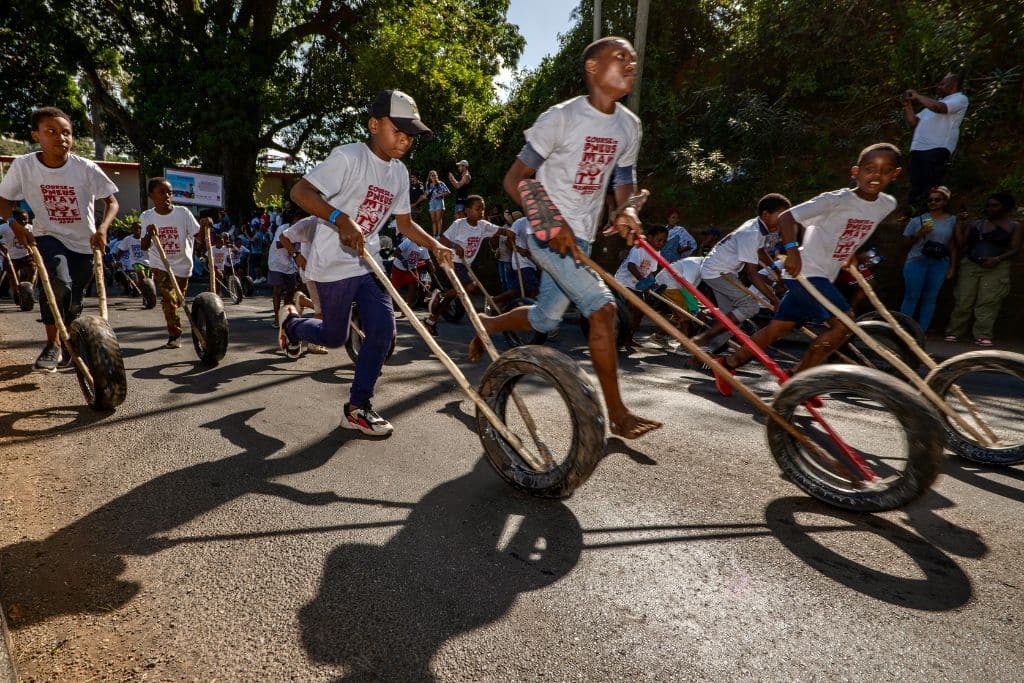
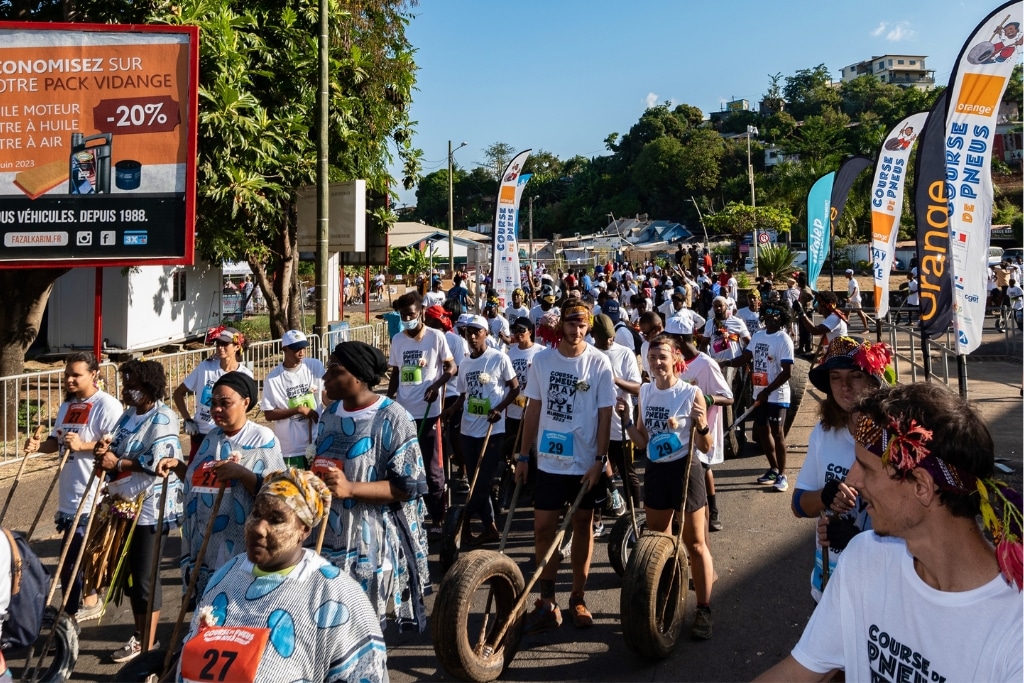
In Mayotte, an archipelago in the Indian Ocean between Madagascar and the coast of Mozambique, a tire race tells the story of a world struggling with its waste.
—
On the roads of Mayotte, an abandoned tire is never just an object. It is a piece of rubber that has reached the end of its life in a place where no system exists to take it back. A silent witness to the difficulties faced by island territories that must handle waste they did not produce, yet are forced to manage.

In 1984, a physical education teacher, Jack Passe, decided to turn this reality into something positive. Drawing from a traditional Mahoran game in which children roll a tire using two sticks, he created the island’s first “tire race”.
What began as a playful school activity soon became a cultural and athletic tradition, showing how local ingenuity can flourish where industrial solutions remain absent. The race demonstrates how communities can reclaim a problem and turn it into a moment of collective energy. Every tire recovered for training or competition is one less tire abandoned in the environment.
But beyond the creativity hides a far more complex challenge underpinning the island’s daily reality.
When a Game Exposes a Larger Issue
Despite continuous efforts, Mayotte still faces structural constraints in managing used tires. Storage capacity is limited. Exporting waste for treatment is expensive in a territory where all recycling must happen elsewhere. Collection schedules vary across municipalities, and in certain areas, tires continue to appear in informal dumps. When filled with rainwater, they become breeding grounds for mosquitoes and contribute to the spread of disease. When burned, they release toxic smoke that contaminates soils and air.
The tire race is a creative and symbolic response, but it does not resolve the underlying issue. Instead, it highlights a broader reality: island territories must manage objects designed and produced elsewhere, without meaningful support from the companies responsible for putting these products on the market.
A Global Reality
Around 3 billion tires are produced every year around the world. Their recycling remains one of the most challenging aspects of the circular economy. Existing end-of-life pathways, though diverse, all have their limitations.
Mechanical recycling grinds tires into crumb rubber used in sports fields and road surfaces, but demand is far from sufficient to absorb global volumes. Retreading extends a tire’s lifespan but does not address its final disposal. Co-incineration in cement kilns is widely practiced but raises serious environmental concerns. Pyrolysis, often presented as a promising solution, requires sophisticated and expensive infrastructure – beyond the reach of most regions and entirely inaccessible to islands. Exporting used tires remains the dominant option, but it merely shifts the burden to other territories and raises clear ethical questions.

Worldwide, production far outpaces recycling capacity. And in many regions, manufacturers are not required to assume responsibility for the end-of-life management of the products they create, especially outside highly regulated markets.
From Tires to Plastics
The tire issue mirrors the much larger crisis of plastic pollution. Both materials follow similar trajectories: massive production, global dispersion, limited recyclability, and long-term impacts on ecosystems and human health. Both also highlight a recurring problem: responsibility for waste is usually borne by communities, not by producers.
To address plastic pollution, the United Nations has sought to adopt a global plastics treaty. But recent negotiations revealed deep fractures. Last August, delegates reconvened for the fifth negotiating session in Geneva, Switzerland. It was the continuation of a session that took place a year earlier in South Korea, but failed to produce a treaty. Negotiators in Geneva worked from the same text, with the same ambition of reaching a legally binding agreement. Yet once again, the talks ended without a deal.

The fault line is clear. Some nations and organizations advocate for a treaty covering the entire plastic lifecycle, including production caps and chemical transparency. Others reject any binding measures on production and push for a narrow agreement focused only on waste management. While this stalemate persists, plastics continue to accumulate in the ocean, and island territories remain among the first to feel the consequences.
Local Ingenuity Cannot Replace Global Responsibility
The tire race of Mayotte illustrates how communities can transform a harmful waste item into an occasion for learning, celebration, and social cohesion. It shows that a territory can create meaning and unity from an object that would otherwise contribute to pollution.
Yet this resilience must not become a convenient excuse for leaving vulnerable communities to absorb the consequences of decisions made far beyond their shores. Islanders innovate, adapt, and make do. What they cannot do is permanently shoulder the externalities of a global economy built on producing faster than it recycles.
Responsibility must return to the source. Companies that design and sell tires, plastics, and other long-lasting synthetic materials must also commit to financing and organizing their end-of-life management. International agreements must be ambitious, binding, and systemic. Island territories must no longer be the final link in a chain they neither control nor benefit from.
Mayotte has shown what creativity can achieve. But it is up to the rest of the world to ensure that such creativity is no longer required to compensate for global shortcomings.
Featured image: Serge Melesan.
This story is funded by readers like you
Our non-profit newsroom provides climate coverage free of charge and advertising. Your one-off or monthly donations play a crucial role in supporting our operations, expanding our reach, and maintaining our editorial independence.
About EO | Mission Statement | Impact & Reach | Write for us