


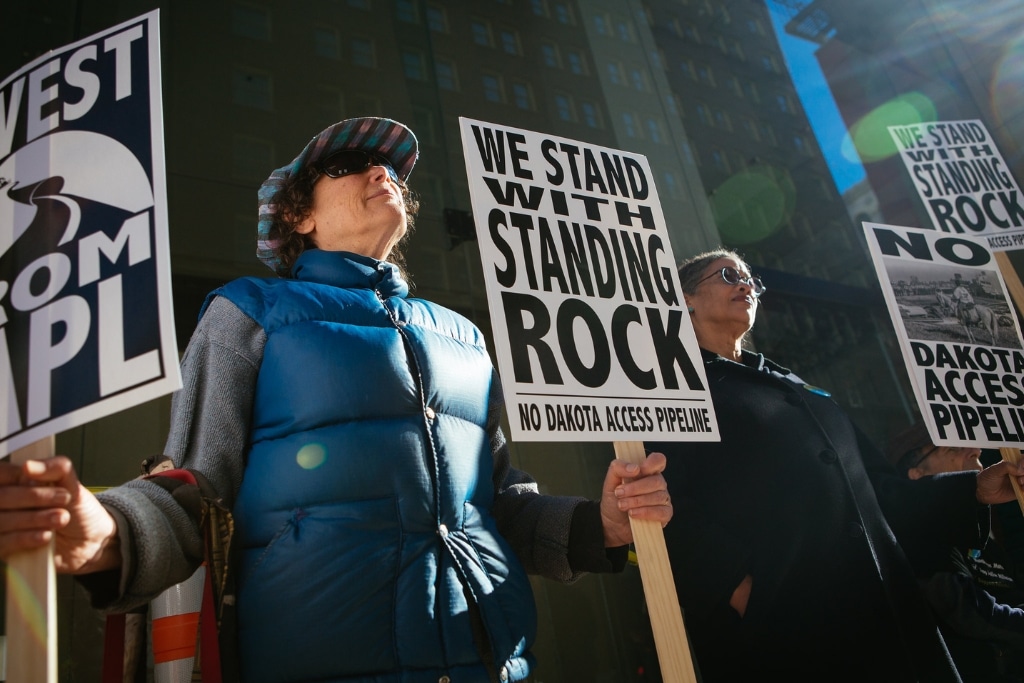
A jury’s verdict that found environmental campaigning group Greenpeace liable for more than $660 million was “patently biased,” according to a group of independent human rights lawyers.
—
This article was first published on March 21, 2025.
A jury’s verdict that found environmental campaigning group Greenpeace liable for more than $660 million was “patently biased” and “extremely disappointing,” according to a group of independent human rights lawyers who described the trial as “deeply flawed.”
The international lawyers and human rights advocates who monitored the marathon trial in Mandan, North Dakota, said Greenpeace was denied its right to a fair trial and described it as an “illegitimate corporate-funded SLAPP harassment case.”
SLAPPs, or Strategic Lawsuit Against Public Participation, have become a common tool to censor, intimidate, or silence critics by burdening them with costly lawsuits, often on grounds that the critiques are defamatory.
Indigenous-Led Protests
Dallas-based Energy Transfer sued Greenpeace International and its American branch, Greenpeace USA, in 2017 for hundreds of millions of dollars in damages for trespass, nuisance, defamation and other alleged offences in relation to protests that took place in North Dakota in 2016 and 2017.
The campaign was organized by youth from the Standing Rock Sioux Tribe and surrounding Native American communities to protest the construction of the Dakota Access Pipeline, which they argued posed a serious threat to the region’s water supply, ancient burial grounds, and historically significant cultural sites.
In early 2016, dozens of people set up water protector camps near the pipeline construction site at Lake Oahe. In the months that followed, the grassroots movement drew support from tribal governments, politicians, environmental and civil rights groups, and celebrities. At the peak of the demonstrations in September, the camp’s population reached as many as 10,000 people, making it the single-largest gathering of Native Americans in more than a century.
It ended on February 23, 2017, when National Guard and law enforcement officers evicted the last remaining protesters. The oil pipeline was completed in April of that year.
Pipeline’s developer Energy Transfer, an oil and gas company worth almost $70 billion, alleged that the defendants “advanced their extremist agenda to attack and disrupt” its business and its construction of the pipeline through “violent and destructive attacks.” It also alleged that Greenpeace “engaged in large-scale, intentional dissemination of misinformation and outright falsehoods,” including about the pipeline’s environmental impacts.
The energy company’s CEO, a billionaire and Trump mega-donor Kelcy Warren, has previously said that environmental activists should be “removed from the gene pool.”
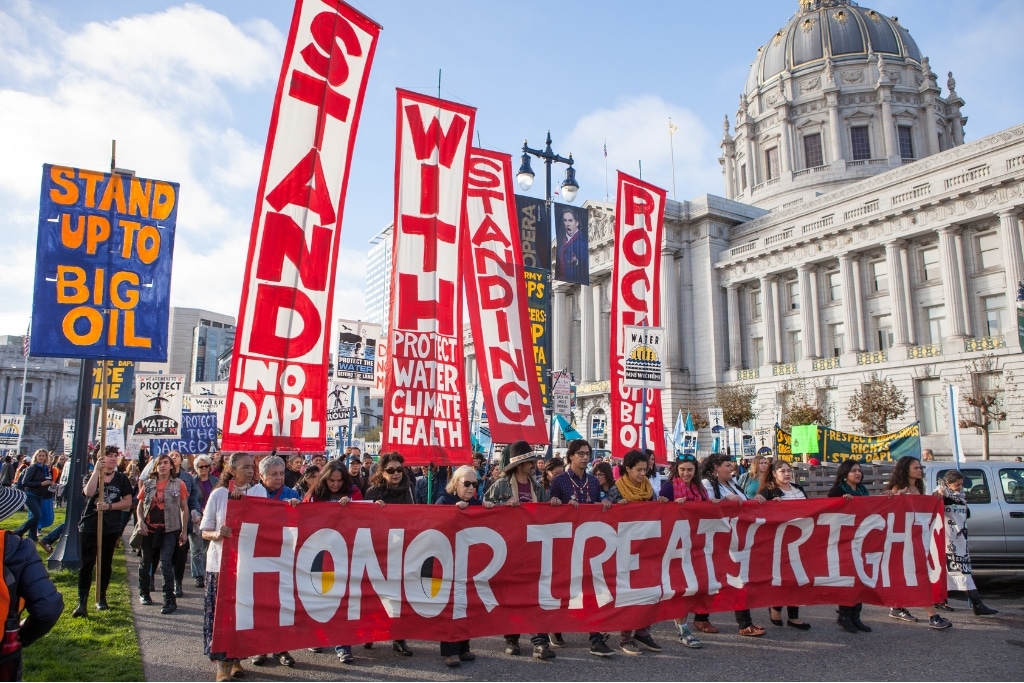
Greenpeace has always defended itself, saying it only played a minor role in what were, in fact, Indigenous-led protests.
According to Steven Donziger, an American attorney part of the independent monitoring team, just six of the nearly 100,000 protesters were from Greenpeace.
According to Daniel Simons, Senior Legal Counsel Strategic Defence for Greenpeace International, the organization’s involvement came in the form of funding for five members of an independent Indigenous networks to provide training on non-violent direct action for two weeks. Simons said the group conducted supply drives for the camps, provided short-term staff to help setting up the camp for winter, and donated lock boxes for protesters to form a human chain – though there is no evidence to prove these were ever used.
Backing Greenpeace’s claim that it was not directly involved in the protests was a Lakota organizer, who said in a video deposition played to jurors that the Standing Rock Sioux Tribe led the protests against the pipeline, not Greenpeace. “To be honest, most of the tribal nations didn’t know who Greenpeace was,” Nick Tilsen, an Oglala Sioux Tribe citizen and activist, said in his deposition, as reported by the North Dakota Monitor.
In a press release ahead of the trial, Greenpeace International described the lawsuit as “one of the world’s most brazen examples of SLAPP.”
‘Pervasive Bias’
Jeanne Mirer, a member of the independent trial monitoring group, said they “documented pervasive bias” in the jury pool towards Energy Transfer.
None of the nine jurors was Native American or a person of color. Several even conceded they had ties with the fossil fuel industry prosecuting the case and were biased towards the plaintiff, but the court failed to replace them. Requests to move the trial to a county not directly impacted by the protests also went unanswered, according to the monitoring group.
“The bottom line is that Greenpeace did not get a fair trial,” said Mirer, who is also President of the International Association of Democratic Lawyers. She described the verdict as “extremely disappointing but not surprising.”
The lawyers travelled to North Dakota to monitor the trial in person, after Judge James Gion refused a request from multiple news organizations, including The New York Times and The Washington Post, to livestream the proceedings as a matter of public interest.
The group also accused Gion of making decisions that ensured Greenpeace would not have a fair trial beyond refusing to ensure impartiality among the jurors. “The judge … repeatedly made evidentiary decisions that trespassed on basic legal rights protected by the First Amendment and prejudiced the ability of Greenpeace to present its full defense,” said Donziger, who is best known for his legal battles with Chevron.

The judge also allowed “lawyers for Energy Transfer to openly criminalize and defame” Greenpeace in open court, according to Donziger, who described the acts as “a sad commentary on our court system and on the lack of ethics of Energy Transfer.”
“In my six decades of legal practice, I have never witnessed a trial as unfair as the one that just ended in the courts of North Dakota,” said attorney Martin Garbus, an acclaimed free speech defender whose previous clients include Nelson Mandela and Daniel Ellsberg.
‘Good Chance’ of Winning Appeal
The jury ruled in favor of Energy Transfer on most counts after more than two days of deliberations, awarding the company roughly $667 million. Greenpeace repeatedly warned that such a sum – more than double the entire operating budget of Greenpeace Canada for its entire 54-year history – could bankrupt its US operations.
The campaign group works as an independent network funded by individual contributions and funding grants. It does not accept money from governments, corporations or political parties, according to its website. In 2023, Greenpeace USA had just a little over $40 million in revenue and support, and about $38 million in expenses, its financial statement shows.
“Being SLAPPed in the face with an over $660 million penalty for something we so clearly did not do is not for the faint of heart. But we are not faint of heart,” Greenpeace International’s Director Mads Christensen said following the verdict.
Susha Raman, Interim Executive Director at Greenpeace USA, said the sum was a “very large amount of money” for organizations like Greenpeace, but a “fairly small amount” for Energy Transfer.
“I will just say that this is a large judgment, and this is a large kind of matter for an organization, or set of organizations, like Greenpeace. But you can’t bankrupt a movement,” she told Inside Climate News.
Christensen slammed Energy Transfer, saying its lawyers “did not present a single piece of credible evidence” to support claims he described as “absurd.” This, many argue, makes for a strong appeal case, which Greenpeace is expected to lodge.
“The North Dakota case is so deeply flawed – at its core, the trial was really about crushing dissent – that I believe there is a good chance it will be reversed on appeal and ultimately backfire against the Energy Transfer pipeline company,” Donziger wrote in an opinion piece for the Guardian.
Amsterdam-based Greenpeace International has also launched a lawsuit against the company in the Netherlands, which it hopes will help recover all damages and costs it has incurred in relation to the North Dakota lawsuit. The case cites Dutch law as well as the European Union’s anti-SLAPP Directive. The EU law, which came into force in April 2024, aims to “protect persons who engage in public participation from manifestly unfounded claims or abusive court proceedings (‘Strategic lawsuits against public participation’).”
Featured image: Earthjustice/Flickr.
This story is funded by readers like you
Our non-profit newsroom provides climate coverage free of charge and advertising. Your one-off or monthly donations play a crucial role in supporting our operations, expanding our reach, and maintaining our editorial independence.
About EO | Mission Statement | Impact & Reach | Write for us
Earth.Org
Free, non-profit and independent environmental journalism.