



Between 2022 and 2024, Hong Kong recorded up to 56 “hot nights” each year – when temperatures do not dip below 28C. By 2100, Hong Kong could see as many as 150 such nights each year.
—
Additional reporting by Vivian Han, Irene Pan, Erin Tan, Danson Deng, and Goby Yao.
On a hot and humid summer night in Hong Kong’s Kennedy Town, Kenneth Fan sat waiting for a spot to sleep in a brightly lit community center. Outside, the day’s heat radiated from concrete towers. Inside, cool air offered a brief respite from relentless nighttime heat – a mounting threat in the city.
“I come here when it’s stuffy at home,” said Fan, 33, who has a job but hesitates to run the air conditioner overnight because of high bills. “If I turn on the air conditioner for the whole family, it will cost a lot.” One summer, the heat woke him up 20 nights in a row.
For decades, Hong Kong’s climate worries centered on typhoons and floods. Now, after its hottest year on record, a quieter, deadlier threat is emerging: heatwaves. According to David Bishai, Director of the University of Hong Kong’s School of Public Health, heatwaves have become the city’s 10th leading cause of death, now claiming the same number of lives as diabetes.
Heat killed 1,455 people in the city between 2014 and 2023 – about 150 each year. Most died out of public view and heat was not recorded on their death certificates. “Every year is the world’s hottest year,” Bishai warned. “That’s the rest of our lives.”
Hot nights in this subtropical city on China’s southeastern coast have risen 38-fold over the past century, driven by a mix of climate change and the city’s dense landscape. Between 2022 and 2024, Hong Kong recorded up to 56 “hot nights” each year – when temperatures do not dip below 28C. By 2100, Hong Kong could see as many as 150 such nights each year.
Hong Kong’s tightly-packed neighborhoods, with 7.5 million residents packed into high-rises, leave apartments hot inside, much hotter than surrounding rural areas. “The sun heats up all these concrete buildings [during the day], and they are going to stay hot all night long,” said Bishai. “Concrete and very dense brick heat up like a pizza oven.”
A 2020 study by the Chinese University of Hong Kong found consecutive hot nights are more dangerous than daytime extremes. Without cool, restful sleep, the body struggles to recover, with the heart and lungs working overtime. “It’s like running a marathon,” said Bishai. “The longer the heatwave lasts, the more likely you are to just run out of steam.” Deaths often spike several days into a heatwave and can keep rising for weeks afterward.
Unequal Burden
The impact of nighttime heat is uneven. Around 220,000 people live in 110,000 subdivided flats – tiny, crowded, often windowless spaces. Here, indoor temperatures at night can feel like 44C. Air-conditioned malls offer temporary refuge, but only until closing time.

Elderly residents and those with chronic illnesses are especially vulnerable. Ambulance calls surge during heat spells, according to Chen Weiquan from the Hong Kong Fire Services Department. The Hong Kong Red Cross now distributes wearable health monitors for the elderly, but the group’s senior manager for community resilience Eva Yeung says the system cannot summon immediate hospital care.
Her team recently placed temperature sensors in rural squatter homes in Hung Shui Kiu, an area that sits in the western part of the city’s New Territories. The findings were sobering: at night, indoor temperatures stayed alarmingly high, with bedrooms regularly exceeding 35C, putting health at serious risk. “People are really suffering,” Yeung said, underscoring the urgent need for accessible public cooling spaces after dark.
A Patchwork of Solutions
Hong Kong operates 19 cooling centers during heatwaves, many open overnight. In 2024, shelters stayed open for 66 nights – almost every night during the peak of summer alerts. “When we see the warning is still on at around 4:30 p.m., we keep the centre open and start preparing instant noodles and blankets,” said Lucy Shih, a staff member at the Kennedy Town complex.
But access is uneven. Fan, who lives in the city’s east, treks to Kennedy Town because nearby centers are overcrowded or uncomfortable. Sometimes the air-conditioning shuts off at 11 p.m., while new research by Greenpeace found a third of shelters did not have any air-conditioning at all. It is mostly men who turn up, Fan said, raising concerns about safety for women, and the desirability of these centers.

Energy costs add another barrier. Many residents avoid air conditioning at night, fearing high power bills. Poor ventilation in public housing means that even with windows open, heat lingers.
Utility companies in the city offer limited subsidies: CLP gave HK$50 million (US$6.4 million) to 70,000 households in 2025, while HK Electric gave HK$1.2 million to 1,200 subdivided flat residents.
The economic toll is mounting, with heat-related illness and deaths straining families, health care and the economy. A 2023 study found that heatwave deaths in 24 Chinese regions cost 2.2 to 4.8 billion yuan (between US$309 million and $674 million) between 2014and2019, with men and those over 65 needing more healthcare support. Local studies link excess nighttime heat to a 3.1% rise in hospitalization, especially among the elderly.
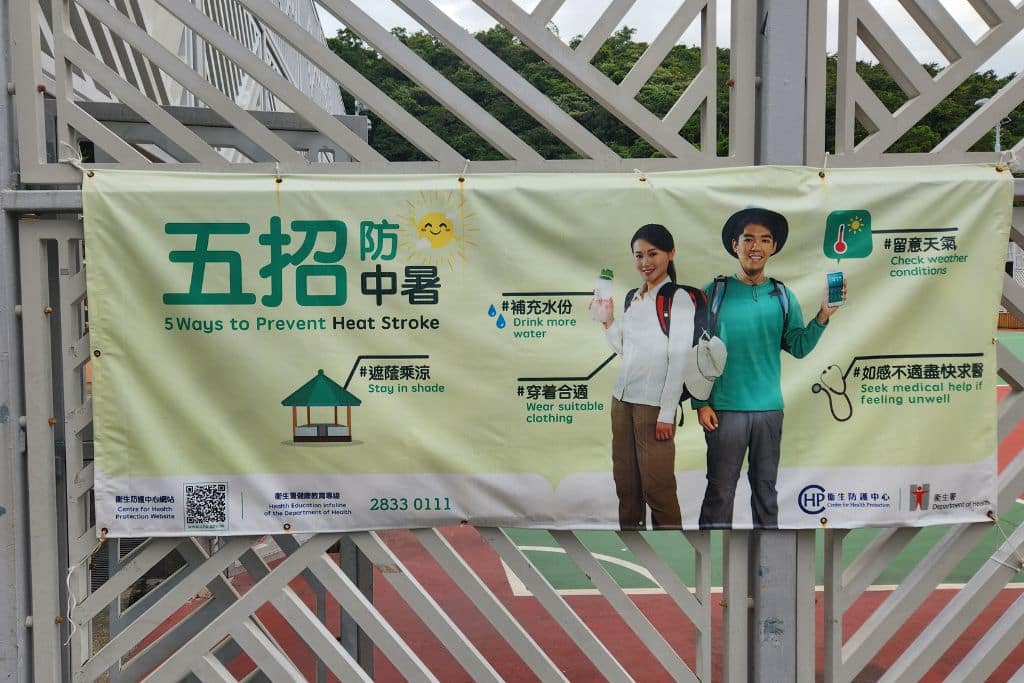
Despite the growing danger, Hong Kong’s Climate Action Plan 2050 focuses on carbon reduction, with little attention to heat adaptation. Unlike the city’s coordinated and heavily-funded flood management strategy, heat response remains a patchwork issue in Hong Kong. The observatory issues warnings; various departments open shelters, coordinate with schools, give health advice or set heat workplace standards – but the city still lacks a unified heat action plan. “A climate adaptation plan is missing in action,” said Bishai.
Globally, as many as 140 countries have heat health action plans, Bishai’s research shows. The best have a lead agency that coordinates and monitors alerts, shelter access, hospital readiness and urban cooling, focusing on the most vulnerable like the elderly and pregnant women. Some cities even encourage pharmacists to warn customers with high-risk medical conditions about heat dangers, ensuring they know to get to a cool place. Cities like Ahmedabad in India have plans in place that helped the city prevent 1,100 deaths per year.
Nearby in the Pearl River Delta, Guangzhou has launched a “Prevent Heatstroke, Enjoy Summer” campaign, offering digital alerts, home visits, and a 24/7 hotline for the elderly. Hong Kong, Bishai argues, needs to catch up.
He is pushing for a citywide heat action plan that brings together health, housing, and emergency services, with real-time data sharing and coordinated public outreach. He has reached out to district councils and government agencies, and his students are in the field, gathering data and raising awareness. “Heat deaths are a ‘nowdemic,’” he said. “We need to wake up to what’s going on.”
He listed long-term solutions including more accessible and secure cooling shelters – especially for women and families – heat-resilient public housing, and smarter urban design such as shaded walkways, green roofs, and heat-reflective materials. The city’s Red Cross, for one, is handing out fans, applying heat-reducing window film and painting roofs with cooling coatings in vulnerable communities.

As the population and buildings age in Hong Kong, and more people live alone, the city’s risks will only multiply. “Getting people to stay cool will stop [heat-related deaths],” Bishai said.
For now, residents like Fan must cobble together their own solutions. “I just want a good night’s sleep,” he said, preparing for a sweltering night in a borrowed bed. “It’s simple, but is that too much to ask?”
Featured image: Marianne Bray.
This story is funded by readers like you
Our non-profit newsroom provides climate coverage free of charge and advertising. Your one-off or monthly donations play a crucial role in supporting our operations, expanding our reach, and maintaining our editorial independence.
About EO | Mission Statement | Impact & Reach | Write for us