
The lagoon of Mayotte is one of the largest and most biodiverse in the Indian Ocean. Yet many young people growing up along its shores have never ventured beneath its surface. Through the “Ambassadeurs du Lagon” program, their first encounters with the underwater world become the beginning of a deeper understanding of why this exceptional ecosystem deserves to be protected.
—
In Mayotte, the sea is everywhere. It surrounds the island, shapes the villages, follows the roads, feeds families and draws the eye. From the hillsides, the lagoon appears vast, luminous, almost self-evident. Yet for many young Mahorais, it remains close but unfamiliar, admired from land, sometimes feared, and rarely explored.
Karimou, 16, was among them. “I had a phobia of the sea,” he told Earth.Org.
That fear is not anecdotal. In Mayotte, drownings leave deep marks on communities. Access to swimming lessons remains uneven. The sea, which could be a refuge, a playground or a source of pride, remains for some a boundary.
The Ambassadeurs du Lagon project was born from this gap: how can a lagoon be protected if the generation expected to inherit it has never truly been given the chance to know it?
Reconnecting New Generations With the Sea
Mayotte is a French overseas department located in the northern Mozambique Channel, between Madagascar and the coast of East Africa. Its lagoon, among the largest in the south-west Indian Ocean, covers a little over one thousand square kilometres, depending on the perimeter used. It is enclosed by a barrier reef of around 150 kilometres, pierced by rare passes, and connected to a mosaic of ecosystems: mangroves, seagrass beds, coral reefs, beaches, ravines and coastal villages.
This lagoon is at once a natural treasure, a living heritage, and a fragile space. Cyclones, climate change, coral bleaching, fishing pressure, waste, runoff, mangrove degradation and land-based pollution all show that the sea does not begin only at the waterline. It also begins in watersheds, rivers, beaches and daily habits.

Faced with this complexity, Mayotte’s Marine Natural Park follows a simple logic: measure, correct, share. Measure the state of ecosystems. Correct pressures where possible. Share knowledge to those who live around the lagoon, be it fishers, local elected officials, or younger generations.
Ambassadeurs du Lagon Belongs to This Wider Approach
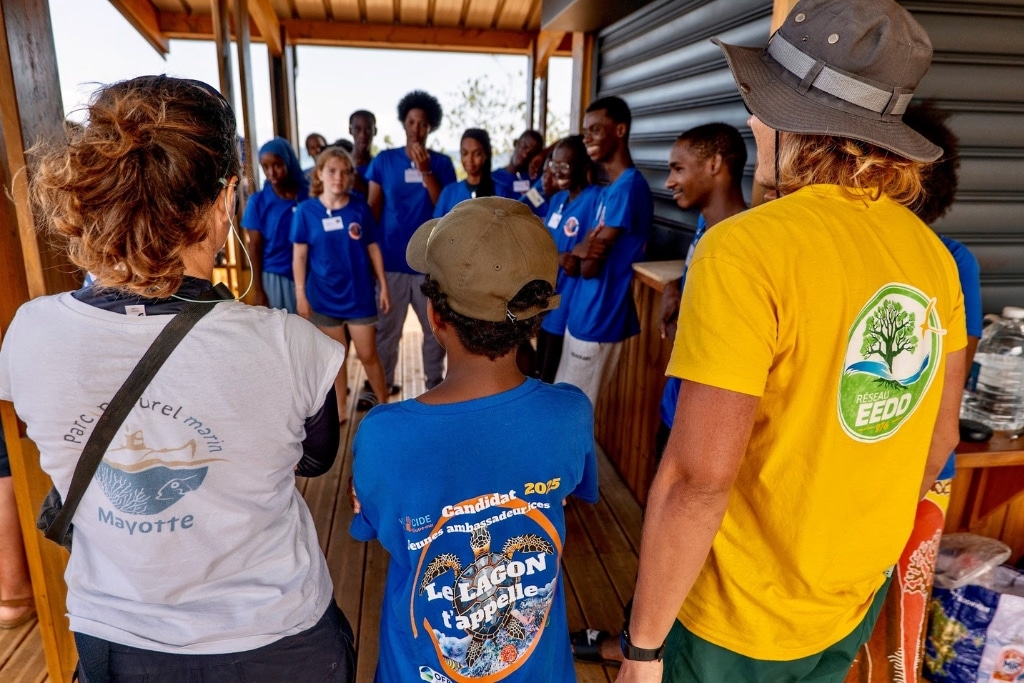
Ambassadeurs du Lagon, led by the Hakiza Wanatsa association in Mayotte and coordinated by Philippe Novel, the project manager and an employee of the association, is carried out in partnership with the Abalone diving center and with the support of the Marine Natural Park. In early September 2025, it brought together 10 young Mahorais aged 16 to 18 from different parts of the island. Most had never dived before. Some lacked confidence in the water; others carried a deeper fear.
The starting point was simple: before asking young people to protect their lagoon, they first had to be given the chance to meet it.

On the morning of the first outing, the young participants were taken to the Abalone diving center in Bouéni. On the dock, the team welcomed the group with warmth and seriousness. Wetsuits were adjusted, tanks lined up, instructions repeated. For many of them, everything was new, from the weight of the equipment, to breathing through a regulator and equalizing pressure in the ears, and even the idea of descending beneath the surface.
The first few meters were a reminder that the sea cannot be approached without learning. Some dealt with seasickness. Others learned to listen to their bodies, slow their breathing, and be patience.
Then something shifted. Heads went underwater. The noise of the world disappeared. Breathing settled. Eyes opened.
Back on dry land, the emotions were at first internal. It was later at the dive center that words returned. Participants compared coral colors, spoke about a curious fish, laughed about a buoy, teased one another, and replayed the dive in the language of teenagers.
The first spark was there: shared wonder before the coral formations. Novel had planned for eight main participants and two reserves. Thanks to the generosity of the center, all 10 would continue towards their Level 1 diving certification.
Learn, Defend, Share
Level 1 training consisted of meetings with naturalists, awareness activities, interventions and workshops focused on the living systems of the lagoon: reefs, seagrass beds, mangroves, turtles.
Before returning to the sea, they also signed a charter. Nine simple commitments summarized the spirit of the program: to learn about the lagoon, understand its beauty and fragility, defend and respect it, share a positive and responsible image of it, take part in training sessions, keep a lagoon journal, contribute to awareness actions, adopt a respectful attitude and proudly carry the role of Sentinel of the Lagoon.

Learn, defend, share. These words go beyond diving. They describe a way of belonging to a place.
The project also fits within a broader educational approach. Learning to know one’s environment, speak out, participate in collective life, gain access to leisure, culture and natural heritage: for these young people, the sea is not only a recreational space. It becomes a place of learning, confidence and participation.
Fear, Depth and Courage
Over the dives, each participant progressed at their own pace. For some, ease came quickly. Gestures relaxed, eyes opened, breathing became calm. For others, diving revealed a more intimate challenge: fear of depth, loss of control, or the water itself.

Ouksam, a bright student and high-level athlete, found himself blocked at six meters, unable to descend further. His difficulty was not only technical. It touched something deeper: accepting that courage does not always lie in performance, but sometimes in acknowledging one’s own fragility.
Karimou, quiet and reserved, also came back from a difficult first experience with dealing with pressure and fear. Then came another dive. This time, he stayed in the water for an hour. Relaxed and almost happy.
“Thanks to diving, I regained confidence in myself,” he said, reflecting back on the experience. Underwater, he discovered a world he had not really known: the corals, the colors of the lagoon, the marine life hidden behind a sea he had once regarded from a distance. “I was able to discover the lagoon,” he said.

As the young participants progressed towards Level 1, discovery became more precise. At the Oasis dive site, they encountered their first stingrays, tropical fish, eagle rays, living coral but also dead coral. Wonder began to mix with awareness.
A Vulnerable Lagoon
The passage of Cyclone Chido in December 2024, the traces of climate change, and bleached corals no longer appeared as distant ideas. They became visible, tangible, painful realities.
The project also awakened scientific curiosity. One student chose to devote his oral examination to diving, to better understand pressure phenomena and gas exchange in the blood. Elsewhere, in baccalaureate exam topics, microplastics, the Indian Ocean plastic continent, threats to marine fauna and risks to humans are also topics increasingly discussed in schools.
But while environmental issues are entering curricula, exams and public awareness, recognition risks remaining limited if it is not accompanied by broader, more structured and more sustained action on the ground.
Measuring to Understand
While the young participants were learning to see the lagoon differently, scientific teams were continuing their own reading of the ecosystem.

After Cyclone Chido, around 66% of monitored sites showed notable degradation. Two main lines of fieldwork guided the campaigns: the response of fish communities to the expansion of algae, monitored in particular by Cyrielle Jac and Donatien Peulourdea from the Marine Park, and the impact of the cyclone on corals and their path towards resilience, studied with Éloïse from the French National Research Institute for Sustainable Development (IRD) and supported by two engineers from the University of Mayotte.
Surveys were conducted at depths of 15 and 3 meters over 10 days and repeated in the spring to compare changes.
Following algae means reading the state of the system. Where algae gain ground, coral retreats.Counting fish means reading the functioning of the reef: sizes, abundance, regeneration, fishing pressure.

Observations and data-gathering can guide management decisions, such as protecting herbivorous fish when algae dominate, redirecting fishing effort elsewhere,and allowing declining populations to recover.
Science provides a framework. The young people give it a voice.
Six Months Later: What Changed?
As exams approached, the young participants gradually moved away from sea outings and returned to school priorities. But this disconnection was only apparent. The lagoon continued to work in their minds.
For Novel, the first result went far beyond technical training. The young participants became lovers of diving and the fear of the ocean, so present at the beginning for some, receded. Where the sea once represented a limit, a danger or an unknown territory, it gradually turned into a space of exploration, knowledge and attachment.
The project also created a space of social and gender diversity. Everyone learned under the same rules, faced the same challenges, shared the same discoveries and the same responsibilities.

Diving even reversed certain expected roles. In a territory where access to the sea and nautical activities can still be shaped by social, cultural or gender representations, several girls proved particularly comfortable underwater, sometimes more so than some boys.
Far from expected roles, the lagoon became a space of concrete equality. Underwater, everyone moved according to their breathing, calm, confidence and ability to listen to the environment.
The participants’ behavior towards nature also changed. They appropriated issues linked to the cyclone’s impact on the lagoon, climate change, reef fragility, waste and the human pressures affecting marine environments. And they took these issues to their friends, and families.
Karimou expressed it in his own way. He regretted the long interruption in the program caused by school rhythms and exams. According to him, that time could have been used differently: to help monitor turtle nesting, observe mangrove regrowth after Cyclone Chido, or raise awareness among younger children.
“It’s really a shame, because I could have helped younger people understand why they should protect and not pollute,” he told Earth.Org.
In his words, the project’s most important effect was already visible: he was no longer only a young person discovering the lagoon. He was beginning to see himself as someone capable of speaking about it, defending it and sharing what he has learned.
For the first phase, that was already a victory.
Connecting the Sparks
But this victory also revealed a broader limitation: in Mayotte, lagoon protection still too often relies on separate initiatives. People act, but their impact remains limited as long as they do not build connections with each other.
During the presentation day last September at the Dembéni Technopole. A total of 48 projects were submitted by teachers, volunteers, and associations, with nine ultimately selected by the Marine Natural Park.
There were complementary skills in the room: associations, teachers, naturalists, projects linked to the sea, waste, youth and coastal environments. But once field activities began, each project often returned to its own schedule, constraints and area of intervention.

Yet the lagoon does not function in separate compartments. What happens on land often ends up in the sea. Waste from ravines reaches mangroves. Mangroves protect seagrass beds. Seagrass beds feed turtles. Reefs shelter fish.
The challenge is therefore no longer only to add projects, but to create synergies; to circulate young people, knowledge, associations and experiences towards a shared goal: the protection of Mayotte’s lagoon.
An Isolated Project Raises Awareness. A Network Mobilizes
And in Mayotte, faced with the urgency weighing on the lagoon, unity is not a slogan: it is a condition for effectiveness.
For Novel, if this type of project is to have impact, it needs stronger involvement from authorities. As long as such initiatives depend mainly on the will of associations, volunteers, committed teachers or private structures, they remain powerful in human terms, but institutionally fragile.
Yet that fragility does not erase the success.
Over the months, he himself switched from diving center manager to a volunteer within the association and, above all, to a passer-on of experience, perspective, and love for Mayotte’s lagoon. His goal was no longer only to teach young people how to breathe underwater, equalize their ears or manage their buoyancy. It was to help them absorb the issues facing the lagoon, to understand that this territory is not merely a backdrop but a living heritage.
From Discovery to Action
The second phase, which is due to begin in September, will need to carry this momentum forward. It will focus more strongly on waste, concrete field actions, beach clean-ups, links with turtle protection associations, and the discovery of mangroves, rivers, ravines and coastal environments.
After learning to see, the ambassadors will need to learn to act and get others involved.

For some young people, discovering the marine environment already represents much more than an activity. Several face complex personal or social situations. For them, the lagoon can become an opening, a source of confidence, perhaps even the first step towards a path connected to the sea, diving, environmental education or the preservation of natural heritage.
What strikes Novel most is that some of these young people now return to him, ask questions, and begin to imagine actions, solutions, extensions of the project. This is when the program changes in nature – it is no longer only about training ten young people but also about seeing the first signs of a generation beginning to think of the lagoon as a common good.
A Promise to Keep
In Mayotte, the link between research, education and transmission already exists. What is missing is not the will but the means.
On the ground, associations, teachers, scientists, diving centres and the teams of the Marine Park already carry an essential part of the work. They observe, train, warn, support and share. But as long as these initiatives rely mainly on the commitment of a few local actors, they will remain powerful in human terms but fragile over time.
Mayotte’s Marine Natural Park is one of the largest marine protected areas in France. President Emmanuel Macron has talked about his ambition to have Mayotte’s double barrier reef recognised as a UNESCO World Heritage site. But international recognition cannot simply be declared. It must be prepared, funded and defended on the ground.
The marine park requires teams, scientific monitoring, education, waste management, local relays, enforcement capacity and political continuity.
In this context, a partnership announced in July 2025 between the French Development Agency and the Aga Khan Development Network, marked an important step. The partners committed to mobilizing €100 million for the Indian Ocean Coastal Regeneration Initiative, covering Mayotte as well as Kenya, Madagascar, Mozambique and Tanzania, with a focus on coastal communities, sustainable blue economies and ocean protection.
This June, the partnership began to take concrete shape in Mayotte, with the announcement of an initial €8.5 million phase funded by the Aga Khan Foundation to support the restoration of the lagoon and strengthen the resilience of coastal communities and ecosystems. The first phase is expected to begin in early 2027.
But these partnerships, however valuable, cannot replace long-term conservation policy. Their impact will be greatest if they strengthen what already exists on the ground – local energy, field knowledge, associative networks, committed teachers and young people who are beginning to see their lagoon differently – while being matched by a genuine and sustained commitment from public authorities.
Featured image: Serge Melesan.

This story is funded by readers like you
Our non-profit newsroom provides climate coverage free of charge and advertising. Your one-off or monthly donations play a crucial role in supporting our operations, expanding our reach, and maintaining our editorial independence.
About EO | Mission Statement | Impact & Reach | Write for us