

Poor indoor air quality can lead to adverse health effects. Maintaining good ventilation and implementing source reduction measures can significantly improve the situation.
—
Good indoor air quality (IAQ) is essential for everyone, as most people spend the majority of their time indoors. Poor IAQ can cause various health problems, particularly affecting vulnerable groups such as the elderly, children, and individuals with pre-existing respiratory or heart disease conditions.
Indoor air pollutants consist of both gaseous and particulate contaminants. While major gaseous pollutants include carbon monoxide, nitrogen oxides, ozone, and volatile organic compounds, particulate pollutants encompass particulate matter and bioaerosols. If there is inadequate ventilation, these pollutants can accumulate and harm human health.
| Indoor Air Pollutant | Sources |
| Carbon monoxide, Nitrogen oxides | Cooking and tobacco smoking |
| Carbon dioxide | Breathing, tobacco smoking, and cooking |
| Ozone | Photocopiers, printers, and fax machines |
| Volatile organic compounds | Building materials, paints, cleaning materials, furniture, adhesives, and pesticides |
| Radon | Building materials, granite, and soil under the building |
| Particulate Matter | Cooking, tobacco smoking, burning candles, and printers |
| Moulds | Moist material |
| Biological contaminants | Filters in air conditioners |
Health Effects
Health effects from indoor air pollution include sick building syndrome and building-related illness. The former refers to a situation where building occupants experience acute and nonspecific symptoms, such as headache, eye irritation, and cough. These symptoms have no identifiable cause, and most occupants relieve soon after leaving the building. In contrast, building-related illnesses are diagnosable illnesses with identifiable causes, such as carbon monoxide poisoning caused by excessive exposure and asthma worsened by allergens. Occupants may require prolonged treatment and recovery time after leaving the building.
IAQ in Subdivided Units
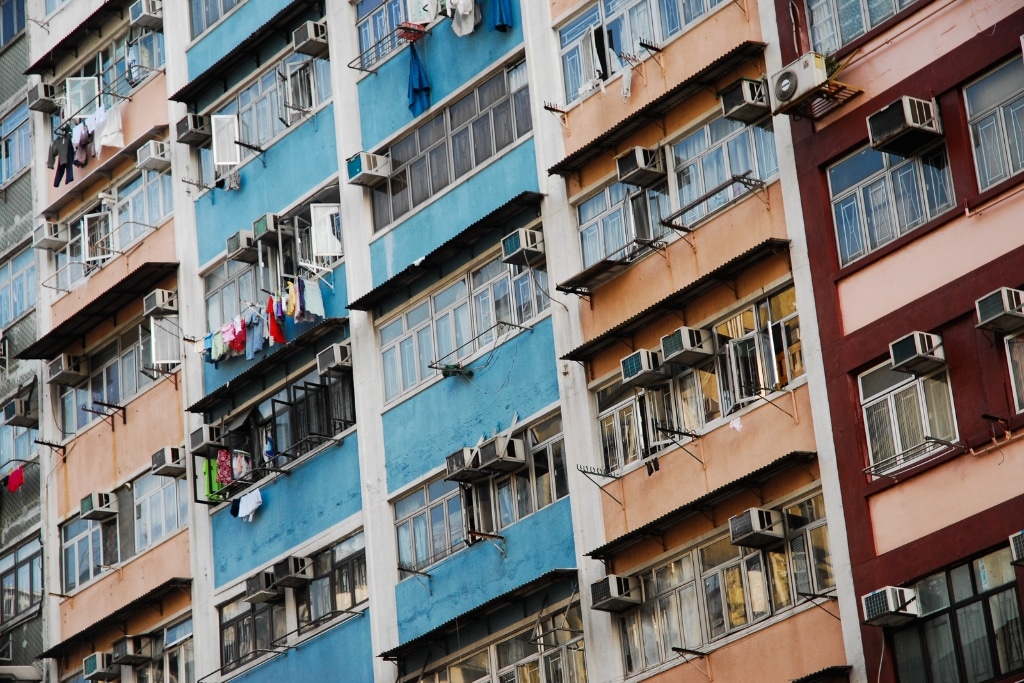
In Hong Kong, approximately 210,000 residents live in subdivided units – tiny apartments created by partitioning a single flat into multiple smaller units. Adding extra partitions in a flat significantly reduces natural ventilation, especially in some units that may have no windows at all. Therefore, IAQ in subdivided units is particularly concerning.

Research conducted in 2019 found open-plan cooking and air conditioning use among the main factors influencing the IAQ in such units. As the median floor area of these units is only 11 square meters (118 square feet), open-plan cooking is common. As a result, the cooking fume spread throughout the whole unit. The research found that the peak concentrations of coarse particulate matter exceeded 1,000 micrograms per cubic meter during cooking, more than 13 times Hong Kong’s statutory 24-hour outdoor limit of 75 micrograms per cubic meter.
It also found that residents frequently use air conditioners to relieve the heat. However, this actually reduces the air exchange rate with the outdoors, as doors and windows are closed, leading to the accumulation of indoor air pollutants.
“Timely interventions are needed to reduce impacts on tenant’s health and provide healthy affordable housing to low-income families,” researchers said.
IAQ in Schools
Research conducted by environmental group Clean Air Network in April warned that Hong Kong schools are also subject to unhealthy indoor air quality levels. The group monitored indoor air quality in eight classrooms in four local secondary schools for two days – when the city was affected by a dusty airstream associated with the northeast monsoon, Hong Kong Free Press reported. They found concentrations of indoor particulate matter to be significantly higher than the statutory limit of outdoor Air Quality Objectives in Hong Kong.

The group said the government should “systematically collect” air quality data from schools and other premises and formulate appropriate policies accordingly.
Mitigation Measures
The Environmental Protection Department has proposed several mitigation measures to improve indoor air quality.
The simplest way to improve IAQ is to increase ventilation. For example, opening windows and doors can significantly increase the supply of fresh air and facilitate the dispersion of indoor air pollutants. If it is not possible, setting an appropriate fresh air intake and exhaust rate in the air conditioners or ventilation systems is also helpful.
Yet source reduction remains one of the most effective ways to improve IAQ. Examples include avoiding smoking indoors, regularly cleaning or replacing air conditioner filters, promptly drying all water spills to prevent microbial growth, and choosing low-volatile organic compound products, such as paints, adhesives, and cleaning agents.
Additionally, portable air purifiers are effective at removing airborne particles, like dust and pollen. Individuals can also consider spending more leisure time outdoors in areas with clean air, such as country parks and mountains.
Indoor Air Quality Certification Scheme
In 2003, the government launched a voluntary Indoor Air Quality Certification Scheme, encouraging property owners or managers to maintain a good IAQ in public places and offices.
Premises owners or managers can employ an accredited IAQ certificate issuing body to assess whether the premises comply with the 10 IAQ Objectives, such as carbon dioxide, formaldehyde, and respirable suspended particles. If they do, premises receive an “Excellent Class” or “Good Class” certificate for one year. After receiving the certificate, premises owners or managers should maintain the IAQ at the certified level and renew the certificate annually.
Limitations
Research conducted in 2024 found that participation in the IAQ Certification Scheme remains low. As of last year, only 2,394 premises had been certified, of which 40% were government premises.
The research highlighted several drawbacks and limitations of the scheme, including high sampling point density and long sampling durations. According to the IAQ Objectives, the concentrations of the 10 indoor air pollutants are measured as eight-hour averages. This lengthy sampling time may disrupt the occupants and business operations.
Furthermore, the certification scheme is voluntary, which results in low motivation for businesses to participate. This is particularly true since they need to invest effort in improving the IAQ and pay fees to employ certifying agencies.
“The expenses can be particularly burdensome for small- and medium-sized enterprises (SMEs). Businesses may be less inclined to participate in the scheme without financial support or incentives,” according to the research.
Featured image: Wikimedia Commons.
This story is funded by readers like you
Our non-profit newsroom provides climate coverage free of charge and advertising. Your one-off or monthly donations play a crucial role in supporting our operations, expanding our reach, and maintaining our editorial independence.
About EO | Mission Statement | Impact & Reach | Write for us