
A devastating event along the west coast of North America in 2013 wiped out nearly all of the area’s sunflower sea stars, with devastating consequences for kelp forests. A consortium of public and private organizations have been using aquacultural techniques to grow sea stars in laboratory settings, with the expectation that these efforts will lead to the eventual recovery of healthy kelp ecosystems and concomitant biodiversity.
—
Troubling reports of sea star wasting disease along the West Coast of the United States began in 2013. Its identification in Washington state spread southward, extending down to Baja. The symptoms of the disease spread rapidly, too – among them lesions, loss of arms, and breakdown of the body into what has been described as a pile of goo.
Sunflower sea stars are a keystone species, the natural predators of sea urchins. As their populations shrank, they were no longer able to maintain a balance in the kelp ecosystem.
A Deadly Disease
Lines of purple puff balls – vibrant in color and prickly to the touch – stretched upwards toward the light. The urchins are attached to the stipes or stem-like structures, the remnants of a once lush kelp forest. The abundant purple sea urchins denuded the kelp forest as they caused the functional extinction of the sunflower sea star.
Wasting disease has probably always been present in sea star populations along the US West Coast, but never at a magnitude to rival what occurred in 2013. The explanation for the extraordinary die-off remains unclear; however, scientists believe it may have been correlated to rising ocean temperatures, as increasingly warm temperatures have been shown to be associated with the prevalence and severity of marine infectious diseases. Furthermore, the shallow nearshore waters in which sea stars are found do not offer the kind of refuge from the rising water temperatures that deeper water offers.
A March 2023 study of California’s Monterey Peninsula documented the profound, decade-long decline of the kelp forest. The study, a collaboration of The Nature Conservancy, Woods Hole Oceanographic Institution, and the University of California Los Angeles, used Kelpwatch.org, an open-source web tool, to detect the decline in canopy-forming kelps – giant kelpand bull kelp.
The Monterey Peninsula, which historically supported a dense and thriving kelp forest with sunflower sea stars, now supported carpets of purple urchins. Unchecked by sea stars, the urchins had devoured the kelp, resulting in a loss of both the kelp canopy and its understory foliage. This drastically altered ecosystem had implications for a variety of species – from the tiniest of zooplankton to larger creatures like gray whales.
Sunflower Sea Stars
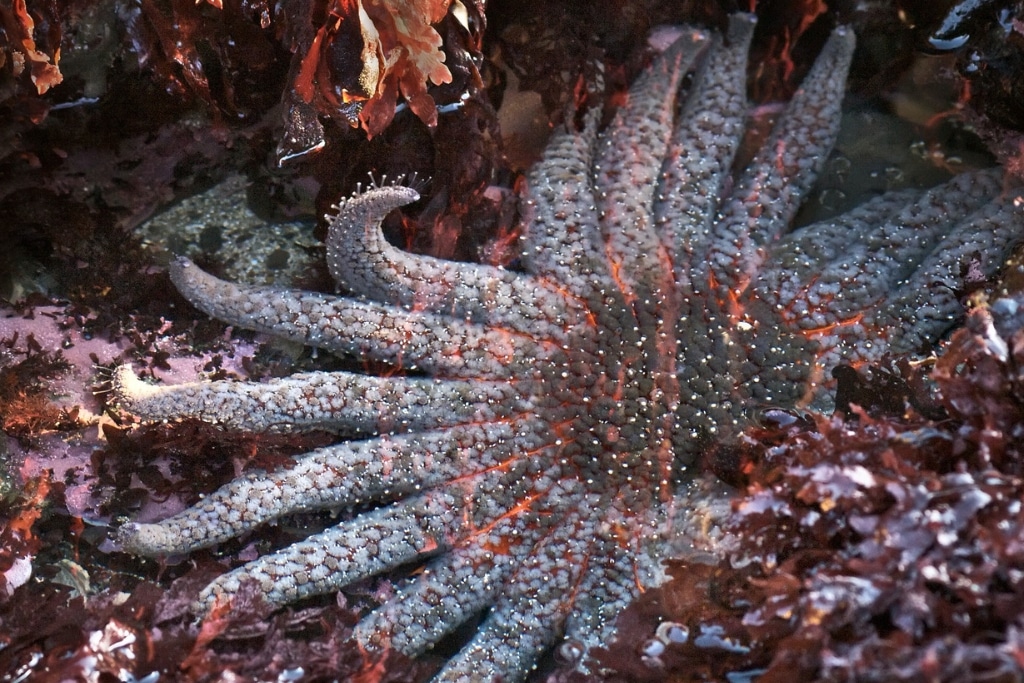
Sunflower sea stars are marine invertebrates. They are classified within the Class Asteroidea and, like all invertebrates, lack backbones. They have a water vascular system, which means seawater courses through their bodies, and their tube feet are animated by water. With age, the number of their arms also increases, with mature sunflower stars observed with as many as 24 arms.

A characteristic that is proving valuable in their recovery is their ability to grow rapidly. At the Sunflower Star Laboratory, a non-profit based in Monterey, California, the sunflower sea star has been recorded to grow to 2.5 centimeters within six months and 28-29 centimeters by two years. At 25 centimeters, the star becomes reproductively active. Reproduction occurs through the broadcast of sperm and eggs into the water.
Reintroduction Studies Underway
Private and public entities, each contributing their own set of strengths and resources, are collaborating in recovery efforts. A breakthrough occurred in 2021, when Friday Harbor Laboratories in Washington state successfully spawned sunflower sea stars from wild-caught adults. Later, Birch Aquarium in San Diego spawned what has become known as the “Cupid Cohort”, a reference to the spawning activity having occurred on Valentine’s Day. The larvae from this cohort were subsequently raised in other labs, including the Aquarium of the Pacific in Long Beach, California; the Academy of Sciences in San Francisco; and the Sunflower Star Laboratory. The work of recovery extends to finding successful strategies to house, feed, and grow the sunflower stars, with the ultimate aim to successfully reintroduce sea stars into the wild.
In 2025, a pioneering field study placed a dozen juvenile sunflower stars reared in the laboratory in an enclosed pod in Monterey Bay. During the five-day study, water samples were collected to evaluate the value of environmental DNA (eDNA) as a tool in endangered species recovery. A second study with 48 laboratory-raised juvenile stars had encouraging results: over the course of four weeks, 47 of the 48 sea stars survived.
Ashley Kidd, Conservation Program Lead and Cofounder of the Sunflower Star Laboratory, has been involved in the recovery efforts, first at the Aquarium of the Pacific and currently at the Sunflower Star Laboratory. Kidd is optimistic about the future because “the action that has been taken, up to this point, has been overwhelmingly collaborative.” The collaboration has involved scientists with a broad range of expertise such as disease ecology, genetics, cryobiology, and developmental larval research.
Kidd is inspired by the efforts: “With every set of questions that we’ve put in front of each other and challenged each other to find solutions for, we have been meeting those answers.”
Featured image: Ingrid Taylar/Flickr.
This story is funded by readers like you
Our non-profit newsroom provides climate coverage free of charge and advertising. Your one-off or monthly donations play a crucial role in supporting our operations, expanding our reach, and maintaining our editorial independence.
About EO | Mission Statement | Impact & Reach | Write for us
Earth.Org
Free, non-profit and independent environmental journalism.