Grounded in binding international law, the ICJ advisory opinion is set to spark a chain reaction that accelerates climate litigation on a global scale.
—
The International Court of Justice (ICJ), the principal judicial organ of the United Nations, delivered its long-anticipated advisory opinion on the obligations of states in respect of climate change on Wednesday.
The judges ruled that government actions driving climate change are illegal and states are legally bound to cut their emissions and compensate vulnerable nations for the harm they have caused.
Presenting the opinion at the Peace Palace in The Hague, the court’s President Yuji Iwasawa said climate change poses an “urgent and existential threat of planetary proportions.”
Earth.Org rounds up reactions to the ruling.
Government of Vanuatu
Hon. Ralph Regenvanu, Minister for Climate Change, Energy, Meteorology, Geohazards, Environment and Disaster Management
This initiative was part of efforts to get the action quicker because we have been in the UNFCCC process for 30 years – we are pulling all international levers possible. We were part of the group that went to ITLOS and got the advisory opinion. We made a submission as part of the Inter-American Court of Human Rights and are pushing for the crime of ecocide to be recognised by the ICC. We are also part of the Fossil Fuel Non-Proliferation Treaty Initiative, where we’re pushing to get more countries on board and trying everything at the international level to speed up action. Today has been a concrete contribution to that.
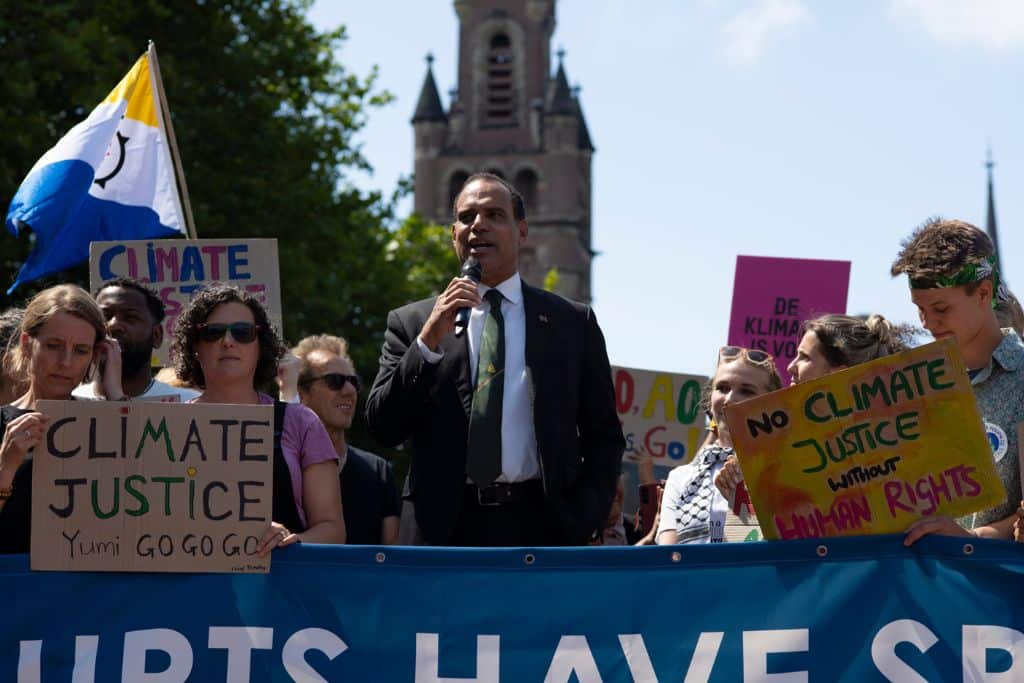
Ralph Regenvanu, Vanuatu’s Climate Change Minister, speaks in front of the Peace Palace in The Hague ahead of the court’s delivery of its advisory opinion on climate change on July 23, 2025. Photo: Teo Ormond-Skeaping/Loss and Damage Collaboration.
Marshall Islands
Ambassador John Silk, Ambassador and Permanent Representative of the Republic of Marshall Islands to the United Nations
The science is clear – and now the law is, too. The International Court of Justice has delivered a unanimous ruling that makes clear that 1.5C is the legally binding global threshold that we have an obligation to stay within. It also told the world that every country is obliged to ensure that they’re putting forward the highest possible ambition in their national climate targets in order to stay within 1.5 – and that we need to scrutinize those targets to make sure they do.
It has also spelled out that those that have benefitted from the exploitation of fossil fuels, for decades now, have an obligation to those of us now suffering as a result. The ICJ also told us today that whether or not a country is a member of climate treaties, they are still on the hook for climate cooperation. If governments fail to do their part, this conclusion from the ICJ makes clear that they will be running in direct contravention to their legal responsibility to prevent harm to the climate.
We are glad that the ICJ has confirmed today what we have long known to be true: there is no basis under international law for countries to lose their maritime zones or their sovereignty as a consequence of climate change related sea level rise. We’re relieved to have this decisively settled, as we confront the immense adaptation challenges that lie ahead in the Marshall Islands.
Pacific Islands Students Fighting Climate Change
Vishal Prashad, Director
By affirming the science, the ICJ has mandated countries to urgently phase out fossil fuels because they are no longer tenable. For Small Island States, communities in the Pacific, young people and future generations, this opinion is a lifeline and an opportunity to protect what we hold dear and love. I am convinced now that there is hope and that we can return to our communities saying the same. Today is historic for climate justice and we are one step closer to realising this.
Members of the Pacific Islands Students Fighting Climate Change (PISFCC) stand in front of the Peace Palace in The Hague ahead of the court’s delivery of its advisory opinion on climate change on July 23, 2025. Photo: PISFCC.
Climate Litigation Network
Sarah Mead, Co-Director
This ruling validates what the majority of people all over the world want and expect from their governments – meaningful climate action. Nearly all countries’ climate plans are falling short of what’s needed to keep everyone safe, which is why more and more people are turning to courts to hold their governments to account. Today, the law stands firmly on their side, confirming leaders do in fact have a duty to protect planet and safeguard everyone’s future.
Center For International Environmental Law
Rebecca Brown, President and CEO
The ICJ’s ruling represents a groundbreaking legal decision in reaffirming the role of international law and global governance in demanding climate justice. At a time when disinformation and political inaction have undermined human rights and environmental protection, this inspired ruling underscores the critical role independent legal mechanisms and multilateralism play in protecting people and the planet. The ICJ’s authoritative interpretation of international law provides clarity on States’ obligations to take meaningful action and hold polluters accountable, ensuring that the rights of the most vulnerable communities are protected, no matter which way the political winds blow.
Sebastien Duyck, Senior Attorney
When a court like the ICJ recognizes new connections between conduct and legal norms, like the idea that failing to curb fossil fuels-related emissions can violate international legal obligations, it does not stop there. That recognition opens the door for further legal claims.
If states have legal duties to prevent climate harm, then victims of that harm have a right to redress. In this way, the ICJ advisory opinion does not only clarify existing rules, it creates legal momentum. It reshapes what is now considered legally possible, actionable, and ultimately enforceable.
Nikki Reisch, Director of Climate and Energy Program
This momentous ruling by the world’s highest court doesn’t just mark a turning point in international law, but a point of no return on the path toward climate justice and accountability. The ICJ made history today with a powerful opinion, recognizing that climate change is a human rights crisis and that the legal duty to protect the climate and to preserve our collective future —firmly grounded in multiple sources of law— requires reckoning with the past. Longstanding duties to prevent environmental harm and protect human rights require phasing out fossil fuels and holding climate polluters to account. No state is immune to climate impacts, and no state is above climate obligations. The Court rejected fossil fuel producers’ attempts to sweep their historical emissions under the rug and signaled the end of the era of impunity for big polluters. The message is clear: there is no carve-out for climate destruction under international law, and there is no legal or technical bar to holding states responsible for resulting harm. The repercussions of this ruling will be felt around the world, in courtrooms and boardrooms, from negotiating halls to town halls, and on city streets. It will serve as a crucial reference for courts facing a rising tide of climate litigation, for communities facing rising temperatures and seas, and for policymakers facing rising calls to make polluters pay. The global majority demanded climate justice, and the World Court responded: the law is on your side.
Joie Chowdhury, Senior Attorney
The world’s highest court has spoken—reinforcing what frontline communities have long demanded: justice means remedy. With today’s authoritative historic ruling, the International Court of Justice has broken with business-as-usual, and powerfully delivered a clear affirmation: those suffering the impacts of climate devastation have a right to remedy and reparation. The Court’s decision lays a stronger legal foundation for climate accountability, offering a vital lifeline to frontline communities and nations, with far-reaching consequences for climate litigation, multilateral negotiations, and campaigns across the world. This victory is a powerful testament to the leadership of Pacific youth, young campaigners across regions, and frontline nations, resolutely advocating for climate justice and the right to a livable future for all. The verdict is out: polluters must pay.
Erika Lennon, Senior Attorney
Today, the ICJ reset the baseline for international climate negotiations, making clear that ambitious climate action is not a political option, but a legal obligation under multiple sources of law. The ruling may help break the gridlock that has resulted in too little mitigation, too little climate finance, and too many broken promises. Countries cannot negotiate their way out of the standards that govern how we treat one another, the planet, and their people. And they cannot meet them with climate plans that do the bare minimum. The time for aligning the climate decisions taken at climate negotiations with international law and best available science was years ago, but the next best time is now. States must take this ICJ ruling and use it to advance ambitious outcomes at COP30 and beyond. People and the planet deserve it.
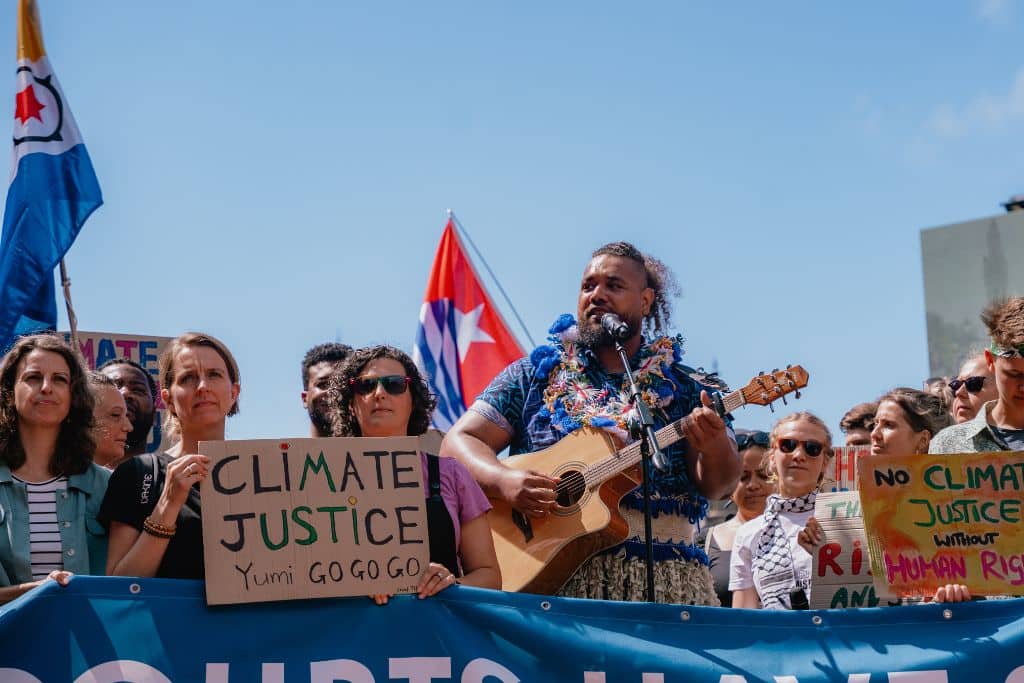
Demonstrations in front of the Peace Palace in The Hague ahead of the court’s delivery of its advisory opinion on climate change on July 23, 2025. Photo: Tengbeh Kamara/Greenpeace.
Grantham Research Institute on Climate Change and the Environment
Joana Setzer, Associate Professorial Research Fellow:
For the first time, the world’s highest court has made clear that states have a legal duty not only to prevent climate harm — but to fully repair it. The ICJ’s advisory opinion affirms that states responsible for climate harm must provide full reparation to injured states, reinforcing the legal basis for climate justice.
This paves the way for more concrete demands around loss and damage, historical responsibility, and the rights of communities facing existential threats. It adds decisive weight to calls for fair and effective climate reparations.
Noah Walker-Crawford, Research Fellow
The ICJ’s advisory opinion brings the weight of international law behind what climate science has shown for decades. By grounding states’ obligations in scientific consensus and human rights law, the Court affirms that governments must not only reduce their own emissions, but also regulate companies to do the same.
This creates a powerful foundation for future claims to hold both states and major emitters accountable.
Earthjustice
Sam Sankar, Senior Vice President of Programs
Every nation on Earth is already experiencing the impacts of a rapidly warming climate, and the worst is yet to come. The ICJ’s opinion is a stern warning to governments around the world, but nobody will be listening in the White House. That’s because the Trump administration’s approach to addressing climate change is to deny that it is happening, including by undoing the Environmental Protection Agency’s ‘endangerment finding.’ It’s terribly sad that at the very same time the rest of the world is moving forward, the Trump administration is trying to take the United States backward.
Yves Lador,Earthjustice’s United Nations Representative
The ICJ’s opinion reinforces the link between international human rights law and climate protection. This is a strong admonishment to all nations of the world that action on climate is not discretionary — the right to a healthy environment includes the right to a healthy climate.
Climate Crisis Advisory Group(CCAG)
Sir David King, Chair and former UK Scientific Adviser
The ICJ’s ruling is not just a legal milestone, it’s a moral reckoning. It confirms what the communities most vulnerable to climate change have long known: the price of foregoing climate action is simply too high.
Governments shouldn’t have needed a court to tell them this. The evidence is clear – we require swift emissions reduction to ensure a safe and liveable future for humanity. Countries must now get on the front foot, and take real, meaningful action by reducing emissions, removing carbon, repairing ecosystems, and building resilience.
Lavanya Rajamani, CCAG member and Professor of Environmental Law at the University of Oxford
The ICJ’s Advisory Opinion on Climate Change is an extraordinary vindication for those who know all too well the global threat climate change poses to life, ecosystems, and the health of the planet.
The court found that States supporting fossil fuels could be acting unlawfully – with consequences for non-compliance including reparations and compensation to affected countries.
UN climate negotiations have struggled over the last three decades to decisively address climate change – but the ICJ’s opinion will empower courts to hold States accountable for weak climate action, and support vulnerable countries in pushing for climate justice through lawsuits and negotiations.
Amnesty International
Mandi Mudarikwa, Head of Strategic Litigation
Today’s opinion is a landmark moment for climate justice and accountability. The ICJ made clear that the full enjoyment of human rights cannot be ensured without protection of the climate system and other parts of the environment. The world’s highest court stressed that states have a duty to act now, regulate the activities of private actors and cooperate to protect current and future generations and ecosystems from the worsening impacts of human induced climate change. This unprecedented opinion will bolster the hundreds of ongoing and upcoming climate litigation cases around the world, where people seek justice for the livelihoods that have been snatched away and the damage caused by major polluters.
Candy Ofime, Researcher and Legal Advisor in the Climate Justice Team
In light of the polluters pay principle, the ICJ established that states’ failure to take action to protect the climate system— including through continued fossil fuel production, licencing or the provision of subsidies to fossil fuel companies—may constitute an internationally wrongful act. Despite big polluters’ suggestion to the contrary, the ICJ recognized that it is scientifically possible to determine each state’s contribution to the climate crisis, taking into account current and cumulative emissions. States, particularly historically high greenhouse gas emitters, must take responsibility and repair the climate harms they have caused and provide guarantees of non-repetition
Fossil Fuel Non-Proliferation Treaty Initiative
Kumi Naidoo, President
This opinion should serve as a clarion call to governments and institutions stalling the fossil fuel phaseout. The ICJ has affirmed what we have long known – that states have a legal duty to protect people and the planet from the impacts of the climate crisis, including taking appropriate action to prevent harm from fossil fuels. This reinforces the urgent need for a Fossil Fuel Non-Proliferation Treaty, which offers a bold, clear path to turn these obligations into concrete, just action. We applaud the Pacific states that made the voices of frontline communities and their calls for climate justice heard on the global stage, and catalysed this historic ruling.
People watch the live stream of the ICJ advisory opinion delivery outside of the Peace Palace in The Hague on July 23, 2025. Photo: Holland Park Media.
Global Climate and Health Alliance
Dr Jeni Miller, Executive Director
The International Court of Justice has delivered a historic affirmation: the climate crisis is a health crisis—and failure to act is a failure to protect life. The Court made clear that fossil fuels are the root cause of this crisis, and that a state’s failure to curb emissions—including through fossil fuel production, subsidies, or exploration—may constitute an internationally wrongful act. This ruling confirms that governments and corporations have a legal duty to prevent further harm, uphold the right to health, and safeguard future generations. From deadly heat and toxic air to disease and displacement, the Court’s message is clear—human health is not collateral damage. Health workers and advocates now have powerful legal backing to demand bold, science-based climate action rooted in justice including a just transition away from fossil fuels, for health and the duty to protect life across all ages and borders.
Climate Action Network International
Tasneem Essop, Executive Director
The era of impunity is over. Governments and corporations now face clearly defined legal obligations to prevent climate catastrophe and make reparations for decades of reckless pollution. This ruling could not have come at a better time—just ahead of the upcoming climate summit—where our demands will be backed not only by the voices of the people and the weight of scientific evidence, but now also by international law. With this ruling as our new compass, we are better equipped to ensure that both people and the planet are protected—and that those who profit from destruction are finally held accountable.
Other Reactions
António Guterres, Secretary-General of the United Nations
I welcome that the International Court of Justice has issued its historic advisory opinion. They made clear that all States are obligated under international law to protect the global climate system. This is a victory for our planet, for climate justice and for the power of young people to make a difference. Young Pacific Islanders initiated this call for humanity to the world. And the world must respond.
As the International Court of Justice has laid out today, the 1.5-degree goal of the Paris Agreement must be the basis of all climate policies under the current climate change treaty regime.
Mary Robinson, Member of the Elders, First woman President of Ireland and former UN High Commissioner for Human Rights
Today, the tables have turned. The World’s highest court provided us with a powerful new tool to protect people from the devastating impacts of the climate crisis — and to deliver justice for the harm their emissions have already caused. This is a gift from the Pacific and the world’s youth to the global community, a legal turning point that can accelerate the path toward a safer, fairer future. The Court has made it clear: governments must hit the accelerator to protect the right of present and future generations to a safe climate — and that includes reigning in corporations and financial actors. The end of the fossil fuel era is coming, and today marks a major milestone on that journey.
Harj Narulla, Barrister, Doughty Street Chambers
Today the International Court of Justice has put corporations and the fossil fuel industry on notice. States will have to drastically cut their emissions to comply with their obligations under international law, which can only happen if they regulate high emitting companies.
Elisa Morgera, UN Special Rapporteur on Climate Change & Human Rights
Today, we’ve entered a new era of climate accountability. The world’s highest court has made it clear: climate-harming activities violate international law and people’s rights. Governments must cut emissions to protect people’s lives and they must provide redress for the damage they’ve already caused.
The right to a clean, safe, and healthy environment is inseparable from the right to life, health, and dignity. The court’s ruling reflects this truth.
The path for big emitters is clear: act now to phase out fossil fuels, support affected communities, and align national laws and finance with international obligations.
Our non-profit newsroom provides climate coverage free of charge and advertising. Your one-off or monthly donations play a crucial role in supporting our operations, expanding our reach, and maintaining our editorial independence.
Martina is a journalist and editor with experience covering climate change, extreme weather, climate policy and litigation. At Earth.Org, she curates the news section and multiple newsletters. She singlehandedly manages over 100 global contributing writers and oversees the publication's editorial calendar. Since joining the newsroom in 2022, she's successfully grown the monthly audience from 600,000 to more than one million.
Before moving to Asia, she worked in Vienna at the United Nations Global Communication Department and in Italy as a reporter at a local newspaper. She holds two BA degrees - in Translation Studies and Journalism - and an MA in International Development from the University of Vienna.
Boost this article
By donating us $100, $50 or subscribe to Boosting $10/month – we can get this article and others in front of tens of thousands of specially targeted readers. This targeted Boosting – helps us to reach wider audiences – aiming to convince the unconvinced, to inform the uninformed, to enlighten the dogmatic.