


A new beehive design could help protect colonies from the growing threat of extreme storms and flooding, as bee populations continue to decline globally.
—
In late October and early November, news outlets were filled with all-too-familiar scenes, as images of the devastation caused by Hurricane Melissa were shared from the Caribbean. Countless destroyed homes, massive flooding and blocked roads left vital services at a standstill. Among those impacted was a small but critical population: bees. In the aftermath, reports revealed that thousands of hives were destroyed. With the storm uprooting trees and plants, and crops completely flooded, colonies have since been left with limited access to pollen, putting billions of bees at risk of starvation.
As storms and flooding grow more frequent and destructive, what happened to bees in the Caribbean is becoming a common occurrence for bee populations around the world.
A Determined Man Searching for a Solution
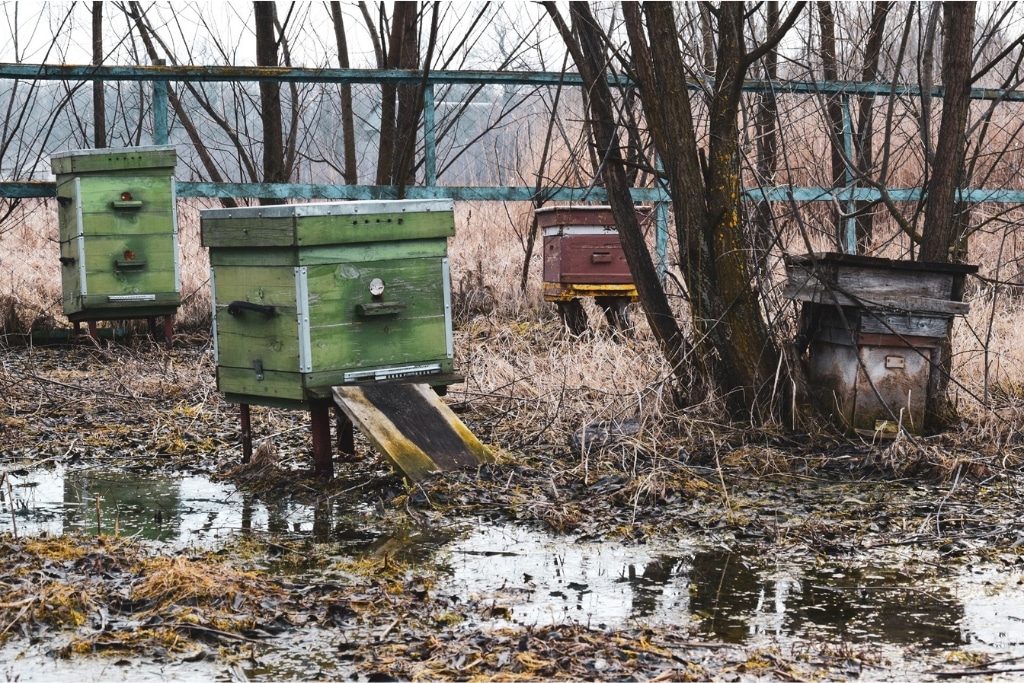
One afternoon in 2023, Konrad Borowski was watching a documentary with his mother when a particular story captured his attention: a beekeeper in the Philippines who had lost 200 beehives overnight due to flooding. The impact was devastating – not just for his family but also for the surrounding community that relied on pollination for farming. Spurred to action by what he had witnessed and fueled by copious amounts of caffeine, Borowski searched for existing solutions to this problem.
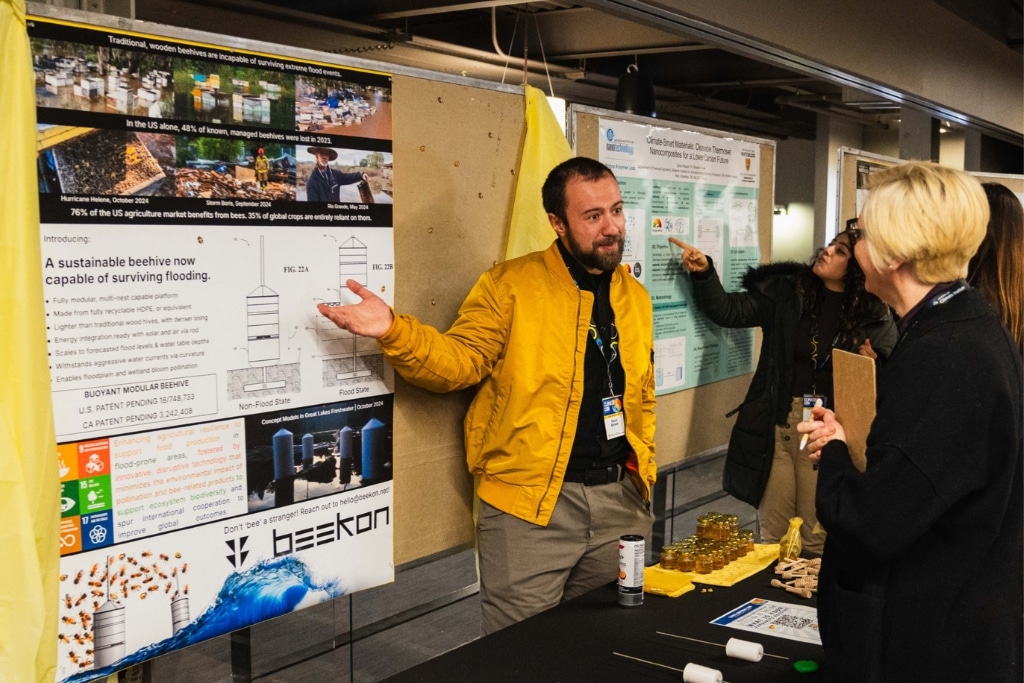
His background in mechanical and systems design led him, a week later, to an initial draft of a computer-aided prototype. From that design, the Beekon hive was born: a buoyant, modular beehive made from recycled plastic. Think of the hive as a lifebuoy wrapped around a central mast that is secured to the ground, acting as an anchor. When water levels rise, the hive floats, saving the colony from drowning. As waters recede, the hive floats back down to its resting position on the ground.
Unlike elevation platforms or emergency relocation – measures beekeepers currently rely on – the Beekon hive is self-activating, requiring no human intervention after installation.
Traditional Hives Are No Longer Fit for Purpose
Traditional beehives are made of wood, a notoriously poor companion to water. Not only do wooden hives absorb moisture quickly, they create damp conditions that invite pathogens like Varroa mites and hive beetles.
“The stationary wooden beehive has been the standard model for more than 200 years,” Borowski told Earth.Org. “Unfortunately, that standard is no longer capable of withstanding many of the environmental stressors we see today. Most beekeeping happens near agriculture, and most agriculture happens near open bodies of water. As a result, we are facing the potential loss of pollination services to entire ecosystems in a matter of moments.”

This is no understatement. Bees are a critical part of the global food chain. Pollinators support 35% of all agricultural land through pollination, 90% of which is handled by bees. In the US alone, honeybees shoulder around $15 billion worth of agricultural work every year. Without them, growing many of the crops we eat would become too difficult and vastly more expensive.
More on the topic: What Happens to Ecosystems When Bees Disappear?
“There’s this predominant idea, maybe misconception, that pollination just sort of happens,” said Borowski. “But it’s ultimately a service. And like any service – water, power, waste management – it depends on reliable infrastructure.”

The importance of bees extends beyond agriculture. In fact, they are pillars of entire ecosystems. By moving between different plant species, bees maintain plant diversity, essentially ensuring that plants are not inbred. Additionally, many species, including birds, reptiles and other insects, have evolved to eat bees. Others, like the honeyguide and the honeybadger, eat beeswax and honey. If bees disappear, these species lose an important food source, ultimately destabilizing the fragile balance of biodiversity.
The Rapid Decline of Bee Populations
Around 35% of invertebrate pollinators, especially bees and butterflies, are currently at risk of extinction. According to the UN, extinction rates are 100 to 1,000 times higher than normal due to human impact. This crisis is not only about dwindling numbers, but also about declining species diversity. A 2021 study found there was a 25% reduction in bee species reported between 2006 and 2015, despite a 55% increase in recorded observations since 2000. This is a strong indicator that certain bee species may have already disappeared. In Europe, one in 10 wild bee species face extinction, while in North America, one in five pollinators are at risk.
A wide range of human activities and climatic threats are behind declining bee populations. Industrial agriculture is the main culprit, with large-scale land conversion and pesticide use destroying local biodiversity and poisoning entire colonies. Extreme weather events add another layer of disruption. Rising temperatures are pushing bees out of their historical habitats, harsher winters reduce their survival rates and irregular seasons make blooming cycles unpredictable.
“The threats pollinators face really cannot be overstated,” said Borowski. “Last year, more than sixty percent of the managed beehives in the United States were lost, on average. It was just under fifty percent the year before. Varroa mites, pesticides, hormone disruptors, biodiversity loss, a shrinking habitable zone – the list goes on. We are fighting to give our pollinators a first defense against the flooding that threatens to wipe them out, too.”
Designing a Climate-Proof Future for Bees
Low-cost and scalable ideas like the Beekon hive may just be the kind of solution needed for a climate-resilient future. But innovation has not come without its setbacks. Beekon’s first large-scale pilot project planned in Malawi was put on hold after the Trump administration shuttered the US Agency for International Development (USAID) earlier this year. Now, a new large-scale pilot in Nepal is on the horizon, in the hopes of deploying as many pilot projects and formal hives worldwide as possible.
Borowski estimates the design can help protect hundreds of millions of dollars in hive losses each year. He also believes the hives offer a low-cost avenue that can stabilize food-producing regions as climate change intensifies or even introduce beekeeping to regions where this is currently non-viable, including riversides, marshlands and mangroves.

Other emerging solutions could play a similar role. For example, the recent development of an artificial “superfood” for bees thanks to a technology allowing for precise genome editing (known as CRISPR), could be a lifeline for beekeepers. In the aftermath of flooding, when plants may take weeks or months to recover, this yeast – enriched with six essential sterols – could act as a nutritional substitute when pollen is scarce.
While the challenge at hand may feel daunting, innovations like these offer a glimmer of hope that human ingenuity can reverse the damage we have caused. Where we may fall short, nature has its own quiet ways of shifting course. Around the world, studies show that bees are adjusting their behaviors and expanding into new regions to adapt to the growing pressures of our changing planet. As Borowski puts it, “there is no Planet B, but there is a Planet Bee.”
Featured image: U.S. Department of Agriculture/Flickr.
This story is funded by readers like you
Our non-profit newsroom provides climate coverage free of charge and advertising. Your one-off or monthly donations play a crucial role in supporting our operations, expanding our reach, and maintaining our editorial independence.
About EO | Mission Statement | Impact & Reach | Write for us