


In 1976, when some of the previous European records were set, this heatwave would have been “virtually impossible,” researchers at World Weather Attribution concluded.
—

A record-shattering, ongoing heatwave affecting much of Europe would have been virtually impossible just decades ago, proof that human-caused climate change is “unequivocally” to blame, a new analysis has concluded.
Much of northern, western and central Europe is sweltering under a heatwave this week that is shattering temperature records. Red alerts are in place in the UK, Germany, Austria, Switzerland, Italy, Spain and France. The heatwave is the most severe ever recorded in the region, according to the World Weather Attribution research group, which is behing the attribution study.
Attribution studies quantify the effect of human-caused warming on extreme weather events like heatwaves and hurricanes. Scientists analyze observation-based weather and forecast data, comparing how these types of events have changed from past cooler climates to today’s climate, which is approximately 1.4C warmer compared to pre-industrial times.
For this study, researchers compared the ongoing heatwave to 1976 and 2003, which were 1.1C and 0.6C cooler, respectively. In 1976, when some of the previous European records were set, such a heatwave would have been “virtually impossible,” they concluded. Compared to 2003, when the first European heatwave of this century took place, chances of such a heatwave occurring at this time of year were “tens to hundreds times” lower.
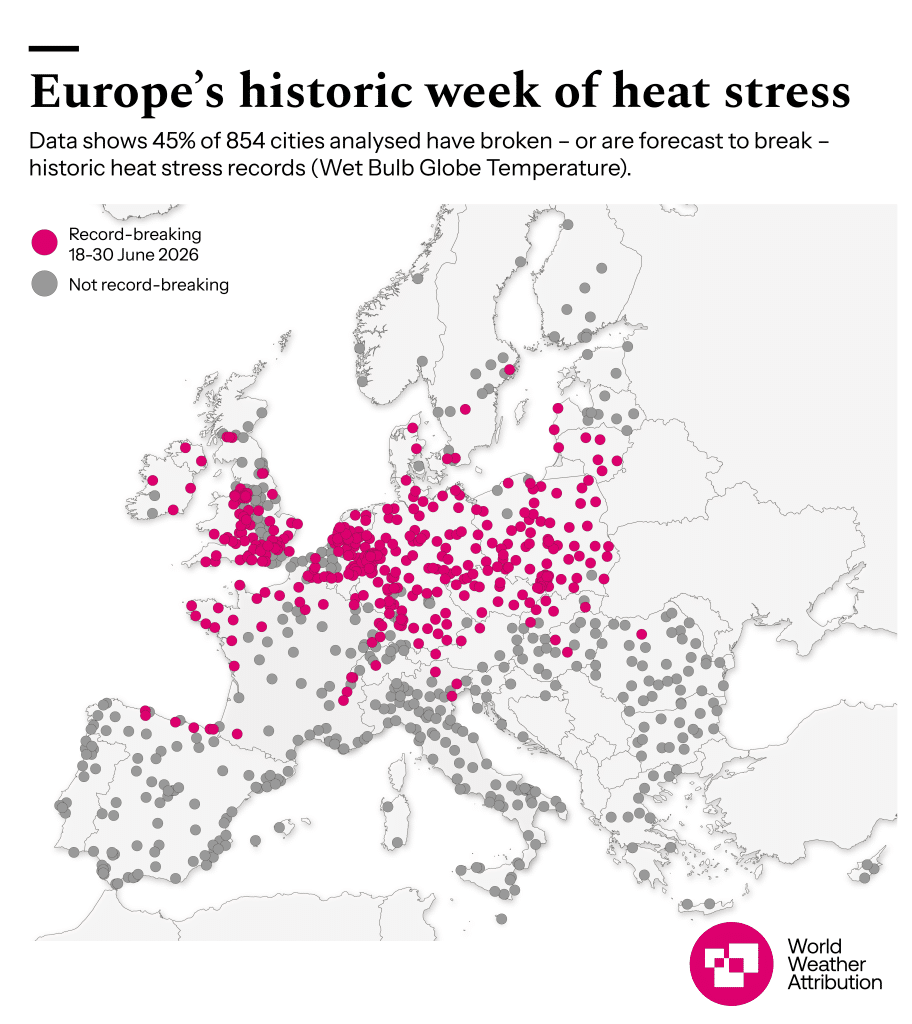
A staggering 45% of 854 cities analyzed across 30 European countries have broken, or are expected to break, their all-time record for wet-bulb globe temperature – a measure of environmental heat stress on the human body that accounts for air temperature and humidity – this week.
Excessively hot and humid conditions can be deadly because they disrupt human thermoregulation – the physiological process that maintains a steady internal body temperature (ideally between 36.5°C and 37.5°C) regardless of external conditions.
In other words, when the wet-bulb temperature breaches 35C – the theoretical upper limit of human adaptability where 100% humidity combines with extreme heat – sweat can no longer evaporate. Once this critical threshold is crossed, the body loses its primary mechanism to cool itself down, leading to rapid, potentially fatal overheating.
An October 2023 study warned that heat and humidity levels will reach lethal levels for hours, days, and even weeks in some parts of the world by the end of the century, making it impossible to stay outdoors.

Researchers also looked at day- and nighttime temperatures recorded during the ongoing heatwave, concluding that both are warming much faster than the global warming rate. The hottest daily temperatures are warming at about triple the rate of global warming; nighttime temperatures at about twice the rate, they found.
High nighttime temperatures are detrimental to human health, as they prevent the body from recovering from daytime heat. This not only disrupts sleep, which can negatively affect physical and mental health, cognitive function, and life expectancy, but it also increases the risk of illness and mortality. A 2020 study by the Chinese University of Hong Kong found that five consecutive “hot nights,” defined as when temperatures rise above 28C (82F), would raise the risk of death by 6.66%.
People without access to air conditioning – a huge proportion of the world’s population – are particularly at risk. While about 90% of households in the US and 60% in China have some sort of air conditioning system, the number is worryingly lower in rapidly warming places like Europe (10%) and India (8%), the most populous country in the world.
Last month, the Climate Change Committee, the UK’s independent climate change adviser, estimated that some 92% of existing homes in the country are likely to overheat during a heatwave, disproportionately threatening those most vulnerable to heat. As heatwaves become more frequent and intense with climate change, authorities must step up cooling in buildings, the adviser said.

Europe is the world’s fastest-warming continent. Here, heat-related mortality has already increased by around 30% in the past two decades, coinciding with a rise in the average temperature. A study attributed nearly 48,000 deaths in the continent in 2023 to extreme heat.
Carolina Pereira Marghidan from the Red Cross Red Crescent Climate Centre urged people to follow local heat advice, seek shelter in cooler spaces and stay hydrated to protect themselves from heat-related illnesses, which can be deadly if not promptly treated. “People in Europe are far more aware of heat risks than they were in the past, but awareness alone is not enough. Many people still live, work, and study in places that are not designed for the temperatures we are now experiencing,” she said.
Featured image: European Union, Copernicus Sentinel-3 imagery.
💡How to stay safe in extreme heat
- 💧Stay hydrated: Drink around two liters of water per day, or about eight glasses. In heat conditions, experts recommend drinking throughout the day and urinating around six to seven times a day, or every two to three hours.
- 🍉Eat nutritious food: Stick to hydrating, fresh food such as watermelon, peaches, berries, grapes, and oranges, vegetables that can be juiced, as well as liquid meals such as soups. Avoid spicy foods, known to make the body sweat. Avoid cooking at home, and opt for the microwave instead of the oven if you have to.
- 💦Exercise responsibly: If you exercise outdoors, take breaks in the shade or indoors to allow your body to cool down faster. Wear sensible attire, such as lightweight, loose-fitting clothing made of breathable fabrics, such as cotton, linen, bamboo, polyester, nylon and microfiber. Hydrate well before a workout and drinking throughout every 15-20 minutes, especially when the physical activity lasts longer than an hour.
- 🌡️Follow local weather services: Check local meteorological services or news channels regularly, as they provide real-time updates and alerts about heat advisories and warnings. Local governments and emergency management agencies often post timely updates on social media platforms as well so keep them monitored.
- 📱Use weather apps: Download reputable weather apps that provide notifications about extreme heat conditions. Many of these apps allow users to set alerts for specific weather events in their area.
- ❗Sign up for emergency alerts: Many cities have rolled out local emergency notification systems or community alert programs that citizens can easily enroll in. These services often send text or email alerts directly to residents during extreme weather events, including heatwaves.
For more tips, check out our article on this topic. To learn more about the risks of extreme heat and how the world is adapting, you can read our 3-part series on extreme heat.