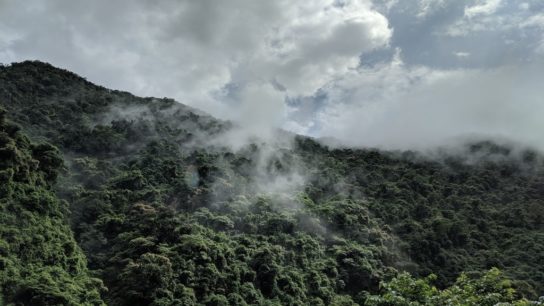


In Patagonia, Chile, the endangered huemul deer is making a steady return. Once nearly lost to farming, hunting, and dam projects, fewer than 1,500 of the country’s national animals remain across the Andes. Rewilding and science, married with cultural pride, are helping save a symbol of Chile and restore balance to one of the world’s most iconic landscapes.
—
By Andi Cross
High on the ridgeline above Lago Cochrane, the forest was bursting with life. A flicker of movement caught our attention amongst the region’s iconic red and gold trees, before the stillness of the forest took over again. We froze, waiting. Daniel Velásquez, the famed ranger leading us, tilted his head and whispered, “That’s Lenga, an endangered huemul.”
Through the branches, a doe stood motionless. Her body tense, ears twitching at the sound of males clicking in the distance. It was mating season for this South Andean deer, and she knew every sound could signal a rival or an unwanted mate. At her side, hidden until he stumbled forward clumsily, was a four-month-old fawn, Calafate – her only priority.
For Daniel, this was a critical moment here in Patagonia National Park, as he had been following Lenga for 10 years. Long enough to know her habits, home range, even her temperament. He had been keeping track of her offspring to create a family tree. “That little one,” he said nodding, without his body moving in any other way to remain as still as possible, “is everything for us.”

Meet the ‘Huemul Whisperer’
The patience it took to get here was anything but by chance, rather months of meticulous planning in the works. Velásquez has been called the “huemul whisperer” for good reason. He has worked these valleys for 14 years, building a strategy of slow, steady tracking that allows him to get close without ever breaking the animal’s trust. Watching him move through the forest, you realize his approach is entirely about respect, a keen awareness of when to pause, when to settle into stillness, and when to become one with the landscape. With him, the deer never bolt and always remain peaceful.
That closeness is key because every individual counts in this National Park. When Velásquez first started working the valley, there were only four females and a single male. The huemul was known as a species clinging to existence by a thread. Today, thanks to years of this rewilding work, there are around 120 huemul in the park, with 10 fawns born in 2025. Velásquez still speaks of them as if each one were irreplaceable. In theory, he is not wrong.

The huemul is Chile’s national animal, emblazoned on the country’s coat of arms alongside the condor. Yet many Chileans have never seen one in the wild. There are only about 1,500 left across their entire range, 70% of them in Chile and the rest in Argentina. Their survival depends on small, isolated pockets like this, where people like Velásquez dedicate their lives to keeping track of individuals the way you might focus on members of your own family.
From Near Extinction to Restoration
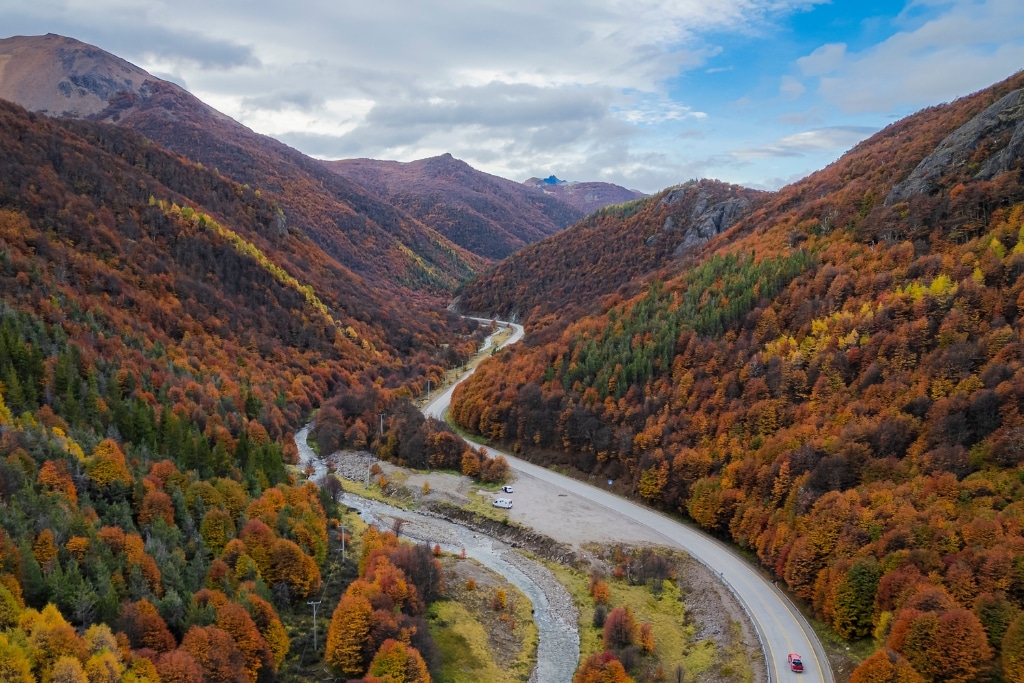
As we stood there, the scene around us said as much about the landscape as it did about the deer. Snow-dusted peaks cut sharp against the horizon. Lenga and ñirre forests known to the area cascaded in bands of orange and green, descending toward turquoise lakes. In the distance, Cerro Kristina rose as a beacon of Doug and Kris Tompkins’ legacy here – the two business people gone conservationists who built and established many of Patagonia’s National Parks. While the valley looked wild upon our arrival, Velásquez explained scars ran deep here.
Not long ago, these rolling grasslands were carved into pastures, grazed bare by cattle and sheep. For nearly a century, this was ranch country. Fences cut across migration routes, exotic grasses replaced native plants, and wild species like the huemul were driven into the steepest, most inaccessible corners just to survive.

Then came a threat that could have erased the valley altogether. In the early 2000s, a massive hydroelectric project called HidroAysén was proposed in Chile’s Aysén region. Five mega-dams were planned along the Baker and Pascua rivers, including infrastructure that would have flooded entire valleys and sent transmission lines cutting through some of Patagonia’s most untouched landscapes. Patagonia National Park, as we know it now, would have been underwater.
The project triggered one of Chile’s largest-ever environmental movements. For nearly a decade, local communities, scientists, activists, and conservation groups fought back with a rallying cry: Patagonia Sin Represas, meaning “Patagonia Without Dams”. In 2014, the project was cancelled. By then, Doug and Kris Tompkins had already begun buying old Estancias in the Chacabuco Valley, rewilding the land, and laying the groundwork for what would become Patagonia National Park.
That is why seeing huemul here was undoubtedly symbolic. This is a valley that went from farmland, to the brink of eradication, to a national park in less than two decades. A landscape once nearly brought to extinction is now being restored, with the iconic huemul stepping back into a home that was almost lost forever.

A Fragile Species
Following Lenga and her fawn higher into the forest, Velásquez pointed out the details most of us would have missed, like when she nipped the sprouts of her namesake, the lenga tree. Or when her hooves had already left a faint trail others would follow, as these deer move through this landscape, shaping it as they go. Huemul are not dramatic or obvious animals. They do not migrate in vast herds like guanacos or clash antlers like northern deer. Their impact is far more hidden, but no less important.
By grazing selectively, they keep vegetation in balance without stripping it bare. By dispersing seeds in their droppings, they give new forests a chance to grow. As prey, they sustain the region’s apex predator, the puma, making up as much as 10% of its diet. In that way, every huemul is a node in the larger web, holding the ecosystem together in ways most people will never see.
And yet, their fragility is startling. Huemul are not competitive with livestock, do not devastate landscapes, and actually, do not demand much of the ecosystem at all. What threatens them is our very own nature as people. Decades of land conversion, cattle, wild dogs, trophy hunting, climate change, even getting hit by cars – as there is only a single paved road through Patagonia National Park – are risk factors. In other parts of Chile, invasive red deer outcompete them, pushing huemul out of the habitats they once dominated.

This is why Velásquez speaks of each sighting with such weight. Every individual that survives here in these high-alpine regions, as well as in the cold Andes valleys, strengthens the chain. They are built for the mountains—smaller and stockier than their northern relatives, with thick coats against the cold and a talent for climbing sheer slopes that would leave most hoofed animals stranded. Their antlers, unlike those of red deer, branch in simple forks. Their coats shift with the seasons, from rich brown in summer to a shaggy, grayish hue in winter. And while they might look unassuming, they are finely tuned survivors of some of the harshest landscapes on Earth.
Preferring these challenging terrains, every fawn that grows into an adult is a victory against all odds. And every stretch of protected forest, steppe, and mountainside gives them the space to keep doing what they have always done: ensuring the ecosystems they occupy are pulsing with life.

While Patagonia National Park on the whole is where the huemul are finally starting to rebound, Cerro Castillo National Park is where their survival still feels most precarious. The population here is tiny, tucked into dense lenga forests and steep ravines beneath the jagged mountain spires that give the park its name. Huemul are notoriously shy, and once they are disturbed, they do not return to the same spot. In a landscape cut by roads, cattle, and tourism, that instinct makes them especially vulnerable.
Setting an Example in Conservation
This is why Cerro Castillo is also home to a groundbreaking experiment managed by the Rewilling Chile team – the country’s first huemul rehabilitation center. Just two kilometers outside the park, the facility was built to rescue injured or displaced deer and give them a chance to recover without being sent far from their habitat. It is a modest set up, featuring two enclosures, one for close monitoring and another larger space where animals relearn how to be wild before release. At any given time, it might only house half a dozen individuals. But for a species this rare, they all count.

The goal with this facility is to stabilize Cerro Castillo’s fragile herd, and eventually stitch it back into a larger “corridor of huemul” that runs across Chile and Argentina. Right now, the populations are like scattered islands. If conservationists can protect the pathways between them which include river valleys, forested slopes, and alpine meadows, then huemul might once again move freely through the Andes as they once did.
What makes this even more remarkable is how fast it is all coming together. Just a decade ago, Cerro Castillo’s huemul were little more than an afterthought. Today, thanks to Rewilding Chile and its collaborators, Chile’s National Forestry Corporation and Agriculture and Livestock Service, as well as other local partners, this small center is positioning itself as a lifeline for the rarest large mammal and most endangered deer in all of South America. If the endeavor proves successful, it could become the model for protecting huemul across the entire southern cone.

But even as these projects offer hope, climate change is reshaping the story in ways no one can fully predict. In Velásquez’s lifetime, the valleys he grew up in have shifted. Snowfall is lighter, streams are drying, and glaciers that once fed the rivers are retreating year by year. “The deer venture further now than they ever have before just to drink,” he told us. “Some streams they always used in the past are gone. The park helps, but nature is changing faster than we can manage.”
For the huemul, those changes are a double-edged sword. Warmer conditions are erasing some of their lower-altitude habitat, exposing them to more predators and to people. Yet higher up, in the alpine zones that were once locked under snow for most of the year, new patches of vegetation are appearing. In theory, these could become fresh grazing grounds and a refuge if the deer can adapt. Some biologists even argue that climate change could expand the huemul’s range, giving them access to plants that were once out of reach.

Opportunity can not erase risk in this scenario. Moving higher brings harsher conditions and fragmented terrain. Staying lower means greater exposure to pumas, dogs, cattle, and roads. And unlike fast-breeding animals, huemul have no margin for error. With a lifespan of about 14 years and only one fawn per year, recovery is painfully slow, magnifying every loss.
It is why Velásquez insists on seeing rewilding as a restoration practice just as much as a long-term resilience powerplay. Protecting the huemul’s range presents options, and the ability to shift with the climate rather than be trapped by it. “We cannot stop the glaciers from melting at this rapid pace,” he went on to explain, eyes still locked on the deer. “But we can give the animals a better chance to survive what is coming next.”
Featured image: Ross Moore.
—
This story is part of an editorial collaboration between Earth.Org and Edges of Earth Expedition, a team dedicated to uncovering powerful stories from the frontlines of the climate crisis. Leading the charge is Andi Cross –an expeditionist, impact strategist, writer, and SSI divemaster –who has spent over two years traveling the world, immersing herself in the realities of environmental change.
This story is funded by readers like you
Our non-profit newsroom provides climate coverage free of charge and advertising. Your one-off or monthly donations play a crucial role in supporting our operations, expanding our reach, and maintaining our editorial independence.
About EO | Mission Statement | Impact & Reach | Write for us