

In the fight to reduce plastic waste, one of the most difficult challenges to crack is how to unleash the potential of reuse – the “middle child” of the three Rs. How can restaurants, bars and cafés migrate from cheap, disposable cups and dishes to durable, reusable items?
—
With the 2024 launch of new regulations on plastic waste in places like the European Union, Hong Kong, and Toronto, Canada, local municipalities have spent the past year scrambling to find a solution for single-use plastics like to-go cups and bowls. Increasingly, these communities have broadened their view beyond recycling, and have begun to explore platforms for reusable items.
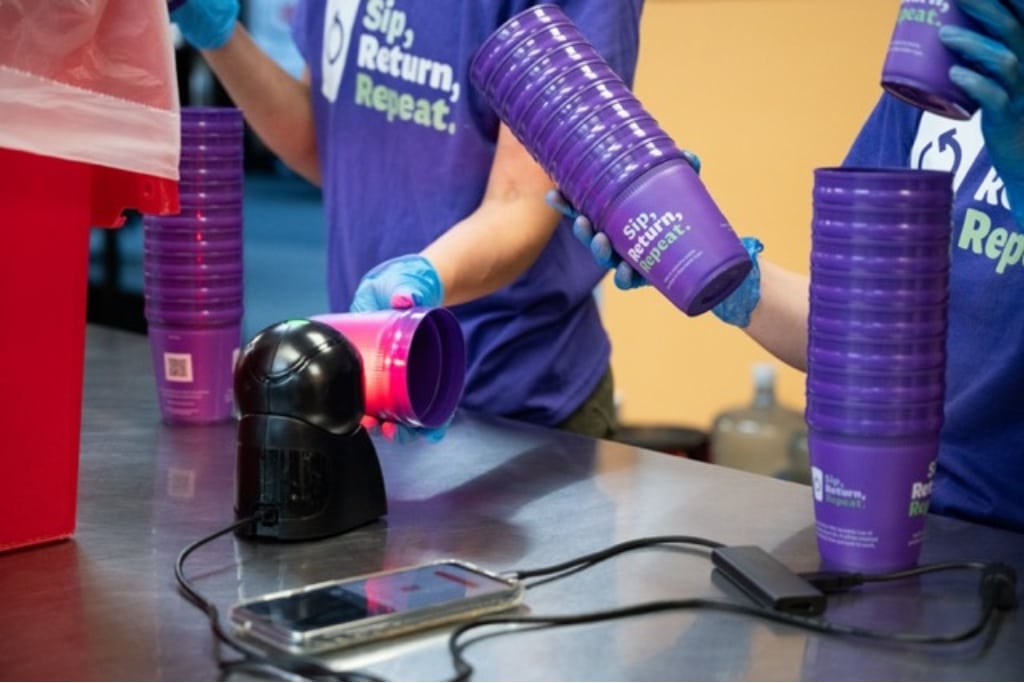
Regulation and cost are the major drivers for the shift. “Compostable biodegradable plastics are always more expensive, so reuse can save against them,” Jonathan Tostevin of Muuse told Earth.Org. Muuse is one of a new generation of businesses that set up turnkey reuse systems for businesses and communities seeking to transition away from single-use plastics. Its “Reuse as a Service” system, or RaaS, includes the provision of durable cups and bowls, collection and sanitation, and returns, which at Muuse are tracked through unique QR codes.
Through its “Reuse as a Service” (or RaaS) platform, Muuse provides reusable cups and bowls that it tracks through unique QR codes. The company – which currently operates in Singapore, Hong Kong, the US and Canada – is also in charge of collecting and washing the cups, before redistributing them to the respective businesses.
From Recycling to Reuse: A Regulatory Shift
Tostevin emphasized that while some municipalities or companies choose to implement a system for reusable food items because they want to act more sustainably, most do so “because of government intervention.”
For Dana Winograd, Executive Director of Hong Kong-based Plastic Free Seas, tackling the growing crisis arising from single-use packaging waste from take-aways is possible. “The growing popularity of reusable tableware systems means that it is getting easier to reduce waste from takeaways,” Winograd told Earth.Org.
But blanket requirements for reusables can have unintended consequences, unless there is a well-designed system in place to facilitate collection, washing, and delivery back to the restaurant. In its absence, a retailer will tend to sell “reusable” containers that are then used just once, before piling up at home or being disposed of. João Jalé, Business Manager at Tomra Reuse, a RaaS provider based in Norway, emphasized the importance of such mechanisms: “A cup may be approved as reusable, but without a system, we consider it single-use,” he told Earth.Org.
The ‘Closed Loop’ Success Story
To ensure the items are actually reused, experts have identified a number of factors that will help retailers and customers get the most bang for the buck. One of them is to choose the right location. “Our focus is more on the contained locations, because that’s where it works best,” said Tostevin. One key opportunity for reusable systems is at large-scale events. Last year, Muuse implemented their reusable cup and tableware system at Coldplay concerts at the massive Rogers stadium in Toronto, Canada, serving 50,000 people over four nights – most of whom would have otherwise used and disposed of at least one single-use item.
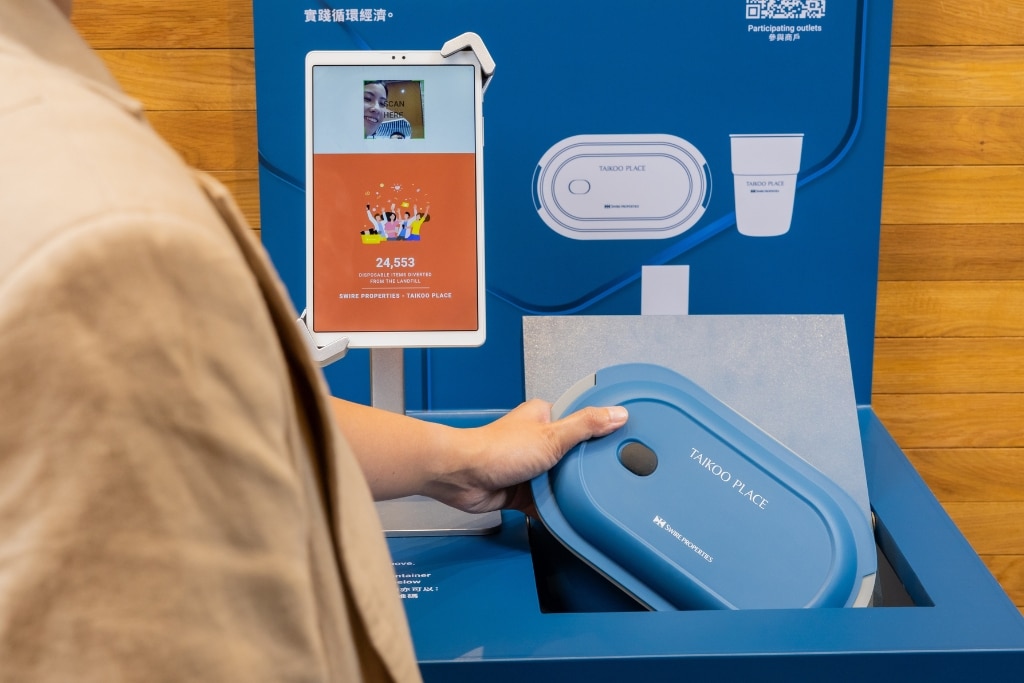
Concentrated restaurant and bar districts, especially those with a single property developer, also make good locations for reusable systems. For example, the Muuse platform is now in place in the Sentosa tourism area of Singapore, where smart return stations take back the items, and at several Swire Property developments in Hong Kong.
Focusing on such locations can also address the challenge of administering the system. “When we started, we built an app, and the consumer had to download the app at the point of sale,” said Tostevin. “It took up time that neither consumer nor service staff had. We pivoted into ecosystems, so you could [return the item] outside the cafe or restaurant, or in the school space. The reuse space is recognizing that there’s still too much friction with an app. Ideally, it can be done without an app altogether, in open environments.”
Case Study: Cleaning Up Lisbon
In the historic Bairro Alto neighbourhood of Lisbon, Portugal, nearly 200 establishments are packed into just a few narrow streets. Until recently, tourists and locals were disposing of nearly 25,000 single-use cups per day. “We had a big problem with cups you could use only once and then throw them away, especially in the hot summer,” Pedro Pinto, the owner of local bar Mojito, told Earth.Org. “The streets had become ugly, and the cups were thin plastic. People could cut themselves.”
To address this, the city’s government formed a partnership known as CopoMais, along with Tomra Reuse and AHRESP, the Portuguese national hotel and restaurant association. Participating bars collect a deposit when they serve drinks in a standard reusable cup, and the deposit can be redeemed at any collection machine. Four machines have already been installed at private locations in the bar district, with 21 more expected to be added – including a number of public machines that will be installed starting in March.
During this “ambassador” phase of the project, 36 bars and restaurants began using the reusable cups to serve customers, a number expected to reach 200 when the system is fully up and running. The initiative solely focuses on cups, which come in four sizes – there is currently no plan to introduce bowls or other tableware.
The project leaders recognized that ease of use was essential to driving customer participation. In the CopoMais system in Lisbon, the €0.50 (US$0.58) deposit is returnable to anyone who puts the cup into a collection machine, and no app is required to get the deposit back; the money is refunded to whatever card or digital wallet is tapped on the machine, usually within two days.

Another point to consider is the placement of collection machines, which typically requires approval, according to Jalé. “For example in the archaeology of Lisbon, every time you take out a stone there could be a Roman ruin underneath. But if you have a low number of machines, it’s not convenient. If the machine is 300 meters away, it’s too far,” he said. “We map by plot. We put the machine in the places where people go in and out of the bar area. We want these people, when they go home, to have a machine within 100 meters.”
Logistics, Hygiene, and Impact
Steve, an English patron at one of the participating bars, agrees. “The reality is that the [collection] bin would have to be in passing. I know me, I’d just be collecting the cups at home, although I might eventually return them all to get the deposit back,” he told Earth.Org. “However, I’d probably be more inclined to drink here because they have this system. It’s important to be eco-conscious.”
Once the cups are collected, they must be washed, sterilized, and returned to the bars and restaurants. While some bars wash and dry their own cups, a centralized washing service that validates the quality, and ensures that there is no mold or marks, helps offer quality assurance. “The standard for washing reusables falls under the same as tableware,” explained Tostevin. “There are no reusable hygiene standards that are globally applied, so in most markets we adhere to international best practice, national standards.”
This may change in the future. PR3, an organization that promotes reusable systems by developing standards to undergird the growing reuse economy, has developed a standard for container washing, inspection, and packing for distribution. Under the CopoMais system, cups are collected regularly and taken to an offsite location for washing, and then re-distributed to the bars.
The most important question is whether the systems achieve their goal of avoiding plastic waste. Muuse claims that its platform has already diverted 1.5 million single-use items from landfill (one reusable item equals one single-use item avoided), and has avoided 175,000 kilograms of greenhouse gas emissions in the process.
Even without considering their environmental aim, such systems can have unexpected benefits. “I’m a selfish man – normally I have to clean a five meter radius around my door every day, but if I have a reusable cup that can be returned for a deposit, people will do that for me,” said Pinto, the Lisbon bar owner. “And with that, I save money and plastic. From an economic perspective it’s really nice.” Additionally, for municipalities required to report about waste and cup use, systems like CopoMais can provide dining establishments with the data they need.
It remains to be seen how these projects will scale. “To implement a new system, to change a behavior, it’s not easy. We’re still learning,” Jalé said.
This story is funded by readers like you
Our non-profit newsroom provides climate coverage free of charge and advertising. Your one-off or monthly donations play a crucial role in supporting our operations, expanding our reach, and maintaining our editorial independence.
About EO | Mission Statement | Impact & Reach | Write for us