

The underground world of fossil diving along the southeastern coast of the United States hosts legions of divers with a passion for recovering ancient shark teeth – some belonging to the extinct and formidable megalodon. Beneath murky riverbeds, these fossils serve as time capsules, offering critical insights into past marine ecosystems and the climate shifts they faced.
—
There is something both primordial and mythic about the Eastern Seaboard of the US that often goes overlooked. Stretching over 2,300 miles from the rocky headlands of Maine to the tropical reefs of the Florida Keys, this coastline has shaped the identity, ecology, and economy of the country. It is a region where shifting sands meet industrial skylines, where colonial cities cling to changing coastlines, and where rivers flow holding centuries of mystery.
The Atlantic Coast is the birthplace of the American experiment and with it are the scars of its most bitter conflicts. It is where rising sea levels now threaten colonial harbors, and where biodiversity hangs in the balance between conservation and development. Yet for all its history and vulnerability, the East Coast is also a place of persistent beauty. From salt marshes and cypress swamps to coastal plains and barrier islands, it is a compilation of the country’s greatest natural systems that have evolved over millions of years.

The state of South Carolina is a standout among the stops along the coast, both culturally and ecologically. Spanish moss drips from live oaks like silver lace, and the air carries a heavy, humid hush that makes time feel so much slower here. The landscape is made up of estuaries, tidal creeks, and sprawling marshlands, creating a web of rich and productive ecosystems in all of North America.
This is a place known for its southern charm and iconic porches, but also its layered and complex histories. From the Gullah Geechee heritage that runs along the coast to the lingering shadows of slavery and subsequent Civil War, the imprints of which are tied to the land itself. Charleston, with its pastel facades and cobblestone streets, has become a strange symbol of both complication and simplicity. But just beyond the city limits you will find another, much lesser known story.

Beneath what seems like endless murk and silt are traces of something prehistoric. The Lowcountry, once submerged under ancient seas, is home to one of the richest fossil beds in the US. What appears at first glance to be a sleepy stretch of southern riverbank is, in fact, a portal to the Miocene and Pliocene epochs – times when mastodons roamed on land and megalodons ruled the seas. And it is in these waters that explorers are uncovering its long-forgotten beginnings.
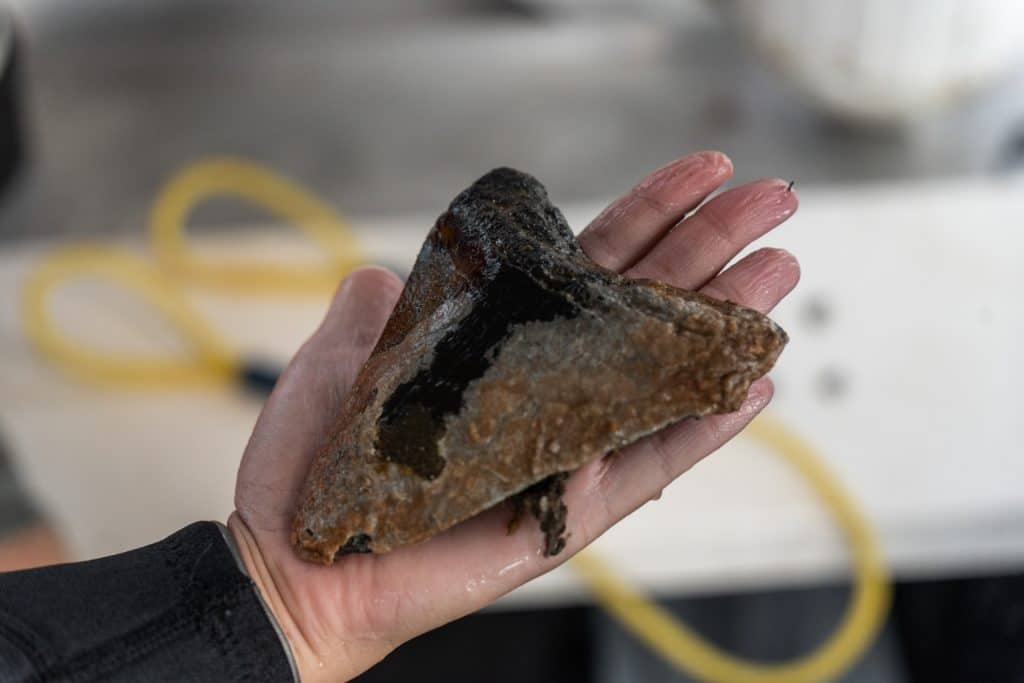
Here, fossil diving is an unlikely effort among the small yet passionate diving community — equally addictive due to the adventure, science, and for some, the obsession. It is not uncommon to descend into the tannin-stained waters of the Cooper or Wando Rivers and emerge with relics of ancient life: whale vertebrae, the teeth of extinct dolphins, fragments of mastodon tusks. And perhaps the most awe-inspiring of them all: the jet-black, palm-sized megalodon teeth.

According to the Natural History Museum, these relics date back between 23 million and 3.6 million years ago, a window of time during which the megalodon (Otodus megalodon) reigned as the apex predator of prehistoric seas. Often hailed as the largest shark to have ever lived, it was capable of reaching estimated lengths up to 24.3 meters (79.7 feet), nearly the length of two school buses.
Recent reconstructions suggest its body may have been longer and leaner than the previously assumed great white-like silhouette, giving it the endurance and hydrodynamics to cruise vast distances in search of prey. What makes this hard to assess is the fact that no megaladon skeleton has ever been found, as the shark is made up of cartilage instead of bones. This new body model also implies an elongated digestive tract, allowing for extended nutrient absorption — a key adaptation for an animal that likely consumed everything, from dolphins to humpback whales.
Its bite force, estimated at over 180,000 newtons, makes it one of the most powerful predators in Earth’s history. Fossilized whale bones bearing cut marks from megalodon teeth and, in some cases, broken teeth embedded in bone, offer grisly but compelling evidence of its hunting behavior. But despite their fearsome reputation, the teeth found today can be considered “climate fossils”.
Embedded in sediment for millions of years, their chemical composition can tell scientists about ancient ocean temperatures, prey availability, and marine biodiversity patterns during the Miocene and Pliocene epochs. Every fossilized tooth can serve as a data point, and can even link these past extinctions to modern-day climate threats.
The demise of the megalodon itself is said to be caused by a cooling planet, habitat loss, and competition with emerging predators like the great white shark, making it something of a cautionary tale. It is proof of what happens when ecosystems change faster than species can adapt. Its fate demonstrates that even the top of the food chain can disappear when ocean conditions shift, leaving us with an unfortunately sobering thought in our current era of warming seas and biodiversity loss.
Diving for fossils along the South Carolina coast is less a leisurely sight seeing activity, and more an act of endurance that tests patience and raw nerve. Beneath the surface, the rivers are dark, fast-moving, and incredibly unpredictable. Visibility often drops as close to zero as it gets, with divers relying on tactile memory rather than sight, navigating mainly by feel. It is not uncommon to be inches from a find, only to miss it. These relics are often buried under inches of soft sediment or wedged between rocks so subtly that only the most practiced hands would detect the difference between fossilized tooth and river rock.

The environment itself is a gauntlet, with tides shifting somewhat unpredictably to the untrained diver. Boat traffic above is constant, with many dive sites positioned alarmingly close to commercial shipping lanes, or tucked under active piers and docks, where the hum of engines and the pull of currents add additional layers of risk. Divers surface with tangled lines, scraped knuckles and, in some cases, do not surface at all. Yet, this is the heart of one of the most productive fossil grounds in North America, so there are always dive teams submerging to see what they can pull from depth.
Few venture here without experience, and fewer still without guidance. In Charleston, the tight-knit professional team of Carolina Dive Locker has emerged as stewards of this submerged fossil world. Led by Jeffrey Eidenberger, a US Navy veteran and SSI Instructor Trainer, and supported by a crew of ex-military divers, master scuba instructors, captains, and technical experts, this operation is a far cry from casual weekend hunts. Each expedition for this team is heavily planned down to the detail, with tide tables checked, boat routes charted, emergency gear prepped, and every diver briefed on contingencies.
Once they are back on shore, they continue their work topside with logging, mapping, and post-recovery analysis to see if they have found new fossil beds, or if they should keep exploring the ones they already know about. Over time, this has produced a living fossil archive that shows up as a crowd-sourced, citizen-scientist dataset. While informal, it holds surprising value for understanding paleo-distribution, ancient migration patterns, and the shifting boundaries of prehistoric coastlines.
These fossils can find their homes and purposes in several ways, like landing in regional museum collections, contributing to academic research, or helping refine dating models for local sediment layers. But more often, their impact is more unassuming — and even a bit more personal. Divers describe a sense of reverence when they unearth a 10-million-year-old tooth, once belonging to a colossus of yore. Some even go as far as to call it “time travel”, others just call it “grounding.”

The crew’s ability to locate these fossil beds with such precision is thanks in large part to side-scan sonar, a technology originally developed for naval and underwater surveying purposes. Mounted on a small boat or towed behind it, side-scan sonar emits acoustic pulses (or “pings”) down toward the riverbed in wide, fan-shaped beams that travel out to both sides. These sound waves bounce off the bottom and return to the sensor, which then converts the echoes into an image.
Unlike traditional sonar, which looks straight down and is primarily used to measure depth, side-scan sonar casts a wide, fan-shaped beam to either side of the vessel, producing detailed, high-resolution images of the riverbed. It shows what is beneath the boat and reveals texture, contrast, and anomalies across large swaths of terrain. Hard surfaces like rock shelves or exposed fossil beds show up as distinctive shapes, cutting sharply against the softer sediment around them.

“Areas where erosion has cut into ancient layers, revealing potential fossil deposits, can be identified by their rougher topography. They often appear as striations or exposed ridges,” said Jesse Lang, a scuba instructor at Carolina Dive Locker and ROV (remotely operated vehicle) operator. “When deployed, side-scan surveys can map extensive underwater landscapes in a fraction of the time it would take to manually explore them.” This precision means divers do not need to search blindly. Instead, they work with real data, which translates into safer, more focused dives.
For this Charleston-based crew, sonar has become a critical lifeline. It is typically operated by Lang and his business partner, George Diaz, who have expertise in deploying and decoding the data from these types of highly-specialized tools. Once the sonar points to a promising site, the team drops anchor, suits up, and drops in, guided by this ghostly sonar imprint still glowing on the boat’s console.

These ancient teeth come from a time when sea levels were higher and coastlines extended further inland. The Atlantic’s ecosystem back then looked radically different. By recording where fossils are found down to their depth and sediment layer, scientists and citizen divers help reconstruct these prehistoric marine environments. The layers act like climate archives, capturing long-term changes in ocean chemistry, temperature, biodiversity, among other key details, and offer valuable context for today’s climate models.
For example, a 2025 study demonstrated that modern shark teeth hold the secret to project future ocean acidification. The results showed erosion, dulled serrations, and weakened structure – damage that could have threatened sharks’ ability to feed and survive in more acidic seas. These teeth, often seen as impervious, still are not impervious to the impacts of a changing ocean.
Fossil diving not only allows us to uncover the past in preparation for the future, but it further connects citizen scientists, divers, and researchers in a shared mission to preserve these marvels of ancient Earth. In Charleston and across the southeastern US, divers logging their finds and mapping fossil beds are building a powerful web that tells the story of a coastline that has always been in flux, and one of an ocean that remembers everything.
Featured image: Adam Moore.
—
This story is part of an editorial collaboration between Earth.Org and Edges of Earth Expedition, a team dedicated to uncovering powerful stories from the frontlines of the climate crisis. Leading the charge is Andi Cross –an expeditionist, impact strategist, writer, and SSI divemaster –who has spent over two years traveling the world, immersing herself in the realities of environmental change.
This story is funded by readers like you
Our non-profit newsroom provides climate coverage free of charge and advertising. Your one-off or monthly donations play a crucial role in supporting our operations, expanding our reach, and maintaining our editorial independence.
About EO | Mission Statement | Impact & Reach | Write for us