
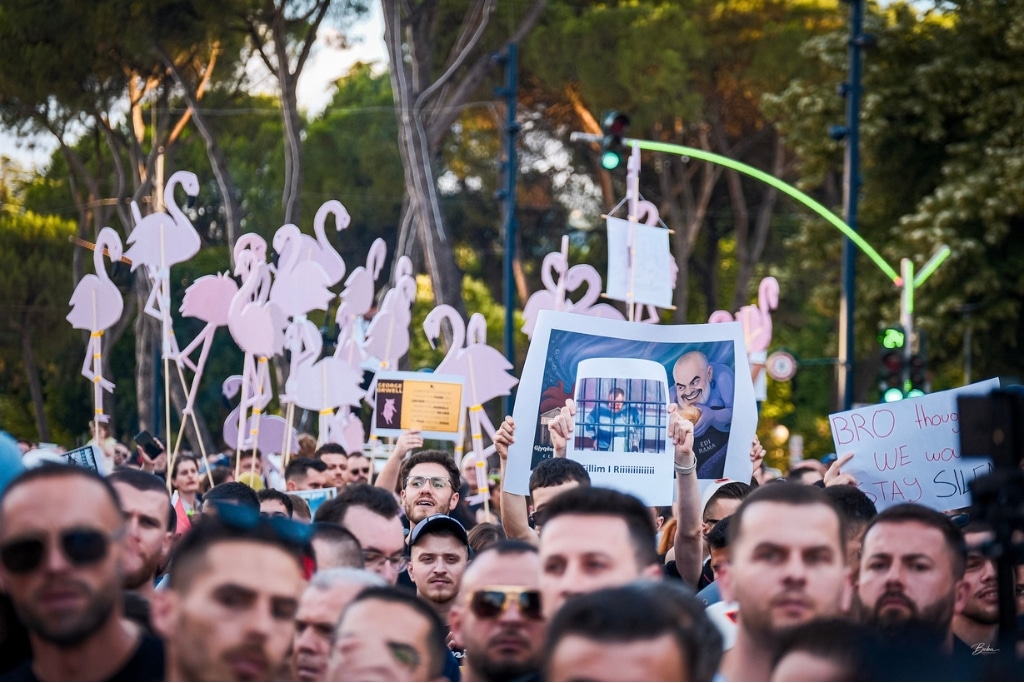
Construction of the resort, which is backed by investor Jared Kushner and will include up to 10,000 hotel rooms and villas, began in April after the government fast-tracked its approval and updated environmental laws to allow five-star hotels in protected zones.
—
Protests continued in Albania on Monday against an elite tourism project backed by US President Donald Trump’s son-in-law, Jared Kushner, in a protected wildlide zone.
Every day for more than a week, thousands of people took to the streets of the capital Tirana and on the southern coast, where the resort has been proposed. Protesters are calling on the government to halt work on the $1.6 billion government-approved development project, which incorporates protected wetlands and coastal habitats as well as the uninhabited island of Sazan in the Mediterranean, opposite the heel of Italy.
The coastal area and surrounding waters provide crucial habitats to over 200 bird species and over 70 endangered species such as the Mediterranean monk seal – one of the world’s most endangered marine mammals, the sea turtle, and the flamingo. Pink flamingos have become the symbol of the protests, leading some to nickname it the “Flamingo Revolution.” The area also sits on the Adriatic Flyway, making it a crucial stopover site for millions of migrating birds between Europe and Africa each year.
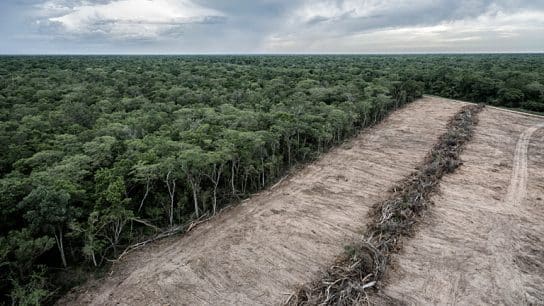
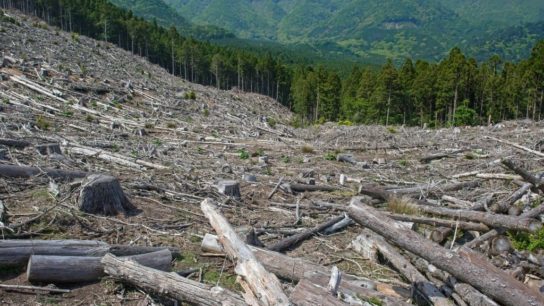
“Yet, forests, dunes, and coastal habitats are being cleared by heavy machinery—without transparency, proper consultation, or accessible environmental permits,” WWF said in a statement.

Construction of the resort, which will include up to 10,000 hotel rooms and villas, began in April after the government fast-tracked its approval and updated its Law on Protected Areas to allow five-star hotels in protected zones. Prime Minister Edi Rama has repeatedly defended the development, describing it as a milestone in the country’s trajectory from a communist state to high-end holiday destination and saying protesters are “well-meaning” but “misinformed” about the potential environmental impact.
“There is absolutely no chance that the investment will stop as long as I am here,” Rama said.
In a letter to the European Commission, BirdLife Europe and Central Asia highlighted the risk of irreversible ecological damage and transboundary impacts on shared biodiversity and called on the Commission to “make clear that destroying a protected habitat, repressing peaceful protest, and providing false information to parliament are incompatible with EU membership.” Albania applied for EU membership in 2009, and has since 2014 been an official candidate for accession. It is expected to achieve full membership by 2030.
“Nature belongs to everyone, not a handful of investors. The horrendous situation in Vjosa–Narte shows why laws are crucial to protect both people and nature. But those protections mean little if governments fail to uphold them,” said Anouk Puymartin, Head of Policy at BirdLife Europe and Central Asia.
The Commission last week warned Albania to refrain from actions that could put it on a collision course with the European Union’s strict environmental safeguards. “In the EU accession process, as part of the closing benchmarks for negotiating Chapter 27 on environment and climate change, Albania is expected to align fully with EU legislation in this area, including the Birds and the Habitats Directives,” a European Commission’s spokesperson told POLITICO last week, calling on the government to repeal the changes to the Law on Protected Areas and “terminate” the law on strategic investments.
But environmental groups fear that it may be too late to reverse the damage inflicted on the protected ecosystem. “By the time the law on protected areas is brought back in line with EU standards, we fear that very little will remain to be protected,” said Aleksandr Trajçe, Director of the Protection and Preservation of Natural Environment in Albania, BirdLife International’s Partner in Albania.
Featured image: PPNEA.
This story is funded by readers like you
Our non-profit newsroom provides climate coverage free of charge and advertising. Your one-off or monthly donations play a crucial role in supporting our operations, expanding our reach, and maintaining our editorial independence.
About EO | Mission Statement | Impact & Reach | Write for us
Earth.Org
Free, non-profit and independent environmental journalism.