



“Unprecedented fire activity in multiple regions drove the country’s total wildfire emissions for 2025 up to become the highest annual total [in 23 years]”, the Copernicus Atmosphere Monitoring Service said on Wednesday.
—
Wildfire activity in the Iberian Peninsula in southwestern Europe is contributing to a dangerous rise in emissions in the region, particularly in Spain.
Dozens of wildfires are currently affecting parts of Spain, Portugal and southern France, with thousands of firefighters deployed to fight the flames.
The “unprecedented” fire activity drove Spain’s total wildfire emissions so far this year to the highest level since 2003 within just a few days, according to the Copernicus Atmosphere Monitoring Service (CAMS). Air quality has deteriorated significantly in parts of the country, with PM2.5 concentrations much higher than the safe level established by the World Health Organization.
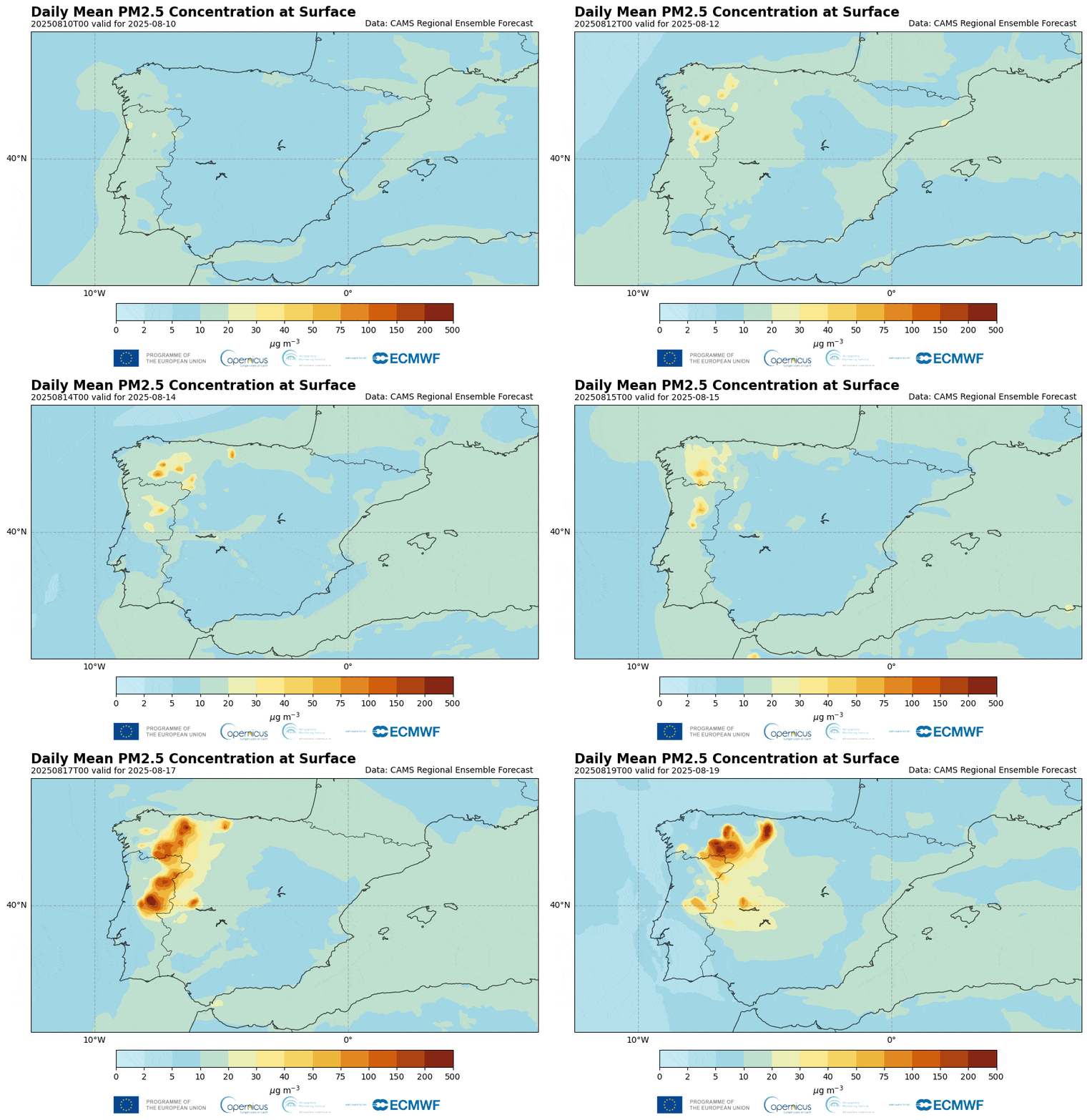
“The wildfire emissions from Spain and Portugal during August has been exceptional,” said Mark Parrington, Senior Scientist at CAMS. “The growth in the total estimated emissions from below averages to reach the highest annual total for Spain in the two decades of the CAMS fire emissions dataset in just 7-8 days.”
‘Climate Emergency’
Spain is currently several major wildfires even as a 16-day heatwave is finally showing signs of easing. Authorities deployed some 2,000 soldiers to battle the fires, 12 of which are affecting the northwestern region of Galicia. Temperatures exceeded 44C in several parts of the country this weekend as authorities warned of a very high risk of fires across “practically the entire country.”
Prime Minister Pedro Sanchez acknowledged the “climate emergency,” recognizing the role of climate change in exacerbating the fires, which have already burnt an area twice the size of London.
“Science tells us so, and common sense tells us so as well, especially that of farmers and . . . those who live in rural areas, that the climate is changing, that the climate emergency is worsening, that it is becoming more recurrent, more frequent, and each time has a greater impact,” Sanchez said, according to the Financial Times.
Neighboring Portugal deployed more than 5,000 firefighters as wildfires swept through northern and central regions. The burnt forest area in the country this year is already 17 times higher than in 2024.
Meanwhile, French authorities deployed over 2,100 firefighters to contain a devastating wildfire – the country’s largest wildfire since 1949 – in the southern Aude region last week.
Wildfires are also affecting Greece, Italy, Turkey and the Balkans.
Worst Wildfire Season on Record
Europe is on track for its worst wildfire season on record. According to data published on August 13 by the European Forest Fire Information (EFFIS) System, 439,568 hectares have already burned in EU countries since the start of 2025 – an area larger than Luxembourg. It is much higher than the 188,643 hectares affected during the same 8-month period last year and more than double the average for this time over the past 19 years (2006-2024), which stood at 218,417 hectares.
Between January and now, European wildfires generated 14.11 million tonnes of carbon dioxide emissions, compared to 9.59 million tonnes during the same period in 2024, according to EFFIS data.
Featured image: Gabriel González.
This story is funded by readers like you
Our non-profit newsroom provides climate coverage free of charge and advertising. Your one-off or monthly donations play a crucial role in supporting our operations, expanding our reach, and maintaining our editorial independence.
About EO | Mission Statement | Impact & Reach | Write for us