

Cities rarely lack good plans – they lack the means to fund them. Public money remains trapped in sectoral silos, forcing integrated agendas through fragmented budgets. Until funding is organized around shared outcomes rather than isolated departments, “joined-up policy” will remain a slogan, writes Marco Zupi, Scientific Coordinator of the UN Local2030 Coalition Network.
—

As I followed the “Cities and Communities” track in Jakarta at the Global Sustainable Development Congress 2026 this past June, one simple thought kept coming back to me. A large city is where the pressures of our century become most visible: traffic that barely moves, glass towers standing beside settlements without secure water, drought one week and flooding the next. It is also where people keep daily life running against the odds. If our promises about sustainability mean anything, this is where they either take shape or fall apart.
The reason is a matter of arithmetic. Most economic activity, most emissions and most concentrated hardship are now urban, and cities are where the population will keep growing. With the deadline of the United Nation Agenda for Sustainable Development, a global action plan adopted by all 193 member states in 2015, approaching, the missing ingredient is no longer ambition; it is delivery. And nothing is delivered in the abstract. A target signed in New York becomes real only when, on the ground, someone installs a water line, keeps a clinic running, or decides whether construction should be allowed on a floodplain.
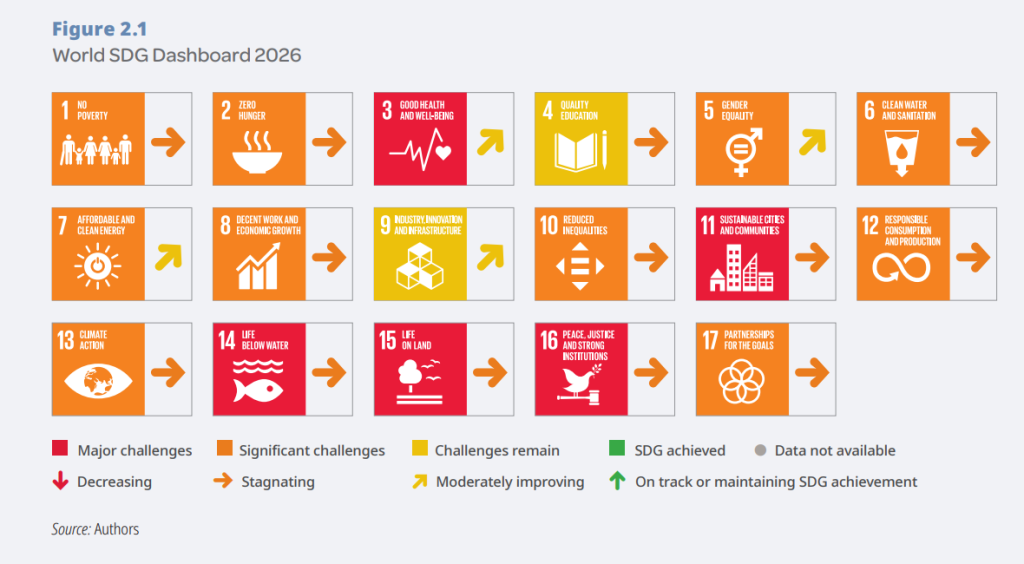
More on the topic: None of 17 UN SDGs on Track to Be Achieved By 2030, Report Finds
We call this “localization,” a word that’s easily misinterpreted. It is tempting to picture it as handing goals downward to a smaller, purer level of government, as if closeness to a problem guarantee a better answer. Listening to practitioners from very different places, I grew more convinced that this picture is wrong. The local is not automatically wiser or fairer; it can just as easily inherit responsibility without the money or authority to act on it.
What localization really asks of us is harder: to govern interdependence. By that I mean joining together the things our institutions habitually keep apart. National frameworks have to meet real local ownership, and public officials have to sit alongside the neighborhood groups, small businesses, universities and residents of informal areas who hold much of the knowledge and do much of the actual work. Where decentralization is genuine, with powers, skills and, above all, stable revenue moving together, a city can convene others and be held accountable for results. Where it is only nominal, elegant “coordination frameworks” rest on nothing.
That is why I have come to see coherence as a budget question and not just a planning one. Cities rarely lack good plans; they lack the means to fund the combinations that would actually work, because public money is still split into sectoral silos, each with its own budget line and department. As a result, an integrated agenda is forced through a fragmented financial system. Until budgets themselves are organized around outcomes rather than sectors, “joined-up policy” will remain little more than a slogan.
The track also reminded me that a city that leaves people out is not, in any lasting sense, sustainable. The honest questions are always about who gets what: who breathes cleaner air, who is shielded when the flood comes, who can still afford to live where redevelopment lands, and who even appears in the data on which decisions are based. Resilience makes the point sharply. A city can fortify its financial core and neglect its edges. Real resilience can only be measured through the eyes of those most exposed to harm and, seen in that light, protection and inclusion stop being trade-offs and start reinforcing one another.
The examples that stayed with me carried exactly this logic. In Freetown, tree-growers are paid according to whether their trees survive, helping cool the city while channeling income to women and young people; adaptation and livelihoods are treated not as separate goals, but as one shared challenge. In rural Chile, a digital rollout was designed so that smallholders, women and Indigenous communities were reached first, rather than being left further behind by the very infrastructure meant to close the gap. Jakarta itself offers an equally powerful reminder: as the city sinks while drawing groundwater faster than its watershed can replenish it, it shows that no city is an island. Every city depends on food, water and land beyond its borders, and governing that urban-rural system is not a footnote to sustainability; it is one of its foundations.

If one clear thread runs through all this, it is that our deepest gaps are not in technology, or even in knowledge, but in coordination, finance, accountability and political will. It is also that universities and cities, when they work as genuine partners rather than occasional advisers, remain one of the most underused tools we have for closing those gaps.
What makes cities such demanding teachers is that they cannot wait. National governments can hide behind policy cycles; cities are judged every day. Either the water flows or it doesn’t; either the bus arrives or it doesn’t. That immediacy is why the city remains one of the clearest tests of how serious we are about sustainability. The lesson may sound simple, until one tries to put it into practice: a sustainable city is built less from imported blueprints than from trust, slowly earned among people who depend on one another and understand that they do. It is a quieter ambition than the language of transformation often suggests, and a much harder one to achieve.
The work did not end in Jakarta. It begins again wherever the next service is delivered, the next flood defense is planned, and the next community is treated not as the object of policy, but as a partner in shaping it.
Featured image: Steven Pisano/Flickr.
—
About the author: Marco Zupi is Scientific Coordinator of the United Nations Local2030 Coalition – Knowledge and Scientific Network. The views expressed are solely those of the author and do not necessarily reflect the positions of the United Nations, UN-Habitat, the Local2030 Coalition, or its partner institutions.
This story is funded by readers like you
Our non-profit newsroom provides climate coverage free of charge and advertising. Your one-off or monthly donations play a crucial role in supporting our operations, expanding our reach, and maintaining our editorial independence.
About EO | Mission Statement | Impact & Reach | Write for us