At the edge of the Malacca Strait, India is breaking ground on a $10 billion “mega-hub” that promises to redraw the maps of global trade. But as rainforests are cleared and Indigenous lands diverted, the Great Nicobar project has become a flashpoint for a fundamental question: Can a nation build a 21st-century economic superpower on the back of a fragile, sinking biosphere?
—
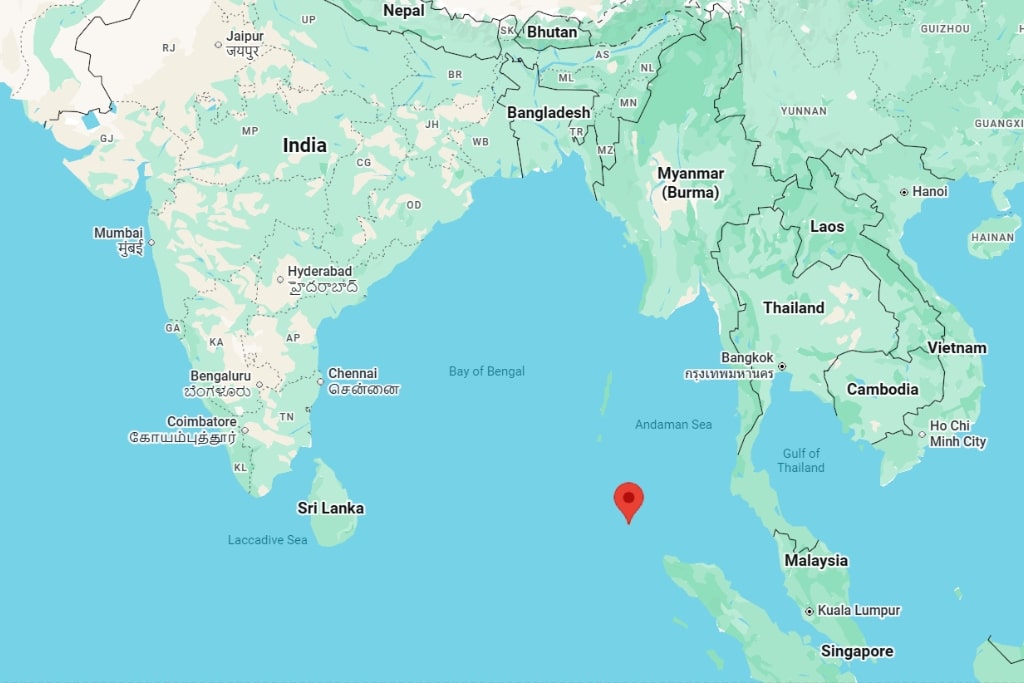
At the southernmost tip of India, Great Nicobar Island is at the centre of an $8–10 billion mega-infrastructure project launched in 2021 under India’s “Holistic Development of Islands” program that aims to transform the island into a global transhipment and economic hub.
Led by the Andaman and Nicobar Islands Integrated Development Corporation, the project includes an International Container Transhipment Terminal, a Greenfield International Airport, a gas and thermal power complex, and an urban township that would accommodate up to 650,000 people.
Great Nicobar Island Concept Plan
The Indian government has framed the initiative as critical for the country’s economic and geopolitical positioning in the Indo-Pacific, valuable for trade and military positioning, particularly in the context of China’s expanding presence in the region. But the project was met with backlash from environmental scientists, policy experts, and civil society groups due to its potential damaging environmental impact, procedural irregularities, and threats it poses to Indigenous communities.
Great Nicobar Island occupies a strategic location near the Malacca Strait, one of the world’s busiest maritime corridors. Currently, a significant portion of India’s cargo is routed through ports such as Singapore and Colombo, resulting in estimated annual revenue losses of $200-220 million. The proposed container terminal is intended to reduce this dependency and position India as a regional shipping hub.
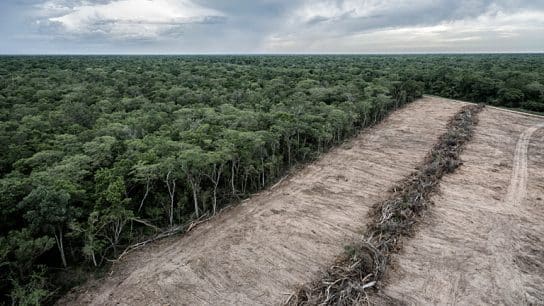
The project covers approximately 166 square kilometres, nearly one-fifth of the island’s total area. This will require the diversion of over 130 square kilometres of forest land, including 84.1 square kilometres currently designated as tribal reserve, according to the Environmental Impact Assessment (EIA) report. The scale of demographic transformation is equally significant. The island’s population, which is currently just over 8,000, is expected to increase more than 80-fold if the township reaches projected capacity, risking an overpopulation crisis in a region that has not seen much human presence other than its Indigenous communities.
Environmental Impact
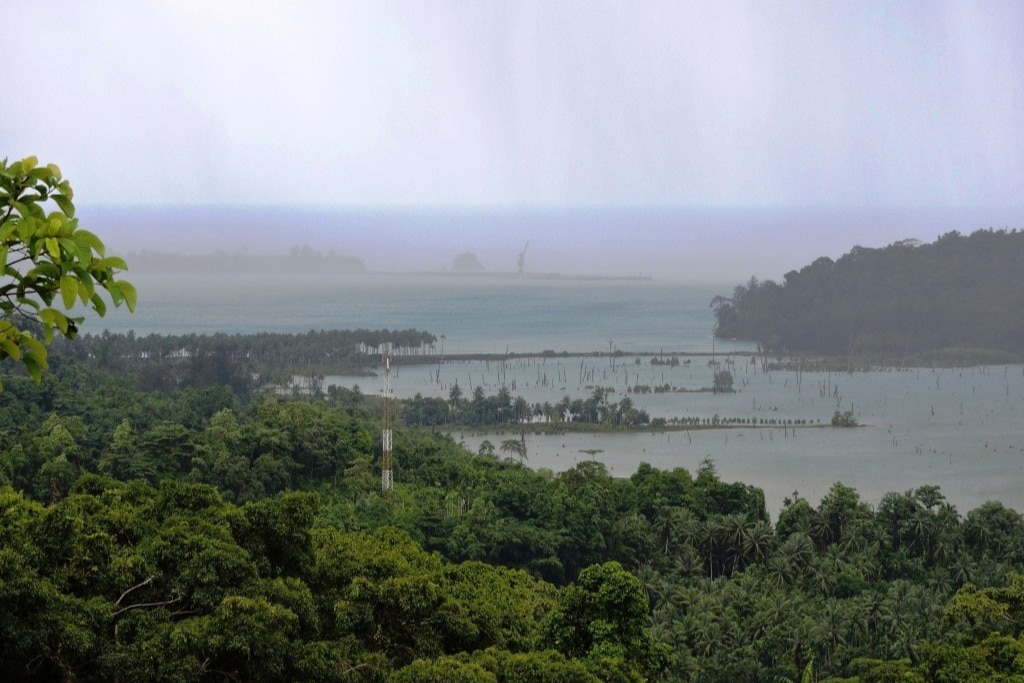
Over 85% of Great Nicobar is designated as a biosphere reserve and part of UNESCO’s Man and Biosphere Programme, home to tropical rainforests, coral reefs, and more than 1,700 endemic species of fauna.
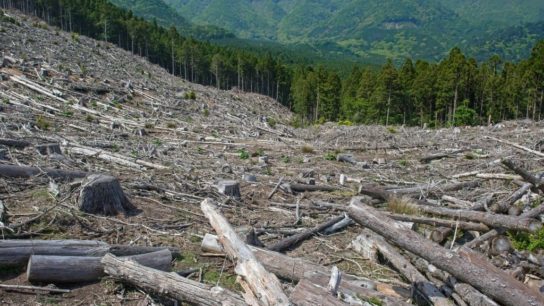
India’s Ministry of Environment, Forest and Climate Change has proposed the grant of environmental and Coastal Regulation Zone (CRZ) clearance for the project. This will lead to the diversion of 130 square kilometres of forest land, with estimates suggesting that up to 852,000 trees could be felled.
The project also directly affects coastal and marine ecosystems. The planned transhipment terminal is located at Galathea Bay, one of the most important nesting sites for the endangered giant leatherback turtle in the Indian Ocean. This species is listed under Schedule I of India’s wildlife protection framework and is globally classified as vulnerable.
According to the EIA report, port construction, dredging, and breakwater development will reduce the effective entry width of the bay, which is currently around 3.8 kilometres. This would have direct implications for turtle nesting access.
Mitigation measures proposed by organizations including the Zoological Survey of India, the Wildlife Institute of India, the Indian Institute for Science in preparation for the EIA report include restricting construction during nesting season, reducing artificial lighting, and installing physical deflectors to guide turtles. However, these measures have been widely criticized by marine biologists as insufficient and lacking empirical validation. This is because, unlike other turtle nesting sites cited in the EIA, Galathea Bay is unique in India for supporting leatherback populations, making ecological disruption here particularly consequential.
In addition to marine impacts, the EIA confirms that coral reefs in the project area will likely be damaged due to dredging. While the report proposes coral transplantation as a mitigation strategy, it fails to provide site-specific plans or evidence of feasibility at the required scale.
Recent conservation practices linked to the project have further raised concerns; this year, hatchlings of leatherback and olive ridley turtles were released at B-Quarry Beach, a site where no turtle nesting has been recorded. Established conservation protocols require hatchlings to be released at their natal beaches to ensure imprinting and future nesting fidelity.

Experts have suggested that such releases may be an attempt to artificially shift nesting patterns away from Galathea Bay, where the port is planned. However, scientific evidence indicates that turtle nesting behaviour is influenced by long-term ecological factors, including beach morphology and sand composition, making such interventions highly ineffective. Nevertheless, removal of an existing hatchery at the project site further indicates that conservation infrastructure is being adjusted to accommodate development rather than the reverse.
Gaps in the Environmental Impact Assessment
The project’s EIA process has been a major point of contention. The report, spanning over 1,000 pages, has been criticized for insufficient baseline ecological data and lack of comprehensive disaster risk assessment despite the island’s seismic vulnerability. The non-compliance with key environmental treaties such as the Convention on Biological Diversity and the Kunming-Montreal Global Biodiversity Framework, as well as incomplete biodiversity studies and limited ecological expertise within the assessment team, raises further concerns.
The Expert Appraisal Committee, an independent body appointed by the government to grant clearances for the project (including that of the CRZ), noted in 2021 that site selection prioritized technical and financial considerations, with environmental factors receiving limited attention. Independent reviews have also pointed out that the project follows a series of regulatory relaxations, including the de-notification of protected areas such as Galathea Bay Wildlife Sanctuary, once again raising concerns about the dilution of environmental safeguards.
Impact on Indigenous Communities
The project has significant implications for Indigenous populations, particularly the Shompen tribe and the Nicobarese community.
The Shompen, classified as a Particularly Vulnerable Tribal Group (PVTG), maintain a semi-nomadic lifestyle and have minimal contact with the outside world. The diversion of tribal reserve land and the influx of a large external population pose risks of disease exposure, cultural disruption, and loss of habitat. The EIA explicitly states that interaction between the Shompen and outsiders is “undesirable,” yet it proposes mitigation measures such as relocating labor camps and physically restricting access to tribal areas.
There is limited evidence of meaningful consultation or consent from these communities. This raises potential conflicts with India’s obligations under both domestic legal frameworks and international norms related to Indigenous rights, including principles of free, prior, and informed consent and creates a direct tension with India’s Forest Rights Act (2006), which recognizes Indigenous communities as primary custodians of forest land.
Great Nicobar also lies in a seismically active zone and was significantly affected by the 2004 Indian Ocean tsunami, which caused permanent land subsidence and coastline alteration. Despite this, critics argue that the EIA does not include a detailed risk assessment of future seismic events. The absence of such analysis has huge implications t, given the scale of proposed infrastructure, including oil handling facilities and power plants. A major seismic event could result in extensive economic losses and environmental damage, including marine pollution. Climate change further compounds these risks. Rising sea levels and increasing storm intensity threaten low-lying coastal infrastructure, raising questions about the long-term viability of the project.
Recent developments indicate continued momentum behind the project. Environmental and forest clearances have been granted, and legal challenges have faced setbacks, allowing construction planning to proceed. In parallel, the government has approved deep-sea mining blocks in waters near Great Nicobar in a broader expansion of extractive and industrial activity in the region. The project has already secured key environmental and forest clearances and is being implemented in phases over a 30-year period, indicating strong institutional commitment despite ongoing contestation.
These decisions have intensified criticism from environmental groups and policy analysts, who argue that cumulative impacts are not being adequately assessed.
What’s Next?
The Great Nicobar Development Project represents one of the most significant infrastructure initiatives in India’s island territories. Its strategic rationale is clear, particularly in the context of global shipping and regional geopolitics. However, the environmental, social, and geological risks associated with the project are substantial and, in several cases, insufficiently addressed.
The diversion of large tracts of primary forest, disruption of critical marine habitats, and potential impacts on Indigenous communities raise fundamental questions about the project’s sustainability. At the same time, gaps in environmental assessment and risk planning highlight weaknesses in regulatory oversight.
As implementation progresses, the project is likely to remain a focal point in debates over how development is planned and executed in ecologically sensitive regions. Whether it ultimately delivers its intended economic benefits without causing irreversible environmental and social damage remains uncertain. What is clear is that the Great Nicobar project will have long-term implications for the island itself and also for how sustainability is defined and applied in large-scale infrastructure planning in the current environmental circumstances.
Featured image: Sandeep Dhumal.
This story is funded by readers like you
Our non-profit newsroom provides climate coverage free of charge and advertising. Your one-off or monthly donations play a crucial role in supporting our operations, expanding our reach, and maintaining our editorial independence.
About EO | Mission Statement | Impact & Reach | Write for us