
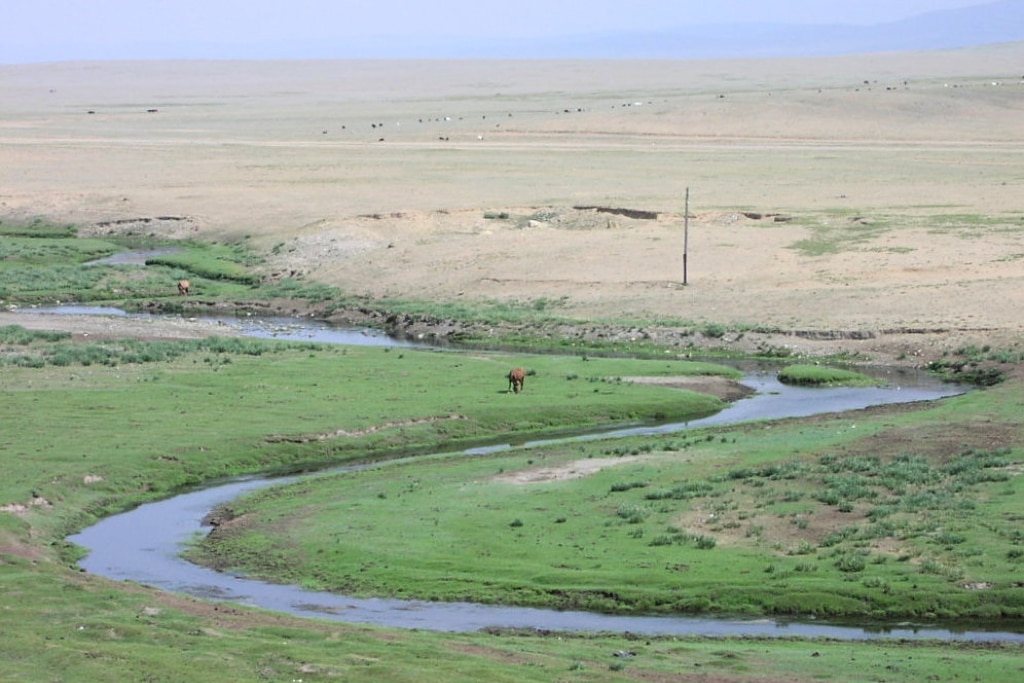
As the world celebrates the International Year of Rangelands and Pastoralists, Mongolia finds itself at a crossroads. Facing a “silent demise” where 80% of its iconic steppe is degraded, the nation must now prepare to host COP17 and decide: is the solution fewer livestock, or a radical new approach to a climate-stressed landscape?
—
Mongolia’s rangelands are an iconic and important part of the country’s history, biodiversity and culture. They also represent some of the most important rangeland habitats in the world. Occupying 70% of Mongolia’s landmass, rangelands have always been publicly owned, and directly support the country’s critical livestock pastoralism economy which provides food, income and wealth to half of the population.
Pastoralism, both in Mongolia and elsewhere, has a long history that intertwines with culture and civilizations. In areas where the local climate is not suitable to agriculture, pastoralism provides a reliable source of food and jobs. Responsibly managed herds serve as critical climate allies, leveraging rotational grazing to stimulate soil health and enhance the land’s capacity for carbon sequestration.
Traditional Mongolian rangeland pastoralism practices are considered resilient and adaptive, but today, they are under pressure from new threats. Mongolia’s rangelands are facing desertification caused by rangeland degradation. Nearly 80% of Mongolia’s land is degraded – double the global average. This, combined with the heavy reliance on rangeland-based pastoralist livelihoods, makes understanding and combatting rangeland degradation critical for the country’s survival.
These issues are not limited to Mongolia: rangelands cover about half of Earth’s terrestrial surface and support as many as 2 billion livelihoods. The United Nations declared 2026 the International Year of Rangelands and Pastoralists – underscoring the importance of the issue of rangeland degradation. However, rangeland degradation does not receive nearly as much attention as similar issues such as deforestation, leading some to call it a “silent demise.”
A Challenging Fight
The challenges to understanding and combatting rangeland degradation are complex. There is no universally agreed-upon definition of degradation, and scientific studies have relied on different methods of quantification of degradation, using different thresholds of vegetation change. Generally, however, it is understood that there are two primary drivers of degradation in Mongolia: overgrazing and climate change.
Overgrazing is widely recognized as a leading cause of rangeland degradation. Due to socio-economic changes during which livestock ownership was privatized in the early 1990s, the population of livestock animals in Mongolia has increased rapidly, overburdening many grazing areas with animals. Goats in particular experienced a sharp increase, coinciding with Mongolia’s cashmere export business boom under increased demand and opaque pricing methods set by manufacturers in neighboring China. It now accounts for 40% of the world’s cashmere production. This is important to note, as goats are browsers as well as grazers; they often pull out the crown of the plant or the entire root system in sandy soils, which is what prevents regrowth.

However, demand from factories and global markets is not the only factor damaging Mongolia’s landscapes. Humans have tended to large herds on the steppe for thousands of years. So, what else is affecting the ability of the land to maintain ecological equilibrium?
A 2025 study published in Science suggests that climate change may be pushing rangelands out of balance, more than overgrazing. The study suggests that attempting to reduce overgrazing by reducing herd size may adversely impact herders’ livelihoods without tackling the root cause of degradation. Additionally, the authors suggest that traditional models often blame rising herd sizes for poor land conditions without accounting for the fact that climate-driven droughts can make even small herds appear too large for the scorched earth.
The study used climate averages and ecosystem type data to analyze and estimate the impacts of both grazing and climate stressors on rangeland health. It found that climate change-linked factors, such as warming and changes in precipitation patterns, had a greater effect than grazing pressures. The authors also discussed how herd sizes are affected by seasonality and rangeland types – herders may wish to stay in cooler mountain taiga rangelands during warm years, possibly amplifying the effects of both climate stressors and grazing stressors on these desirable areas.
Mongolia at COP17
Understanding the causes of rangeland degradation is the first step in changing how the Mongolian government and rangeland managers create and implement policy. In the aforementioned study, the authors said, “Our findings suggest that policy levers focused on herd size alone – such as Mongolia’s livestock taxes – may have a limited effect on desired rangeland outcomes, especially at multiyear time scales.” They suggested managing different types of rangeland differently, based on how they are affected by climate change – for example, focusing more effort on areas to make them better for livestock under climate-stressed conditions, or taxing livestock in certain areas at a higher rate.
Working to protect Mongolia’s rangelands and the ecological, cultural and societal benefits that they bring will become increasingly important as climate change accelerates and pressures from the globalized economy grow.
Whether it is through herd management, climate change mitigation or adaptation, the question of how to fight desertification will be on the table at COP17 this year in Mongolia’s capital of Ulaanbaatar. The country, which this year will take up the presidency of the UN Convention to Combat Desertification, has the opportunity to take the lead in effectively combatting degradation and protecting its natural and cultural heritage.
Featured image: Wikimedia Commons.
This story is funded by readers like you
Our non-profit newsroom provides climate coverage free of charge and advertising. Your one-off or monthly donations play a crucial role in supporting our operations, expanding our reach, and maintaining our editorial independence.
About EO | Mission Statement | Impact & Reach | Write for us
Earth.Org
Free, non-profit and independent environmental journalism.