


High recovery costs, limited collection infrastructure and limited suppliers are just some of the factors that make the recycling of rare earth elements (REEs) challenging.
—
Rare earth elements (REEs) are incredibly useful for batteries, electronics and motors.
There are 17 REEs found in Earth’s crust. Physically, they are soft, heavy and often silvery-white. This periodic table group includes the 15 lanthanides – such as neodymium, dysprosium, europium, scandium and yttrium. Their unique geochemical properties have made them essential for many modern technologies, from fiber-optic cables and LED screens to electric vehicle motors and MRI imaging.
Why Is Recycling Rare Earth Elements Challenging?
Despite their critical role in modern technology, REEs remain a non-renewable resource with dismal recovery rates. Currently, global recycling of REEs is estimated at a mere 1%, with the vast majority of these metals – contained in everything from electric vehicles to everyday electronics – ending up in landfills as waste. This systemic loss is driven by a lack of robust infrastructure and the absence of a legislative push to prioritize material circularity.
Here are the main challenges to REE recovery.
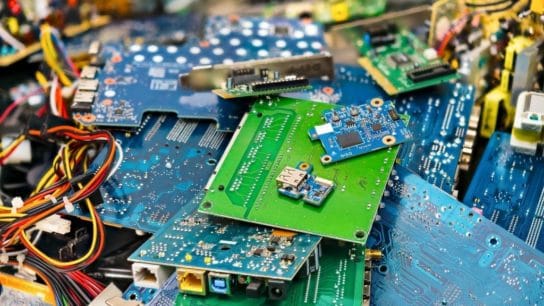
- Technical challenges: Rare metals are often used in small quantities and integrated into complex components, often with strong adhesives. They are blended with other materials and are difficult to separate and recover, even from other rare earth elements.
- Economic challenges: Mining new minerals is less expensive and more favored by stakeholders than investing in recycling existing ones. The production levels and commodity prices of metals are also volatile, which can result in uncertain returns on investments.
- Environmental challenges: Current recycling methods for REEs are hindered by a substantial environmental trade-off. These processes are inherently energy-intensive, requiring extreme temperatures and the use of hazardous chemicals. Consequently, the effort to recover these metals often results in a significant ecological footprint, generating toxic byproducts and secondary e-waste in the process.
- Health challenges: Hazardous chemicals, toxic fumes and heavy machinery can pose risks to workers’ health and safety, with long-term exposure linked to REE deposition in the lungs that can result in serious respiratory diseases.

Progress in Rare Earth Metal Recycling
What follows are three emerging technologies in the REE recovery and recycling sector. Efficiency can widely vary based on specific REEs, leaching conditions, source materials and other critical factors. Current rates are based on lab research and pilot programs. You can compare these three leading extraction methods to gain a better understanding of their benefits.
Hydrometallurgy
Traditional hydrometallurgy utilizes aqueous solutions to extract metals from solid materials, including ores and e-waste. It requires strong acids to dissolve, purify and recover the target metals.
While this method offers over 95% recovery and 99.5% purification, it is the most chemically intensive. The chemical-laden wastewater must be carefully managed to prevent further complications.
Bioleaching
This emerging technology involves utilizing microorganisms that produce organic acids to dissolve REE in e-waste. Under optimal conditions, bioleaching can achieve a leaching efficiency of 98.7% for REEs, surpassing that of hydrometallurgy. It also requires less energy consumption and reduces the use of harmful chemicals. However, bioleaching is considerably more time-consuming than other methods.
Supercritical Fluid Extraction
Supercritical fluid extraction (SFE) uses supercritical carbon dioxide to extract REEs from a solid or liquid material. Supercritical CO2 is pumped into an extraction chamber to dissolve the target REE compounds. The extract-rich fluid is then directed to a separator, where the CO2 returns to a gaseous state and the extracted compounds can be collected. SFE can be up to 95% efficient and moderately cost-effective, although it requires high pressure.
Environmental and Economic Considerations
Approximately 8% of the world’s carbon footprint comes from the global metals and mining industry. Carbon emissions are a significant contributor to climate change, leading to extreme weather conditions, ecosystem disruption and increased air pollution. Even with the implementation of new extraction methods, environmental and economic issues persist: traditional hydrometallurgy results in chemical waste, bioleaching is not yet scalable, and SFE is energy-intensive.
The European Union and the US intend to create alternative REE production and recycling rather than relying on imports from China, which has historically produced and exported the majority of REEs. For example, the EU’s Critical Raw Materials Act, enacted in May 2024, aims to diversify the EU’s raw materials supply.
However, there are currently short- and long-term supply risks and processing vulnerabilities, especially in the mining and processing stages. These global concerns include import sources, investing in infrastructure and stockpiling.
More on the topic: China’s Power and the Planet’s Pain: The Challenge of the Rare Earth Supply
How Can a Circular Economy Be Achieved?
Clear government regulations and guidelines are crucial for effectively recycling REEs in the future. These could facilitate global and national mining practices in response to the increased requirements of the energy transition for REEs. Manufacturers must be held accountable for the end-of-life management of their products. Meanwhile, consumers should be incentivised to properly dispose of their personal e-waste to prevent it from ending up in landfills.
Emerging fields, such as artificial intelligence and machine learning, may be helpful in optimizing REE. AI algorithms can be utilized for separating components containing REEs, improving extraction process parameters and analysing design options based on environmental impact. This can support a more circular REE economy, yet further research and infrastructure are required.
A Future Worth Recovering
Technological advancements and innovations might make it possible to reliably recover and recycle REEs. However, the drive for cutting-edge technology often outpaces sustainability efforts. Researchers must overcome logistical barriers, economic concerns and more challenges to fully realize this potential without contributing to further waste. Ultimately, REE recycling necessitates a multidisciplinary approach centred on element recovery and minimal refuse.
You might also like: China’s Power and the Planet’s Pain: The Challenge of the Rare Earth Supply
This story is funded by readers like you
Our non-profit newsroom provides climate coverage free of charge and advertising. Your one-off or monthly donations play a crucial role in supporting our operations, expanding our reach, and maintaining our editorial independence.
About EO | Mission Statement | Impact & Reach | Write for us