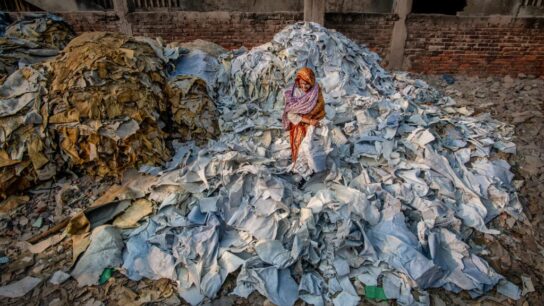



Every year, millions of tons of plastic waste are exported from wealthy nations to poorer countries, with a commitment to recycling them. In most cases, however, this waste ends up in landfills or is burned, with serious implications for the health of receiving communities and the surrounding environment. This unfair system is known as plastic colonialism.
—
Plastic pollution is not just an environmental problem but also a political and social one. While plastic bags and bottles being washed up on beaches is a heavily discussed topic and disturbing images of dying turtles entangled in plastic are everywhere online, these visuals do not tell the whole story.
In reality, not all unrecycled plastic from the Global North ends up in the ocean; a large portion is shipped to countries in the Global South, where it often accumulates in landfills, open dumps, or poorly regulated recycling operations, creating serious environmental and social consequences that receive little mediatic attention.
What Is Waste Colonialism?
The practice of developed nations consuming excessively and exporting their waste – primarily plastic waste – to less developed countries, often with inadequate waste management infrastructure, is known as waste (or plastic) colonialism. This concept refers to wealthy nations exporting plastic and other types of waste to poorer countries, often under the guise of recycling. It has devastating consequences for the people and communities left to deal with it.
Exporting trash involves more than just environmental harm; it reflects systemic inequality and a historical pattern of exploitation. The term draws a direct line between historical colonialism, where natural resources and labor were stripped from colonized regions, and the current waste trade, where the burden of environmental damage is once again pushed onto those least responsible for it.
The logic is elementary: when consumption – primarily of plastic – continues to rise, there are only two solutions to eliminate the waste: incineration or dumping. Incineration becomes the only plausible alternative if a country does not allow large-scale dumping within its borders. The problem? Incinerating plastic carries a significant carbon footprint, which most countries responsible for plastic waste are trying to reduce. As a result, some choose to avoid both options and instead export their waste elsewhere, preferably to a country with weaker waste regulations.
For years, high-income countries, especially across Europe, in the US, Japan, and Australia, have been exporting plastic waste abroad under the claim that it will be recycled, but the reality is far more complex. A report by the Environmental Investigation Agency (EIA) published last year revealed that in 2023, the Netherlands, Germany, the UK, Belgium, France, Italy, the US, Japan, and Australia were among the top waste exporters to non-OECD countries.
Which Countries Are the Most Affected By Waste Colonialism?
For over 20 years, China was the world’s biggest importer of plastic and other waste. Since it lacked local resources, starting in the 1980s–90s, the country accepted trash from richer countries to use as raw materials for its industries. However, this mechanism led to serious pollution, health risks and illegal dumping in the country. In 2018 China banned the import of plastic waste with its National Sword Policy. Since then, Western countries have been redirecting their exports to other parts of Asia and Africa. Countries like Malaysia, Indonesia, Vietnam, Thailand, and the Philippines have taken up much of the imports, many arriving illegally or misdeclared. As for Africa, Ghana is slowly becoming a dumping ground, and Mexico and Peru in Latin America are following its steps.
According to the OECD, in 2023, five of the world’s top 20 plastic waste importers were non-OECD countries. Malaysia became the largest global destination, receiving 0.61 million tonnes of plastic waste. In line with Malaysia, imports also rose in Vietnam (by 3%) and Indonesia (by 26%), highlighting an ongoing shift in export patterns.

Way Forward
Despite global efforts like the 1989 Basel Convention, an international treaty designed to minimize the transboundary movement of hazardous and other wastes and to prevent their illegal traffic, illegal plastic waste trading is still happening, especially in wealthier nations. It is the failure of international regulations and national systems meant to manage plastic responsibly.
One example is the UK, where the Extended Producer Responsibility scheme, designed to promote domestic recycling, is being strongly abused and exploited by criminals.
Fake recycling records are used to pocket around 50 million pounds a year, allowing plastic to be exported abroad under the false label of “recycled”. This fraud doesn’t just undermine genuine recycling efforts, but it actively enables waste colonialism. By disguising waste as recyclable, the UK and other wealthy nations can shift the environmental burden onto countries in the Global South.
The consequences are severe: this trade worsens poverty, may aid the spread of diseases, and can cause lasting harm to people and the environment in the countries that receive the waste. It also reinforces old patterns of exploitation, similar to those from the colonial era. In Surabaya, Indonesia, reports revealed that local communities were burning plastic waste as fuel for tofu production, leading to the discovery of dioxins in eggs laid by nearby chickens.
Although the plastic waste crisis is significant, things can still improve, and the answers might be closer than we think. For example, in the Middle East and North Africa (MENA) region, people have been reusing, repairing, and repurposing materials for generations by turning old clothes into rugs or bags and using natural materials instead of plastic. These everyday practices show that sustainable living is nothing new; it is part of our culture.

When we combine these traditions with innovative modern solutions, like holding companies accountable for their waste through Extended Producer Responsibility policy and giving countries more power to reject harmful waste shipments, we can start to address the problem at its root. This right, however, is often weakened by economic dependence, corruption and limited regulatory capacity.
In fact, most responsibility falls on richer countries; instead of dumping their waste on poorer ones, it is time they invest in fair, local waste systems so that no community is left to deal with pollution they did not create.The world is now at a critical juncture as a Global Plastic Treaty is in the works: an opportunity to set enforceable rules and real accountability for plastic production and waste. Serious actions are fundamental: bold policies, clear responsibilities, and global cooperation are needed to confront waste colonialism and its consequences.
Featured image: Global Environment Facility/Flickr.
This story is funded by readers like you
Our non-profit newsroom provides climate coverage free of charge and advertising. Your one-off or monthly donations play a crucial role in supporting our operations, expanding our reach, and maintaining our editorial independence.
About EO | Mission Statement | Impact & Reach | Write for us