



“In the face of threats to international law and the growing tendency to sweep climate change off the political agenda, there has been an urgent need for legal clarity on the obligations of states,” writes Léa Weimann, co-lead of Youth for Ecocide Law.
—
By Léa Weimann
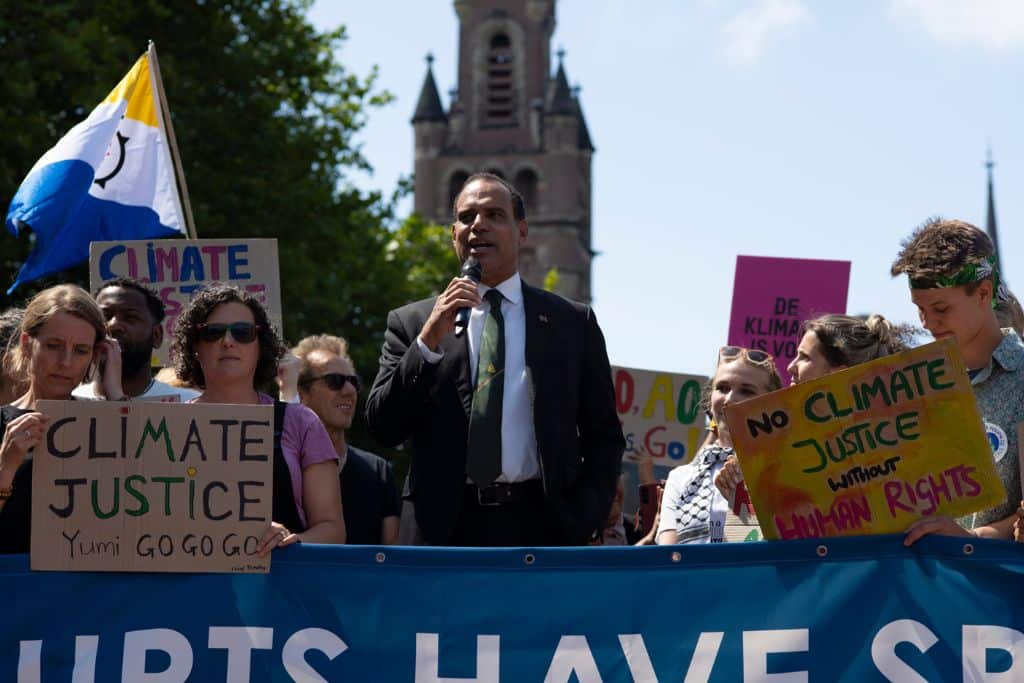
For years, young people across the Pacific sounded the alarm on climate disaster, insisting that their voices be heard. It was a determined grassroots movement, starting with a group of 27 law students from eight Pacific Island nations in 2019, that first called on their governments to take climate justice to the world’s highest court.
The Pacific Islands Students Fighting Climate Change campaign, backed by World’s Youth for Climate Justice (WY4CJ) and youth worldwide, demanded legal accountability from states for the climate crisis and environmental damage impacting the most vulnerable communities. While this should not have been their burden to carry, young people stepped forward, demanding accountability.
On July 23, in response to this youth-led campaign and a United Nations General Assembly resolution supported by more than 130 countries, the International Court of Justice (ICJ) delivered a landmark advisory opinion on states’ legal obligations to address climate change. This is a historic victory not only for the Pacific nations and young people who championed the case, but also for the wider international community seeking justice and accountability in the face of environmental collapse.
While advisory opinions are not legally binding judgments, they give clarity to contentious international matters and carry both legal authority and moral weight.

The ICJ opinion recognizes that protecting the environment is not a discretionary policy choice but a binding obligation under international law. It confirms that states have international obligations to address climate change under a wide body of international law, and not only under the legal principle of lex specialis, which gives priority to more specific rules (such as climate treaties) over general ones (such as human rights law), as some developed states had argued in the hearings. Importantly, the court also confirmed that even states that are not party to climate treaties, such as the Paris Agreement, remain bound by universal customary international law obligations.
The judges clarified that states have binding obligations under international law to not just prevent environmental harm, but cooperate internationally, and provide remedies and reparations when damage occurs. They went as far as clarifying that a state’s failure to properly regulate fossil fuel production, licensing and subsidies could constitute an international wrongful act if it is a violation of the international obligations of a state. It confirms that states have a legal obligation to prevent significant harm to the climate system with a stringent duty of due diligence. These are just a few of the key findings from the ICJ opinion.
The international rules-based order, built after World War II by the Allied powers, including the US, UK, France, the Soviet Union, and China, was designed to prevent atrocities, wars, and impunity. Its institutions were created to uphold peace, justice, and shared global norms. Yet today, this system faces unprecedented strain. Some of the most powerful global players are retreating from key international agreements and leadership roles, while conflicts rage globally at levels not seen since the Cold War. In the face of threats to international law and the growing tendency to sweep climate change off the political agenda, there has been an urgent need for legal clarity on the obligations of states.
The eroding status of international law disproportionately threatens developing nations, many of which are among the world’s most vulnerable to climate and ecological collapse. Yet, these countries are not passive bystanders, they are instead often leading efforts to strengthen and adapt international law to address the urgent realities they face. The whole process of the advisory opinions before the ICJ is evidence to this.
Vanuatu, one of the world’s most climate-vulnerable nations, has long faced the impacts of sea-level rise, intensifying storms, and prolonged droughts that threaten ecosystems, infrastructure, and livelihoods. In response to these worsening conditions, the country led a coalition of Pacific Island states including Fiji, Samoa, Tuvalu, and the Solomon Islands in driving the advisory opinion initiative forward at the United Nations.
Their call for legal clarity was met with strong international support. In 2023, more than 130 countries backed the request at the UN General Assembly. The proceedings went on to become one of the most widely engaged in the ICJ’s history, with over 190 states and organizations participating through written and oral submissions during the hearings in December.
In a parallel effort to strengthen environmental protection through international law, Vanuatu, alongside Fiji and Samoa, has been spearheading a formal proposal to amend the Rome Statute of the International Criminal Court (ICC) to include ecocide as the fifth core international crime, joining genocide, war crimes, crimes against humanity, and the crime of aggression. This bold initiative has since gained critical backing from countries such as the Democratic Republic of the Congo, which faces immense environmental pressures, not least due to increasing demand for its so-called “transition minerals” that are essential for the green economy.
Together, these states are shoring up the international legal framework to better protect vulnerable ecosystems and communities, demanding legal tools that hold not just states but also individuals personally responsible for the most severe environmental destruction.
The ICJ advisory opinion and the growing movement to recognize ecocide as a core crime at the ICC show that the international rules-based order remains essential to protecting the states and peoples it was created to serve, ensuring that no one is left behind or allowed to slip under the waves.
In a globalized world, where the actions of the most powerful are felt by us all, we cannot turn our backs on the institutions that act as guardrails against the worst harms humanity can inflict upon itself. Seeing the inseparable connection between human rights and ecosystem health increasingly reflected in these institutions is cause for hope and celebration.
The process of advisory opinions before international courts shows the agency, initiative and power of young people to champion change. It calls on each and every one of us to engage in democratic processes, support those that are most vulnerable, and ensure that our legal systems are fit to protect current and future generations.
Featured image: Pacific Islands Students Fighting Climate Change.
—
About the author: Léa Weimann is a climate change law specialist, co-lead of Youth for Ecocide Law, and PhD candidate in Law at the University of Cambridge.
This story is funded by readers like you
Our non-profit newsroom provides climate coverage free of charge and advertising. Your one-off or monthly donations play a crucial role in supporting our operations, expanding our reach, and maintaining our editorial independence.
About EO | Mission Statement | Impact & Reach | Write for us