


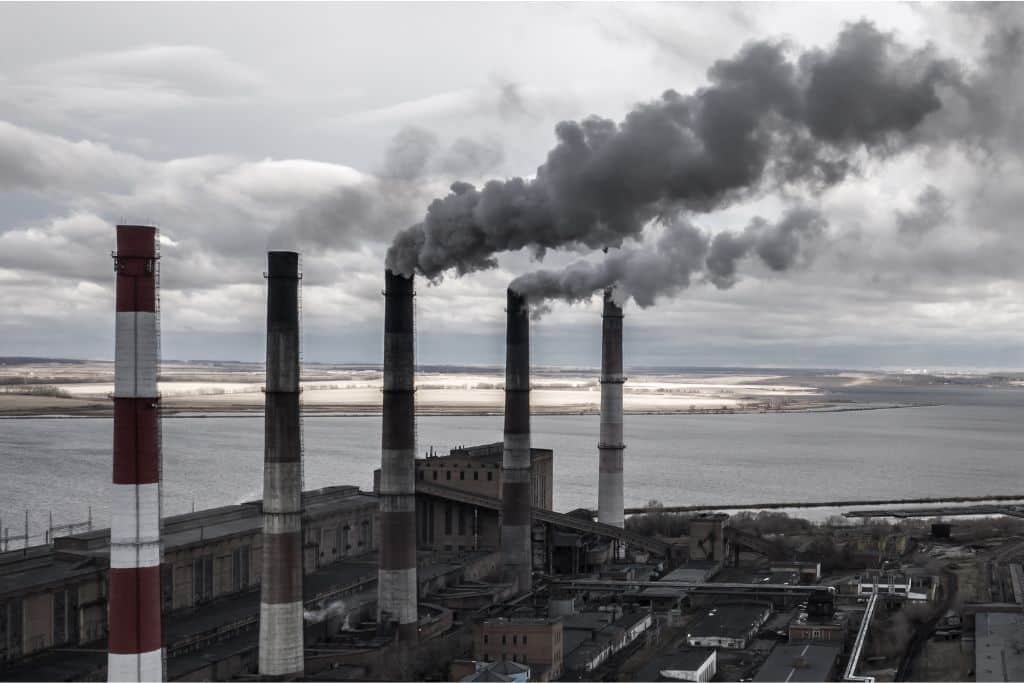
The Obama-era endangerment finding determined that greenhouse gases pose a risk to public health and welfare, providing the legal framework that allows the US Environmental Protection Agency to regulate emissions. The Trump administration is set to repeal it today.
—
The Trump administration today is set to repeal the endangerment finding, the legal framework that underpins the federal government’s power to regulate greenhouse gas emissions.
In a meeting with journalists at the White House on Tuesday, Press Secretary Karoline Leavitt confirmed the long-anticipated rollback of a 2009 endangerment finding that required the Environmental Protection Agency (EPA) to regulate greenhouse gas emissions.
“President Trump will be joined by [EPA] Administrator Lee Zeldin to formalize the rescission of the 2009 Obama-era endangerment finding,” Leavitt said, adding that the move would make it cheaper for Americans to buy gas-guzzling vehicles such as light duty cars, SUVs, and trucks. Echoing Zeldin’s words, Leavitt called the move “the single largest act of deregulation in the history of the USA.”

The endangerment finding refers to a comprehensive Obama-era report titled “Endangerment and Cause or Contribute Findings for Greenhouse Gases under Section 202(a) of the Clean Air Act”. The peer-reviewed report was developed by 31 climate experts and verified by federal expert reviewers hailing from NASA, the National Oceanic and Atmospheric Administration, the US Department of Agriculture Forest Service, and other agencies.
It determined that six greenhouse gases, including carbon dioxide, threaten public health and welfare for current and future generations. As such, it provided the basis for the federal government to regulate greenhouse gas emissions through mechanisms such as emission controls on vehicles and power plants.
Contentious Global Warming Report
Last July, the US released a report which downplayed the risks of global warming, made false claims about sea level rises, and wrongly stated that the impact of carbon dioxide increases plant growth. The report, written by five climate change skeptics part of a “Climate Working Group”, was used by the administration as the basis of its proposal to overturn the finding.
Last month, a court found that the Energy Department violated federal law by secretely convening the group, which “not merely ‘assembled to exchange facts or information,’ but rather provided substantive policy ‘advice and recommendations’ to the Department of Energy.” The 1972 Federal Advisory Committee Act prohibits federal agencies form recruiting or relying on secret groups to formulate policy.
Environmental Groups Condemn the Move
The draft text of the repeal, released last summer, states that all greenhouse gas emission standards for light-duty, medium-duty, and heavy-duty vehicles and engines will be eliminated. It further states that the endangerment finding does not authorize the EPA to prescribe emission standards at all, and that “no requisite technology for vehicle and engine emission control can address … global climate change concerns.”

Zeldin, who has falsely claimed that greenhouse gas emissions from fossil energy production do not “contribute significantly to air pollution”, previously claimed to be “driving a dagger straight into the heart of the climate change religion.” In June, he proposed that the EPA repeal all greenhouse gas emissions standards for the power sector.
Climate action groups were quick to condemn the move. 350.org, an non-profit environmental organization, said the claimed savings ignore the far greater costs of unchecked climate pollution, with the long-term social costs of emissions from US companies estimated to reach $87 trillion.
“This isn’t about saving taxpayers’ money, it’s about saving an industry that has already been exposed as a permanent danger to American families. Climate denialism will bleed the people dry,” Anne Jellema, 350.org Executive Director, said in a statement shared with Earth.Org. “While the Trump administration can manipulate scientific agencies, it can never suppress the truth that ordinary people in the US and around the world are paying the real price for Big Oil’s profits: lives are being lost, homes are being destroyed and costs are soaring.”
Benjamin DeAngelo, lead author of the original document, told Earth.Org, “Looking back on the original 2009 endangerment finding, and all of the supporting science and responses to comments, the entire record still holds up incredibly well. What’s the ‘air pollution’? Greenhouse gases in the atmosphere. Does it endanger public health and welfare? Yes, when looking at the whole body of evidence, including both what was known and unknown at the time in 2009. Do U.S. motor vehicles contribute to the air pollution? Undoubtedly yes.”
The decision is expected to encounter legal challenges. Marcus Sarofim, a climate science and policy analyst who helped write the finding , told Earth.Org it is “disheartening to see the EPA rolling it back with shoddy legal and science arguments.”
“While the EPA is almost certain to lose in the DC Circuit Court, this Supreme Court is very hard to predict. Meanwhile, the rollback will create uncertainty for all the regulated sectors,” Sarofim added.
No Such Thing As ‘Clean’ Fossil Fuels
A long-time defender of planet-warming fossil fuels, Trump’s focus has been focused on strengthening ties with the industry and selling fossil fuels, coal in particular, as clean and cheap sources of energy. Last week, US Interior Secretary Doug Burgum launched a widely mocked “coalie” mascot to promote increased use of the world’s dirtiest fossil fuel. But experts note that the administration’s claims have no basis in reality.
Jason Lam, Research Fellow at Project Drawdown, a climate non-profit, said that a “clean” coal power plant – of which there are only two currently in existence, one in Canada and one in the US – would need to consume up to a quarter of the energy it produces in order to capture carbon dioxide from the exhaust gas of coal power plants and store it underground. “To recoup those costs, operators will have to sell electricity at a higher price, a tall order given already skyrocketing energy prices across the country,” Lam said.

Despite the removal of guardrails at the federal level, many US states continue to enact climate protection at the state level. Climate targets from the states that match the Obama-era Nationally Determined Contributions include 26 states, representing 60% of the US GDP and a similar amount of emissions.
You might also like: One Year of Trump: How the US Reversed Climate Progress, at Home and Abroad
This story is funded by readers like you
Our non-profit newsroom provides climate coverage free of charge and advertising. Your one-off or monthly donations play a crucial role in supporting our operations, expanding our reach, and maintaining our editorial independence.
About EO | Mission Statement | Impact & Reach | Write for us