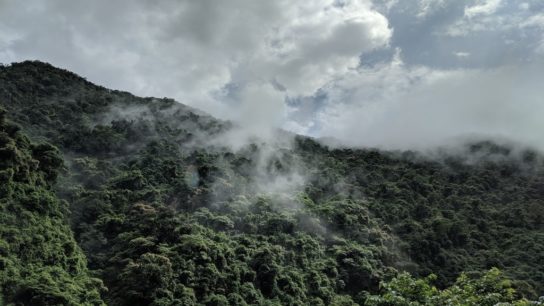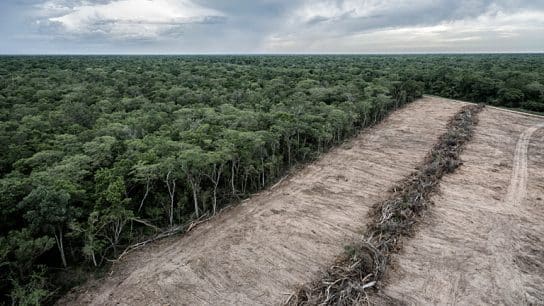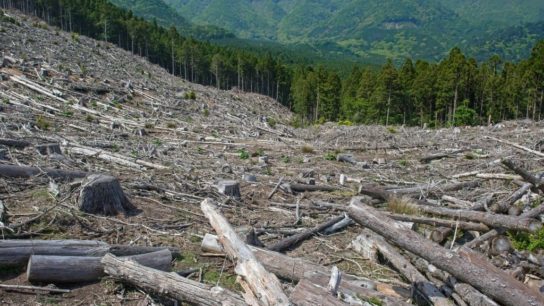



Early hopes for a global roadmap to halt deforestation pitched by Brazilian President Luiz Inácio Lula da Silva were dashed by the second week of COP30 last month. With more than 1,600 fossil lobbyists onsite, neither a roadmap to transition away from fossil fuels nor one to end deforestation appeared. Despite this, however, an ambitious plan for a $125 billion fund to protect forests – the Tropical Forests Forever Fund – is gaining momentum.
—
The world’s forests are fundamental to climate change mitigation efforts, storing approximately 861 gigatonnes of carbon. In his midpoint press conference at COP30, United Nations Secretary-General António Guterres underscored their importance, stating that “it is imperative to halt and reverse deforestation by 2030 – so nature remains a shield, not a casualty.”
Halting and reversing deforestation is an achievable goal. “People can be fatalistic and think deforestation is a consequence of modernity, but we’ve made huge amounts of progress and ending deforestation is possible,” Felix Finkbeiner, Founder of Plant-for-the-Planet, told Earth.Org. While today’s forests contain just half of the six trillion trees they did at the end of the last ice age, deforestation peaked in the late 1980s when the Earth was losing three times as much forest every day as we are now.
With this in mind, in 2021 at COP26 in Glasgow, 140 countries pledged to end deforestation by 2030. However, the pledges have not borne fruit. According to the Forest Declaration Assessment, deforestation rates have remained stubbornly high since the beginning of the decade. In 2024, global deforestation totaled 8.1 million hectares, leaving the world 63% off track from this 2030 target.
At a high-level event held on the eve of last month’s COP30, Brazilian President Luiz Inácio Lula da Silva called for a roadmap to halt deforestation. During the two weeks that followed, 90 countries supported setting up a mandatory negotiation process to see progress towards the 2030 goal. However, what resulted was only an independent initiative launched by COP30 President André Corrêa do Lago at the last minute, to create his own Forest and Climate Roadmap which aimed to “gather parties and stakeholders to discuss how to halt and reverse deforestation.” The actual decision, meanwhile, makes only indirect references to ending deforestation, staying “mindful of” its importance.

Into this thicket of indecision, the launch of the Tropical Forests Forever Facility (TFFF), aimed at financing the reduction of deforestation in tropical countries, was “one of the highlights in Belém,” Mauricio Voivodic, WWF-Brazil’s Executive Director, said in a statement.
The idea for the $125 billion fund was conceived by World Bank economists Ken Lay and Garo Batmanian almost two decades ago, refined by Batmanian when he joined the Brazilian government, and first introduced at COP28. Its objective is to reward tropical forest countries that are already maintaining or reducing deforestation rates, but require ongoing financial support to continue doing so. The TFFF seeks to address this shortfall by offering a long-term, performance-based funding model that rewards forest conservation.
“It’s like a university endowment for forest conservation. So instead of every year having to beg for money from donors, you provide a big pool of money once, and then it pays for forests every year,” said Finkbeiner.

Under the model, tropical forest countries can receive annual payments of $4 per hectare of preserved forest – essentially receiving funding to preserve the status quo. This would mean an annual payout of $2 billion every year for Brazil, which is almost 60% rainforest, or a more modest $13 million for a country like Portugal (which has committed $1 million to the fund), with its 3.3 million hectares of coniferous and broadleaf forests.
However, payments are subject to heavy penalties: $400-$800 are deducted per hectare deforested, and $140 per hectare degraded.
“Payment for ecosystem services is not new, but one of the biggest issues is payment for ecosystems that were never under threat,” explained Finkbeiner. “With this mechanism, [countries] have a massive incentive to reduce deforestation. This is important because it does an end-run around the whole additionality question” – when forest conservation interventions are questioned or dismissed because they are in places where forests are not threatened.
The success of the TFFF will depend on an initial $25 billion sponsor capital from governments and foundations. This will serve as the core of the TFFF’s investments and as junior debt in the case of losses. The sponsor capital is then intended to leverage $100 billion in private investments. Adding a quirk to the fund’s future, the Norwegian government (which rakes in $65 billion in oil revenues annually) pledged $3 billion – but only if the total sponsor capital reaches $10 billion by the end of 2026.
As of now, total pledges stand at $6.738 billion, led by Germany, Brazil, Indonesia, and France, along with $10 million of pledges from philanthropies and multilateral development banks.

Some details of the plan are yet to be ironed out. Among others is the definition of “degradation” – should it include selective harvesting, which is harder (for now) to spot with satellite monitoring? Likewise, questions remain as to the investment strategy of the fund itself. Investments are intended to be in fixed income products, mostly debt in the Global South, which has potential to be a huge boon for governments such as Ghana. However, while the concept note makes it clear that any investment that leads to further deforestation must be excluded , it is not determined whether this excludes every company with any investment whatsoever, or only those with 100% of their revenue derived from, say, fossil fuels.
Featured image: UN Climate Change/Kiara Worth via Flickr.
This story is funded by readers like you
Our non-profit newsroom provides climate coverage free of charge and advertising. Your one-off or monthly donations play a crucial role in supporting our operations, expanding our reach, and maintaining our editorial independence.
About EO | Mission Statement | Impact & Reach | Write for us