

If treated as a country, data centers could rank sixth globally for electricity consumption by 2030. They would also require an amount of water equivalent to the annual needs of 1.3 billion people.
—
By Martina Igini
Artificial intelligence (AI) is expanding at breakneck speed, used by hundreds of millions of users and processing billions of queries each day. AI is now one of the most significant drivers of that data center growth. But this growth comes at an unfathomable environmental toll that is at the center of a new United Nations report.
The report, compiled by the United Nations University Institute for Water, Environment and Health and published on Wednesday, used primary data from a range of sources to quantify the carbon, water and land footprints of AI’s electricity use across the globe. The numbers are staggering.
The AI market is expected to grow 25-fold in the coming decade, from $189 billion in 2023 to nearly $5 trillion by 2033. Generative AI – the subfield of AI that autonomously generates text, images, video, audio and code in response to user prompts – already accounts for about 20% of the global market share; by 2030, it is expected to reach 40%.
To function, generative AI needs massive training datasets to learn from. Training these models is an extremely resource-intensive process, but nothing compared to what it takes for them to process billions of interactions each day – not just in terms of the electricity needed to run these centers, but also in terms of the amount of water needed to keep them cool and the land footprint from energy infrastructure and supply chains.
The report estimates that global data centers consumed some 448 terawatt-hours of electricity in 2025, with AI accounting for a fifth of the total. This would make them the world’s 11th largest electricity consumer, if they were a country. This amount of electricity would also be enough to supply the annual residential electricity needs of the 1.3 billion people living in Sub-Saharan Africa for 2.6 years.
This amount of electricity consumption carries an enormous carbon footprint – 189 million tonnes of CO2 equivalent, which only 3.2 billion tree seedlings grown over 10 years would be able to offset.
In terms of water, data centers last year consumed enough to fill 1.8 million Olympic-sized pools – enough to cover the annual basic domestic water needs of over 600 million people in Sub-Saharan Africa.
In terms of land, data centers’ electricity demand covered an area nearly 4.5 times the size of Greater London.
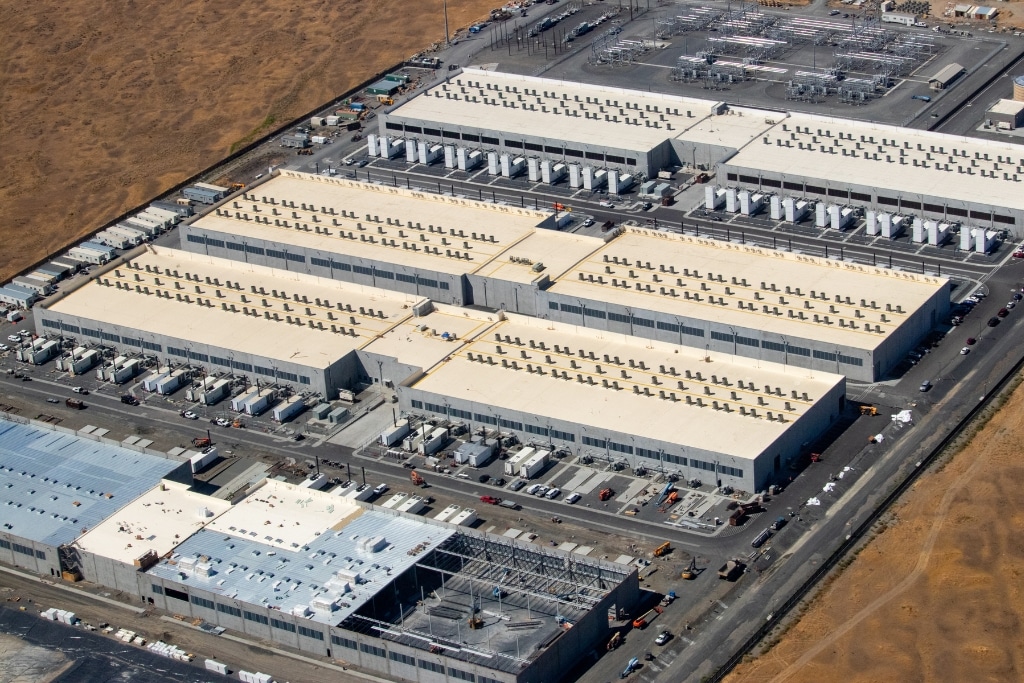
“The public debate still often treats AI as software, but AI is also physical infrastructure: data centres, electricity generation, cooling systems, transmission networks, chips, minerals, land and water,” said Kaveh Madani, the institute’s Director and lead author of the report.
But these staggering numbers are nothing compared to a scenario where AI’s share of data center electricity consumption indeed rises to 40% by 2030. If that happens, the technology’s electricity consumption would make the AI industry one of largest consumers of electricity globally, behind only five countries. The associated water footprint would be 9.3 trillion liters – enough to cover the annual basic domestic water needs of over 1.3 billion people in Sub-Saharan Africa for a full year. And its land footprint would be about twice that of the Jakarta metropolitan area, the most populous metropolitan area in the world, home to over 32 million people.
If that wasn’t enough, the report also estimates e-waste from AI hardware to reach 2.5 million metric tons by the end of the decade – like discarding 250 Eiffel Towers every year.
“What we are showing here is probably just the tip of the iceberg,” Madani told AFP. “We need to require more transparency. We need the providers to provide that information.”
The report also calls on governments to require AI providers to disclose their environmental footprint and on users, organizations and public institutions to use AI intelligently by opting for low-footprint tasks – such as text generation over image or video – and conventional search tools.
Other more sustainable approaches to using generative AI tools include keeping prompts and outputs concise, batching related tasks, reusing previous results, and avoiding unnecessart iterations, according to the report. Meanwhile, AI providers should be transparent with users and inform them when their choices – such as asking for an image or video – can result in intensive energy demand.
Featured image: Wikimedia Commons.
This story is funded by readers like you
Our non-profit newsroom provides climate coverage free of charge and advertising. Your one-off or monthly donations play a crucial role in supporting our operations, expanding our reach, and maintaining our editorial independence.
About EO | Mission Statement | Impact & Reach | Write for us
Earth.Org
Free, non-profit and independent environmental journalism.