
Following the failure to reach consensus on a Global Plastic Treaty in Geneva this August, world-leading marine scientist Richard Thompson OBE from the University of Plymouth discusses where the conversation on plastic pollution can go from here.
—
This is part 1 of a two-part interview with Prof. Richard Thompson. Read part 2.
Professor Richard Thompson OBE has worked on plastic pollution for over 30 years and has advised governments and industry on appropriate policies and interventions to combat this global environmental issue. As a coordinator of the Scientists Coalition for an Effective Plastic Treaty – a collective of over 400 scientists from 65 nations working together to ensure decision makers are informed on the latest plastic pollution research – Thompson advocates for reducing plastic production and international adoption of agreed essentiality, safety and sustainability criteria for unavoidable plastics.
Thompson and his team’s research at the International Marine Litter Research Unit has demonstrated the accumulation of microplastics in the oceans since the 1960s. Their work led to the ban of microbeads in cosmetic products in the UK in 2018 and has guided policy on the benefit of fitting filters on new washing machines to limit the release of textile fibres – a policy that is being advocated in France from 2025.
In March 2022, during a UN Environment Assembly, all member states passed Resolution 5/14, which set out a commitment to develop an international legally binding instrument to end plastic pollution. The Intergovernmental Negotiating Committee (INC) was established to develop this instrument, which aims to address the full life cycle of plastic, from production to design and disposal.
Since then, there have been five INC sessions to negotiate the details of this instrument. The extended fifth session (INC5.2) took place in August in Geneva. As a scientist, Thompson’s role is limited to providing evidence and answering questions from member states on the scientific research into the impacts of plastics on the natural environment and human health.
“We are not the negotiators, but we try to make sure that the negotiators from UN member states have accurate information before them,” he told Earth.Org.
He described his role as an “observer”, but one that is necessary to create clarity in muddy waters created by actors who have other motives. The negotiations saw 234 registrations of fossil fuel and chemical industry lobbyists, outnumbering the combined diplomatic delegations of all 27 European Union nations.

No Treaty Is Better Than a Weak Treaty
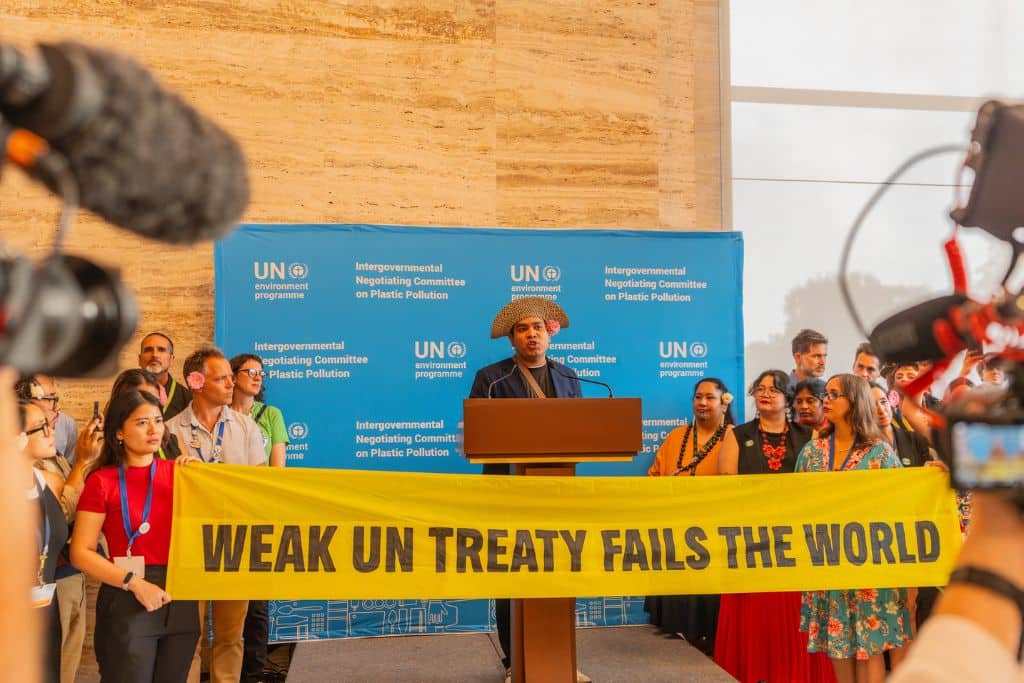
Delegates ultimately failed to reach an agreement, and talks were postponed to a later date. The resolution initially aimed at having a treaty by the end of 2024.
“It’s frustrating,” said Thompson. “Member states have clarity on the scale and magnitude of the problem, and they are more engaged with science than they were before. But this hasn’t brought us to where we need to be in terms of agreement on the way forward to address the issue.”
Despite the frustration, Thompson said what matters ultimately is establishing a treaty which is substantial and provides clear guidance: “There’s no point having a treaty that doesn’t have the teeth to do what it’s required.”
With annual production of plastics now exceeding 400 million tonnes per year, the majority being single use items which rapidly accumulate in the environment and oceans, pressure to reach consensus is growing.
More on the topic: Why the World Urgently Needs a Global Plastic Treaty
The Road Ahead
Moving forward, delegates face three potential outcomes, according to Thompson.
Option 1: A low-ambition treaty supported by all parties
The first potential outcome is a treaty that lacks appropriate measures to reduce plastic production, and instead places more emphasis on improvements to waste management.
In this scenario, plastic pollution continues to escalate, with the gap between the quantities produced and our ability to manage the associated waste growing larger every year.
Option 2: An ambitious treaty supported by all parties
The second possible outcome is an agreement on an instrument which addresses the whole life cycle of plastic, from design through to production and waste management. This would include measures to reduce plastic production as well as essentiality, safety and sustainability criteria, where only plastic items that bring an essential benefit, are known to be safe, and are more sustainable than at present can continue to be produced. Appropriate testing standards and labelling would support the recognition of more sustainable plastics in national and international trade.
Option 3: An ambitious treaty supported by the majority of nations
There is one last possible outcome: the 100-plus member states who support a high ambition treaty could create a separate framework outside of the UN process. This would facilitate extensive international cohesion regarding legislation and could set in place an instrument that other states could join later.
“You’ve got more than 100 nations aligned with something that’s of a suitable ambition. Over time, I think you could persuade others to join because they may well recognize that there are commercial disadvantages by not being part of that grouping,” said Thompson.
Non-Negotiables: Establishing Essentiality, Safety and Sustainability Criteria
Thompson acknowledged that plastic can bring benefits to society, and maintained that an international agreement on plastic pollution should contain essentiality, safety and sustainability criteria.
Essentiality criteria will be crucial in helping us determine which plastic products are essential to society and which are not. Such criteria have been adopted previously at the international scale in the Montreal Protocol, a global agreement to protect the Earth’s ozone layer by phasing out the production and consumption of chemicals that deplete it. At the fourth meeting of the parties to the Montreal Protocol in 1993, Decision IV/25 was agreed, which introduced essentiality criteria. This defines a harmful substance as essential for society if its uses are necessary for health or safety or is critical for the functioning of society, and there are no acceptable alternatives.
A real-world example of a non-essential plastic are microbeads in cosmetic products. They are not necessary for health or safety or critical for the functioning of society and other acceptable alternatives do exist.
“I haven’t heard a single consumer post the ban say they miss not being able to wash their face with millions of plastic beads,” said Thompson.
The Safety and Sustainability Need
Establishing safety criteria is another non-negotiable for Thompson. A report by PlastChem identified that there are over 16,000 types of chemicals found in plastics, with over a quarter known to be hazardous to human health or the environment.

Thompson also advocates for sustainability criteria to ensure the plastic products that bring essential benefits are more sustainable. He argues that having such chemical variety makes it very difficult to efficiently recycle and reuse plastics. The sheer variety hinders our ability to create a more circular waste system. Importantly, we cannot recycle our way out of plastic pollution, as data shows: less than 10% of the world’s plastic has been recycled once.
Transparency is another requirement. Public information on the use and origin of over 9,000 plastic chemicals is lacking. A lack of rigorous safety testing before a plastic is produced further compounds the issue. Of the 4,200 plastic chemicals known to be hazardous to human health, 3,600 are not regulated internationally, as reported by PlastChem.
Thompson advocates for a reduction in the chemical diversity of plastics and greater transparency on chemical composition to limit health and environmental impacts and increase sustainability.
Featured image: Martina Igini/Earth.Org
This story is funded by readers like you
Our non-profit newsroom provides climate coverage free of charge and advertising. Your one-off or monthly donations play a crucial role in supporting our operations, expanding our reach, and maintaining our editorial independence.
About EO | Mission Statement | Impact & Reach | Write for us