
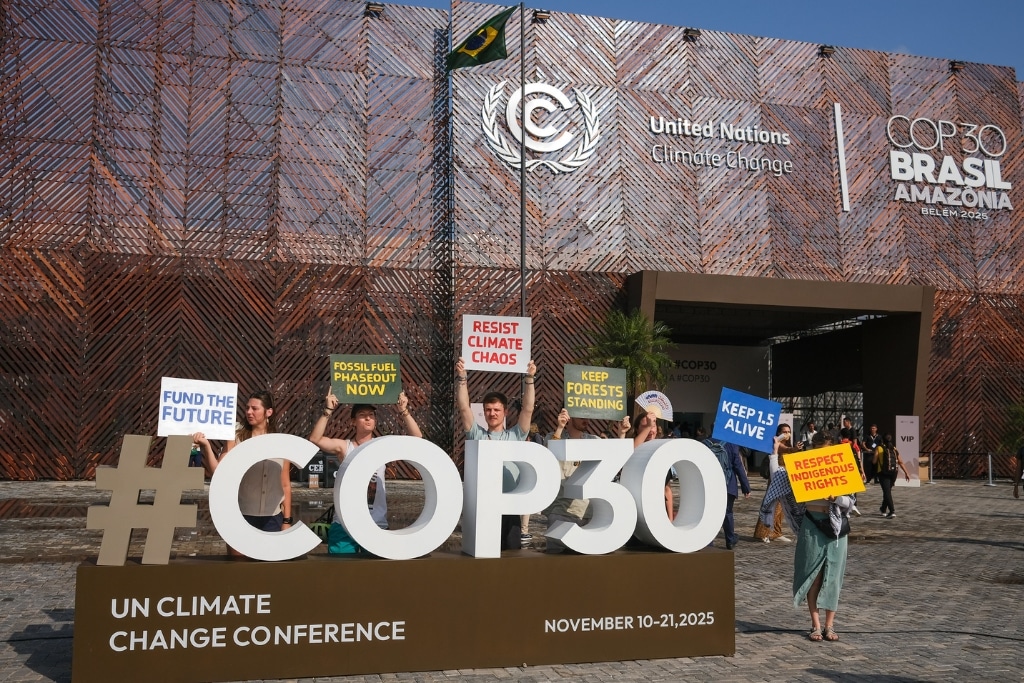
The 30th United Nations climate change conference (COP30) kicked off on Monday in Belém, Brazil Some 56,000 people are attending, making it the second-largest COP in history. Building on previous negotiations, the UN climate summit is expected to seal deals on climate finance for developing countries, carbon markets, and forest protection. Here is a recap of the main events and announcements from Week 1.
—
COP30 officially kicked off on Monday. With 56,118 delegates registered, COP30 is provisionally the second-largest COP in history, behind only COP28 in Dubai, which was attended by more than 80,000 people. Some 1,600 participants – one in every 25 – is a fossil fuel lobbyist, according to Kick Big Polluters Out. Representatives from the fossil fuel and meat industries are also in attendance.

Brazil and China sent the biggest delegations – 3,805 and 789 delegates, respectively – according to Carbon Brief. For the first time in 30 years, the US sent none, a move in line with the Trump administration’s anti-climate stance. Aside from President Donald Trump, other world leaders – including Chinese President Xi Jinping and those of Russia and Japan, Australia, Indonesia and Turkey – are also set to skip the summit.
California Governor Gavin Newsom arrived in Belém on Wednesday to attend a series of events – the highest-ranking US official to show up at COP30. Speaking on several panels, the Democratic governor accused US president Donald Trump of having “abandoned any sense of duty” by not showing up to the summit.
“I’m here because I don’t want the United States of America to be a footnote at this conference, and I want you to know that we recognise our responsibility, and we recognise our opportunity,” Newsom told the summit’s audience.

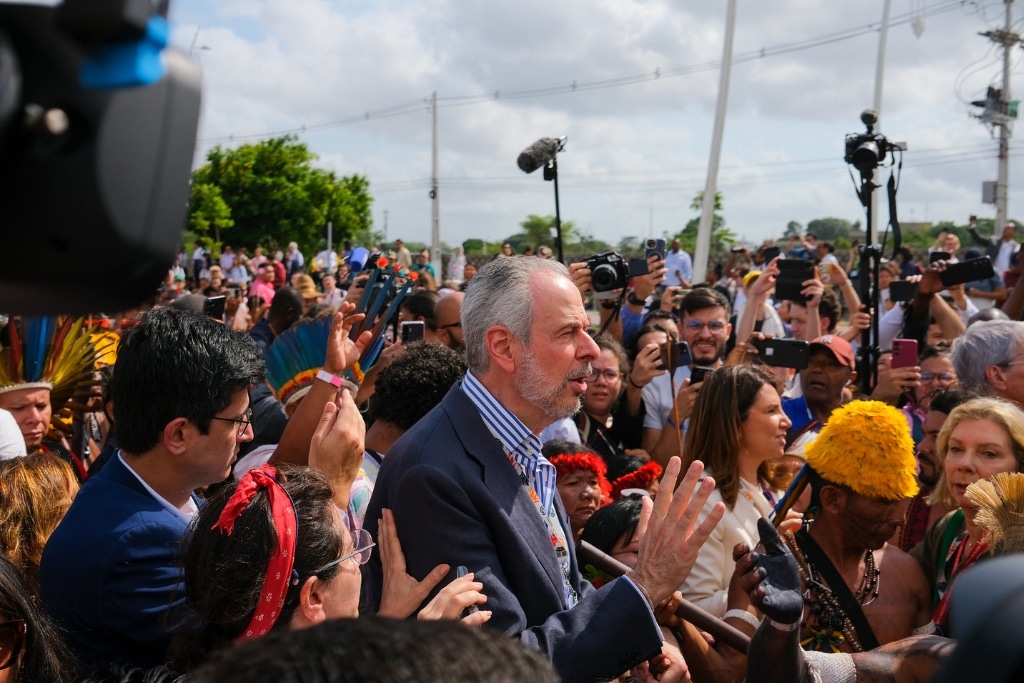
The 30th UN Conference of the Parties is taking place in Belém, Brazil, at the heart of the Amazon Basin. The Brazilian government has committed to unprecedented Indigenous participation, with some 2,500 Indigenous people attending the summit. It is the first time Indigenous leadership, rights, and knowledge are placed so centrally in global climate negotiations. Yet only 14% (360 individuals) secured accreditation for the Blue Zone, the restricted area for official negotiations, InfoAmazonia revealed.
“To be here, you need accreditation, and in my region, only two people received it. The process is also expensive. They are not interested in hearing from those who truly need to be heard,” said Lucas Tupinambá, a young Indigenous leader from the Tapajós-Arapiuns Indigenous Council and resident of Santo Amaro village along the Tapajós River. Lucas spent two days traveling by boat to reach COP30.

We have put together a list of points you can expect on two major fronts: climate finance and adaptation. And if you want to take a step back and learn more about the UN climate negotiations process, check out this guide on the history of the COP and this glossary with the key terms you will most definitely come across in the coming days.
Below is a recap of the main announcements, reports, and protests from COP30 Week 1.
More on COP30 from Earth.Org (click to view)
News
- Did COP30 Succeed or Fail?
- COP30 Week 2: Recap
- COP30 Week 1: Recap
- Reactions Pour in After Weak COP30 Agreement
- No Mention of Planet-Warming Fossil Fuels in COP30 Agreement
- Misinformation Becomes a Political Weapon Over Fire at COP30
- Business Coalition at COP30 Urges Transition Away From Fossil Fuels
- 83 Countries Join Call to End Fossil Fuels at COP30
- ‘People’s COP’ Marked By Civil Society Protests and Direct Action Events
- American States, Institutions Scramble to Fill Gap Left by US Absence at COP30
- Disability Activists Seek Official Recognition at COP30
- Brazilian Government Announces Ordinances to Recognize 10 Indigenous Lands
- Six Countries Pledge $58.5 Million to Adaptation Fund As UN Warns of $310 Billion Deficit
- Pope Leo Upholds Environmental Legacy of ‘Green’ Pope Francis, Urging Concrete Action on Climate at COP30
- Brazil to Demarcate Indigenous Territories Following Munduruku Protest at COP30
- COP30 Launches Global Declaration to Combat Climate Misinformation, Fake News
- Brazilian Government Seeks to Advance Discussion on Ending Fossil Fuels at COP30
- COP30: Fossil Fuel Lobbyists Outnumber Every Country Delegation Except Brazil
- COP30: Brazilian Government Puts Owners of the World’s Largest Beef Producer on ‘VIP List’
- Despite Record Turnout, Only 14% of Indigenous Brazilians Are Expected to Access Decision-Making Spaces at COP30
- Countries’ Climate Pledges Put World on Track for 12% Reduction in Emissions, UN Says
- Current National Climate Pledges Fall Far Short of What Is Needed to Limit Warming to 1.5C, Report Shows
Explainers
- COP30 Glossary: What You Need to Know About This Year’s UN Climate Summit in Brazil
- COP30 Volunteers Make World’s Biggest Climate Event Possible
- Navigating COP: A Deep Dive into the UN Climate Conference Process
- Oceans at COP30: Moving Beyond Pledges to Build an Architecture for Change
- Climate Adaptation at COP30: What to Expect
- Climate Finance at COP30: What to Expect
- Explainer: Why Gender Will Be High on the Agenda at COP30
- COP30 Volunteers Make World’s Biggest Climate Event Possible
- COP30 Youth ‘Go Bananas’ for Nuclear
Opinion
- Why COP30’s Success Depends on Comprehensive Food System Action
- Why COP30 Needs Indigenous Voices
- At COP30, Wealthy Nations Must Close the Adaptation Gap – My Home of Bangladesh Depends on It
Pre-COP30
- US Will Not Send High-Level Representatives to COP30, White House Says
- EU Agrees on Weakened Emissions Reduction Target Ahead of COP30
- 40 Elite Athletes Call for Urgent Adaptation Finance at COP30 Amid Climate Threat
- UN Climate Chief Urges Countries to Step Up Climate Action, Finance Ahead of COP30
- COP30 Host Brazil Calls For Bold National Emissions Reduction Plans Ahead of September Deadline
- COP30 Presidency Calls For Initiatives to Promote Information Integrity Amid Rampant Climate Disinformation
- Local Leaders to Tackle Climate Issues in Brazil Prior to COP30
- UN Climate Chief Says Energy Transition ‘Unstoppable’ Despite US Exit From Paris Accord, Urges Countries to Deliver on Climate Finance at COP30
Finance
Loss and Damage Fund
On Monday, a long-sought fund for responding to climate change-caused loss and damage launched its first call for project proposals, with the initial package totaling $250 million. Countries vulnerable to climate change have six months to submit funding approvals from mid-December, with grants of up to $20 million per project expected to be disbursed from mid-2026.
The Loss and Damage Fund was launched at COP27 in Sharm El Sheikh, but sat mostly empty until now. In March, President Trump withdrew the US from the fund’s board. It was not clear from the letter whether this also meant the country was pulling out entirely from the fund, which is hosted by the World Bank.
As of June 30, a total of US$788.80 million has been pledged to the fund, mostly from European countries. $17.5 million came from the US.

Baku to Belém Roadmap to 1.3T
Last week, the UNFCCC issued the Report on the Baku to Belém Roadmap to 1.3T. The document aims to “provide a coherent action framework reflecting initiatives, concepts and leverage points to facilitate all actors coming together to scale up climate finance in the short to medium term.” It outlines five “action fronts” to help deliver on the $1.3 trillion aspiration, incorporating regional considerations, with a deliberate focus on addressing the needs of the poor and particularly vulnerable, including Small Island Developing States and Least Developed Countries. It also sets out short-term deliverables.
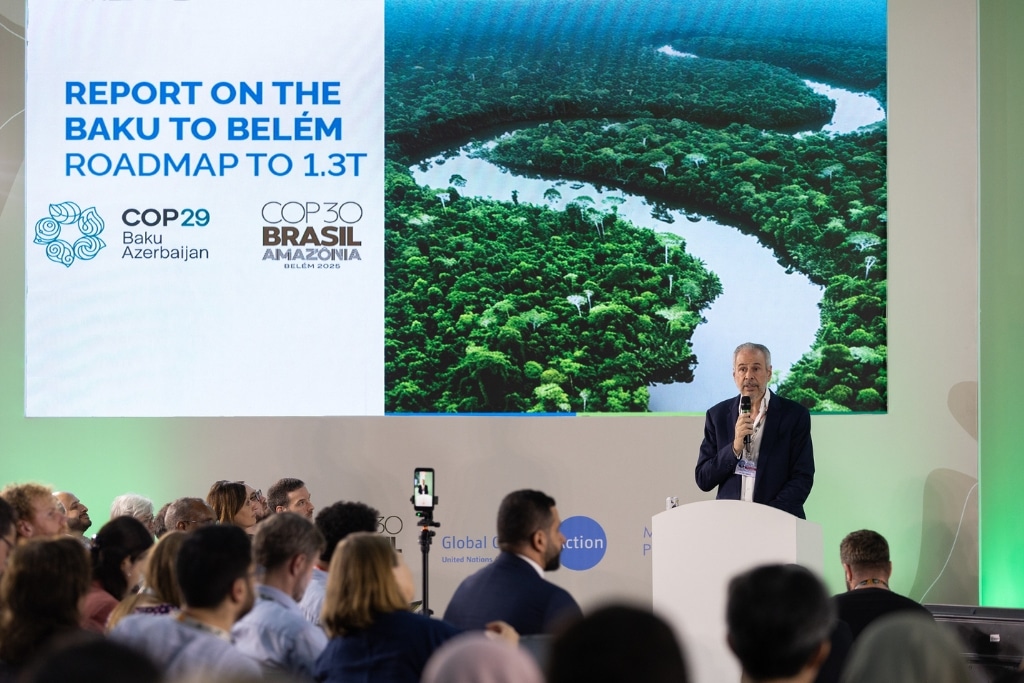
Meanwhile on Thursday, the Independent High-Level Expert Group on Climate Finance (IHLEG) laid out what it calls an “entirely feasible path” to mobilizing $1.3 trillion in climate funding for developing countries by 2035. It comes as negotiations on a pathway to scale up climate finance from a large variety of sources from last year’s $300 million pledge to $1.3 trillion are underway.
The group, chaired by economist Nicholas Stern, says about half of the $1.3tn could be met by the private sector.
More on the topic: Brazilian Government Seeks to Advance Discussion on Ending Fossil Fuels at COP30
Philanthropies
On Thursday, a coalition of more than 35 leading global philanthropies announced a joint $300 million commitment to tackle the escalating public health crisis driven by climate change. Funders include Bloomberg Philanthropies, the Gates Foundation, Wellcome, Rockefeller Foundation, IKEA Foundation and CIFF.

“The immediate focus for the first $300 million will be to accelerate solutions, innovations, policies and research on extreme heat, air pollution and climate-sensitive infectious diseases. The funds will also strengthen the integration of critical climate and health data to support resilient health systems that protect people’s lives and livelihoods,” according to a press release.
Meanwhile, a report published this week by the ClimateWorks Foundation found that philanthropic funding for climate adaptation and resilience efforts worldwide reached $870 million last year – a historic high.
More on what to expect from COP30 on finance here.
Reports
Global emissions
Speaking of reports, the International Energy Agency (IEA) just launched its 2025 World Energy Outlook, which shows that more renewables will be built between now and 2030 than in the last 40 years combined. Oil and coal are expected to peak by 2030.
A separate analysis by Carbon Brief revealed that China’s CO2 emissions have now been flat or falling for 18 months, with the country hitting its target of peak CO2 emissions well ahead of schedule. China is the world’s largest single greenhouse gas emitter. Massive growth in solar and wind power generation – by 46% and 11%, respectively, in the third quarter of this year – compensated for a rise in demand for electricity.

NDC update
On Monday, UN Climate Change Executive Secretary Simon Stiell unveiled a graph showing that the historic 2015 Paris climate agreement is working.
Without the agreement, we would be looking at an increase of emissions between 20-48% by 2035 compared to 2019 levels. But 86 new national climate plans submitted by 113 countries ahead of COP30 – also known as Nationally Determined Contributions – put us on track to cut emissions by 12% in the next 10 years.
“That’s a big deal,” said Stiell. “We are now bending the curve of planet heating emissions downwards – for the very first time.”

This doesn’t mean we are doing enough.
Atmospheric concentrations of all three major greenhouse gases – CO2, methane and nitrous oxide – all reached record levels in 2024, and are set to increase further this year. Climate Action Tracker now estimates that the world is on track for 2.6C of warming.
Deforestation
Tropical Forest Forever Fund
Brazilian President Luiz Inácio Lula da Silva last week announced his flagship initiative to pay for forest conservation, known as the Tropical Forest Forever Fund. 53 countries have endorsed the fund, but its initial investment target of $25 billion was cut back significantly, with only five other nations – Norway, Indonesia, Portugal, France, and the Netherlands – committing significant money. A total of $5.5 billion have been pledged so far.
China has reportedly declined to invest in the fund, arguing that developed nations should bear primary responsibility.
Land rights
A dozen countries have pledged to formally recognize land rights across 80 million hectares inhabited by Indigenous, Afro-descendant and other communities by 2030.

Carbon Markets
Another one of Lula’s flagships initiatives at COP30 is a coalition aimed at improving collaboration on carbon markets by aligning practices and standards. The European Union and China joined it last week, along with the UK, Canada, Chile, Armenia, Zambia, France, Mexico and Germany.
“Brazil believes that integrating carbon markets could be one of the most important legacies of COP30 as it would facilitate trade and ultimately help to curb emissions,” according to Bloomberg.
Climate Disinformation
Wednesday saw the launch of the Declaration on Information Integrity on Climate, bringing together countries, UN agencies, and civil organizations in a global commitment to combat misinformation that threatens the fight against the climate crisis. 12 countries have so far signed the declaration: Belgium, Brazil, Canada, Chile, Denmark, Finland, France, Germany, the Netherlands, Spain, Sweden and Uruguay
The Declaration calls on governments to create policies of transparency and safety for journalists, scientists, and environmental advocates, and to ensure public access to climate data. It also encourages the private sector to adopt responsible and transparent advertising practices and invites funders and universities to support information integrity projects, especially in developing countries.
The urgency expressed in the Declaration on Information Integrity on Climate, launched at COP30, is backed up by science. Recent studies show that combating misinformation is as essential as cutting emissions to tackle the climate crisis.
It marks the first time that any states have formally committed to rooting out climate misinformation.
Read more on this: COP30 Launches Global Declaration to Combat Climate Misinformation, Fake News
Protests
Indigenous protesters storm venue
Media reported “chaotic scenes” at COP30 on Wednesday after a group of Indigenous protesters stormed the conference’s venue, clashing with security guards. Politico called it the “most serious act of unrest seen in years” at a COP. The protesters were demanding greater Indigenous representation in the conference’s discussions.
Gabriel Braga, a student and spokesperson for the movement, said: “It’s not possible to discuss a new kind of society without addressing the climate. Our region was used for natural resource exploitation, decimating Indigenous peoples and their territories.”

“What happened at COP30 isn’t chaos, it’s clarity,” said Robin Roels, Policy Officer for Raw Materials at the European Environmental Bureau.
“After decades of oil and mining companies invading Indigenous lands, poisoning rivers, displacing entire peoples, and erasing cultures in the name of profit, those same communities are standing up on the world’s biggest climate stage and saying: enough. They’ve lived through genocide, land grabbing, and corporate colonisation dressed up as ‘development.’ Now, they’re bringing that truth into the halls of power, and the world can’t look away,” Roels wrote in a post on LinkedIn.
More on the topic: Despite Record Turnout, Only 14% of Indigenous Brazilians Are Expected to Access Decision-Making Spaces at COP30
On Friday, around 90 Indigenous people from the Munduruku Indigenous group staged a peaceful protest, blocking the main entrance to the Blue Zone. Access was halted for about an hour, with the army called in to reinforce security.

AgriZone
On Monday, climate campaigners confronted Big Agriculture lobbyists in a protest at the COP30 “AgriZone”, an exclusive zone at COP30 dedicated entirely to agribusiness interests and sponsored by Nestlé and Bayer.
The AgriZone is the latest development in the growing trend of COP – the world’s only multilateral decision-making forum on climate change – being co-opted by big polluters and business interests. More than 5,000 fossil fuel lobbyists have been given access to the UN climate talks since COP26, according to a recent report by The Guardian.
Industrial agriculture is the main driver of deforestation in the Amazon and responsible for a third of global greenhouse gas emissions.
The campaigners, part of the Global Campaign to Demand Climate Justice, condemned Brazil’s decision to host the AgriZone, emphasizing the danger of allowing the industry to influence the climate negotiations.

“It is deeply concerning to see a third zone popping up at COP30 dedicated entirely to agribusiness interests,” said Elodie Guillon, World Animal Protection. “Industrial animal agriculture is not only a leading cause of emissions, but a major driver of deforestation and farmed and wild animal suffering.”
In Pictures: COP30 Week 1



Featured image: UN Climate Change/Zô Guimarães via Flickr.
Follow our COP30 coverage.
This story is funded by readers like you
Our non-profit newsroom provides climate coverage free of charge and advertising. Your one-off or monthly donations play a crucial role in supporting our operations, expanding our reach, and maintaining our editorial independence.
About EO | Mission Statement | Impact & Reach | Write for us