
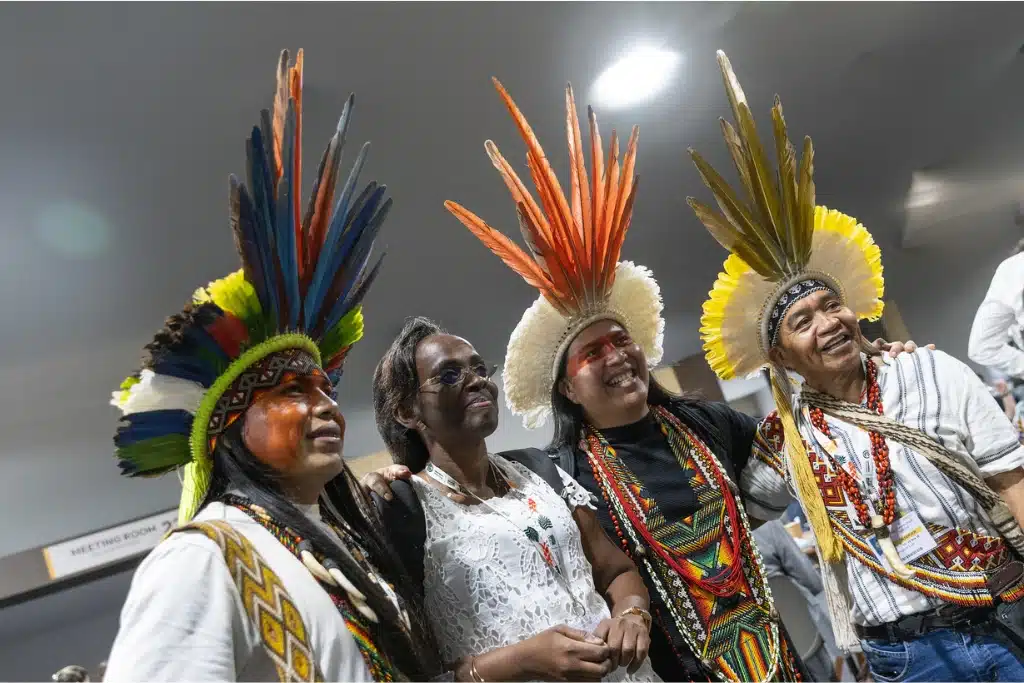
The Coalition of Indigenous Peoples of Brazil (APIB) estimates 2,500 Indigenous people from across Brazil have gathered in Belém. Leaders are demanding a bigger role in the negotiations and the inclusion of land demarcation as climate policy.
—
By Jullie Pereira
Indigenous peoples have converged on Belém to participate in the 30th United Nations Climate Change Conference (COP30), which opened Monday. According to the Coalition of Indigenous Peoples of Brazil (APIB), about 2,500 Indigenous representatives – the largest ever at a COP – are expected to attend. Yet only 14% (360 individuals) secured accreditation for the Blue Zone, the restricted area for official negotiations.
The previous record for Indigenous participation was set in Paris in 2015 and matched in Dubai in 2023, with about 350 Indigenous attendees each, according to COP30 organizers.
This turnout results from Brazilian initiatives to include as many peoples as possible in climate discussions. These include the Peoples’ Circle – an umbrella group for Afro-Brazilian, Indigenous and traditional communities – a dedicated pavilion in the Green Zone, and the COP Village, a camp welcoming participants from Tuesday.
More on COP30 from Earth.Org (click to view)
News
- Did COP30 Succeed or Fail?
- COP30 Week 2: Recap
- COP30 Week 1: Recap
- Reactions Pour in After Weak COP30 Agreement
- No Mention of Planet-Warming Fossil Fuels in COP30 Agreement
- Misinformation Becomes a Political Weapon Over Fire at COP30
- Business Coalition at COP30 Urges Transition Away From Fossil Fuels
- 83 Countries Join Call to End Fossil Fuels at COP30
- ‘People’s COP’ Marked By Civil Society Protests and Direct Action Events
- American States, Institutions Scramble to Fill Gap Left by US Absence at COP30
- Disability Activists Seek Official Recognition at COP30
- Brazilian Government Announces Ordinances to Recognize 10 Indigenous Lands
- Six Countries Pledge $58.5 Million to Adaptation Fund As UN Warns of $310 Billion Deficit
- Pope Leo Upholds Environmental Legacy of ‘Green’ Pope Francis, Urging Concrete Action on Climate at COP30
- Brazil to Demarcate Indigenous Territories Following Munduruku Protest at COP30
- COP30 Launches Global Declaration to Combat Climate Misinformation, Fake News
- Brazilian Government Seeks to Advance Discussion on Ending Fossil Fuels at COP30
- COP30: Fossil Fuel Lobbyists Outnumber Every Country Delegation Except Brazil
- COP30: Brazilian Government Puts Owners of the World’s Largest Beef Producer on ‘VIP List’
- Despite Record Turnout, Only 14% of Indigenous Brazilians Are Expected to Access Decision-Making Spaces at COP30
- Countries’ Climate Pledges Put World on Track for 12% Reduction in Emissions, UN Says
- Current National Climate Pledges Fall Far Short of What Is Needed to Limit Warming to 1.5C, Report Shows
Explainers
- COP30 Glossary: What You Need to Know About This Year’s UN Climate Summit in Brazil
- COP30 Volunteers Make World’s Biggest Climate Event Possible
- Navigating COP: A Deep Dive into the UN Climate Conference Process
- Oceans at COP30: Moving Beyond Pledges to Build an Architecture for Change
- Climate Adaptation at COP30: What to Expect
- Climate Finance at COP30: What to Expect
- Explainer: Why Gender Will Be High on the Agenda at COP30
- COP30 Volunteers Make World’s Biggest Climate Event Possible
- COP30 Youth ‘Go Bananas’ for Nuclear
Opinion
- Why COP30’s Success Depends on Comprehensive Food System Action
- Why COP30 Needs Indigenous Voices
- At COP30, Wealthy Nations Must Close the Adaptation Gap – My Home of Bangladesh Depends on It
Pre-COP30
- US Will Not Send High-Level Representatives to COP30, White House Says
- EU Agrees on Weakened Emissions Reduction Target Ahead of COP30
- 40 Elite Athletes Call for Urgent Adaptation Finance at COP30 Amid Climate Threat
- UN Climate Chief Urges Countries to Step Up Climate Action, Finance Ahead of COP30
- COP30 Host Brazil Calls For Bold National Emissions Reduction Plans Ahead of September Deadline
- COP30 Presidency Calls For Initiatives to Promote Information Integrity Amid Rampant Climate Disinformation
- Local Leaders to Tackle Climate Issues in Brazil Prior to COP30
- UN Climate Chief Says Energy Transition ‘Unstoppable’ Despite US Exit From Paris Accord, Urges Countries to Deliver on Climate Finance at COP30

Indigenous participants from Brazil attend as part of the party overflow category, which lets the country include additional representatives beyond its official United Nations delegation. The 360 credentials were transferred to APIB, which gathered nominations from regional organizations and submitted the final roster to Itamaraty, Brazil’s Ministry of Foreign Affairs.
Holders of this credential can enter negotiating areas but cannot contribute to discussions, vote or join closed meetings. Still, they can follow delegations closely, so they can interact with national experts, participate in side events and share their perspectives on negotiation priorities.

Toya Manchineri, Coordinator of the Coordination of Indigenous Organizations of the Brazilian Amazon (Coiab), believes participation is still insufficient. Indigenous leaders want to be included in Brazil’s official delegation.
“Ideally, we would participate as negotiators within the official country delegation, right? That would make a real difference. In a conversation with [Indigenous Peoples] Minister Sônia [Guajajara], I told her: ‘Minister, let’s work together so the Brazilian government considers Indigenous leaders as part of the official delegations for negotiations.’ It would make this a different COP,” he said.
Lucas Tupinambá, a young Indigenous leader from the Tapajós-Arapiuns Indigenous Council and resident of Santo Amaro village along the Tapajós River, spent two days traveling by boat to reach COP30. He attended the opening plenary session this morning, where he denounced the presence of dredgers – vessels extracting minerals from the river – around the Tapajós and demanded climate mitigation and adaptation measures.
At first, Lucas was struck by the COP30 venue but criticized its separation from the local community. “To be here, you need accreditation, and in my region, only two people received it. The process is also expensive. They are not interested in hearing from those who truly need to be heard,” he said.
He is particularly concerned about the oil agenda and resource exploitation in the Amazon. “We have to stay alert, because many events take place throughout the day. As a social movement, we must constantly monitor where these discussions are happening. Before any talks about oil, dredging Amazonian rivers, privatization or any measure that could harm the rights of Amazonian peoples, they must listen to us,” he said.

What They Want
APIB, Brazil’s leading Indigenous organization, has a clear goal for the conference: to make Indigenous land demarcation an official climate policy, enshrined in the country’s Nationally Determined Contributions (NDCs).
This push, underway for two years, is led by the We Are the Answer campaign, which has reached Indigenous communities worldwide. “Our core message is that demarcation and territorial protection are policies for facing the climate emergency. This needs not just to be acknowledged, but also implemented by global leaders – and in our case, above all, by Brazil,” said Kleber Karipuna, APIB’s executive coordinator.
APIB has championed this agenda at major events, including the Pre-COP in Brasília and Climate Week in New York. It was also presented during the COParente Cycle, an initiative under the Peoples’ Circle led by the Ministry of Indigenous Peoples (MPI) and the National Foundation for Indigenous Peoples (FUNAI), which took place in various territories.

At the opening plenary on Monday, President Luiz Inácio Lula da Silva echoed APIB’s call, urging the international community to “recognize the role of Indigenous territories and traditional communities in mitigation efforts.”
His remarks suggest possible paths forward. For Toya Manchineri, the challenge now is persuading all participating countries to include this measure in the final COP30 agreement. “For us, it’s already a victory that the president recognizes this need. Now we’ll see if he can persuade other heads of state,” he said.
Indigenous Programming
At COP conferences, Indigenous organizations participate in plenary sessions, debating issues such as territorial protection, extreme weather impacts, mining, adaptation strategies and health, among other topics.
For COP30, the presidency established the Peoples’ Circle, led by Minister Sônia Guajajara. This forum includes two main bodies: the International Indigenous Commission, with Indigenous representatives worldwide, and the International Commission of Traditional Communities, Afro-descendants and Family Farmers, bringing together delegates from 16 Latin American countries.
The Peoples’ Circle has its own pavilion at the conference, serving as a venue for climate justice debates and amplifying grassroots civil society voices who share insights from their territories.

As of Monday, the assembly of the COP Village, a camp at the Federal University of Pará (UFPA), supported by the Ministry of Indigenous Peoples (MPI), began. There, plenary debates on climate change and its impact on Indigenous lands will be held.
The Ministry of Indigenous Peoples (MPI) expects 3,000 attendees from Brazil and abroad.
“We worked closely with the COP presidency to ensure this level of participation and visibility for Indigenous peoples. I believe this will leave a legacy that extends beyond mere participation. Securing such a large Indigenous presence at COP30 in Brazil is unprecedented – a historic achievement, both in the Blue Zone and other venues,” said Kleber Karipuna, the APIB leader.
Featured image: UN Climate Change/Kiara Worth via Flickr.
—
This story was originally produced by InfoAmazonia through the Socio-environmental Collaborative Coverage of COP30, and published with edits by Earth.Org. Read the original story here.