

Last month’s COP30 featured the largest Indigenous participation ever at a UN climate summit. Yet their lack of access to the negotiating table was a stark reminder of the cultural disrespect and systemic exclusion Indigenous peoples continue to face in critical diplomatic spaces.
—
By Evke Bakker
When 150-odd Indigenous activists forced their way into the COP30 venue last month to protest the lack of progress in climate negotiations and demand stronger recognition of their rights, Jairo Arapiun was among them. The dramatic images of the scenes that followed went around the world. Jairo features in many of them, clashing with security. A powerful image that headlined countless news stories shows him being clasped by security while a fellow activist tries to break the guard’s grip.
But what most photographs fail to show is the moment when a UN security guard violently tears off his traditional headdress, known as cocar, and hurls it backwards – a painfully symbolic gesture that sums up the cultural disrespect and racism Indigenous people face in diplomatic decision-making spaces like COP.
“There is a great lack of respect toward Indigenous leadership. Our cocares are symbols of leadership, spirituality, protection of our life… When someone who isn’t authorized to touch it does so, we are very saddened, even angry,” Jairo explained days later in an interview with Earth.Org. “My headdress was torn off violently; it was violated along with me.”

He did not interpret the moment as an individual or personal attack, but rather a structured, institutional attack: “Someone told them: ‘Don’t let Indigenous peoples in, don’t let Black people in, don’t let people from the peripheries in here, because this COP is not for them.’”
Jairo is the cacique geral, the Indigenous leader of four villages of the Terra Preta territory in the Lower Tapajós region. He is also an activist with Conselho Indigena Tapajós e Arapiuns (CITA), an organization that has been fighting for the well-being of the 13 peoples of the Lower Tapajós region since its inception in the year 2000. Jairo and about 150 other Indigenous activists from the Lower Tapajós made their way across the entire state of Pará to Belém for the summit. They travelled by bus and ferry to protest the pollution and exploitation of their lands and their exclusion from the UN summit – the year’s biggest and most-awaited international climate conference.
For the 41-year-old Indigenous activist, forcing entry into the COP was a last resort: “Our lives are being decided here, and we don’t have space,” said Jairo. Although COP30 advertises to be “open to all”, and even was branded as “the Indigenous COP”, not many Indigenous Brazilians received accreditation.
Of the 2,500-odd Indigenous representatives in attendance, only 14% (360 individuals) secured accreditation for the Blue Zone, the restricted area for official negotiations. Among them, only one person came from Jairo’s region.
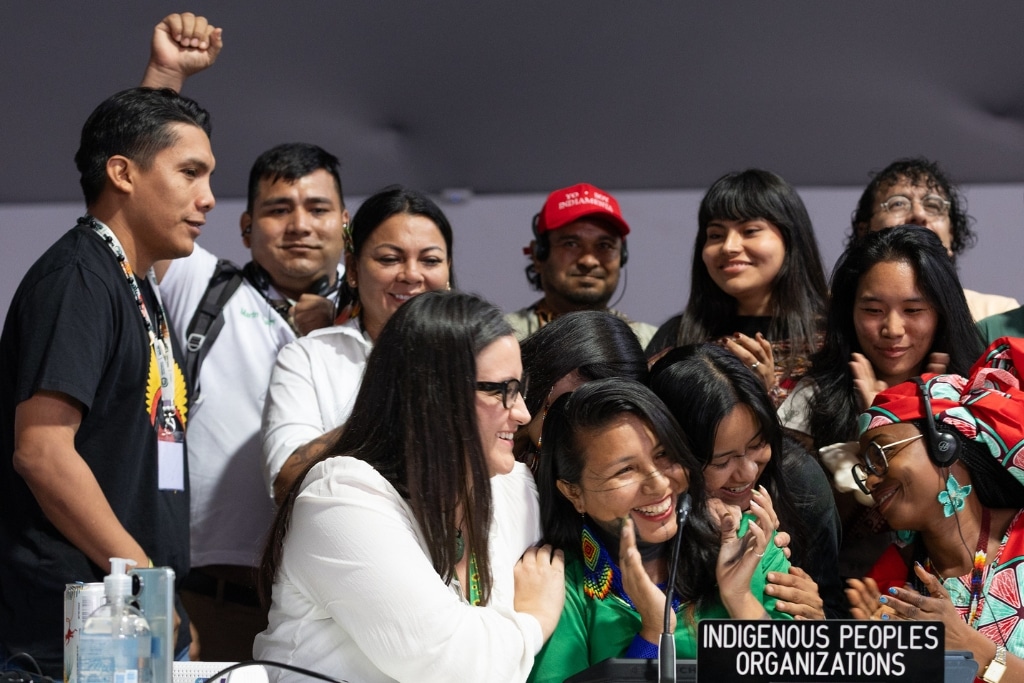
Reflecting on the pivotal events of November 11, Jairo said that they “just unfolded. There was no plan.”
“Unfortunately, there was that moment of violence, not very deep, but it happened, on both sides,” he recalled. During the struggle inside COP, both UN security guards and activists were injured.
After the protesters dispersed, an Italian activist with the grassroots movement Debt for Climate picked up the cocar. Having witnessed and filmed the moment in which the headdress was torn from Jairo’s head, he did not entrust UN security with returning it to its rightful owner. Through local networks, he managed to return it to its owner days later.
Calls to Step Up Security
Following the protest, security around the Blue Zone tightened dramatically. A leaked document shows that one day after the incident, the UN called on Brazil to increase the presence of authorities around the area. This, however, did not prevent Indigenous people from staging other protests.
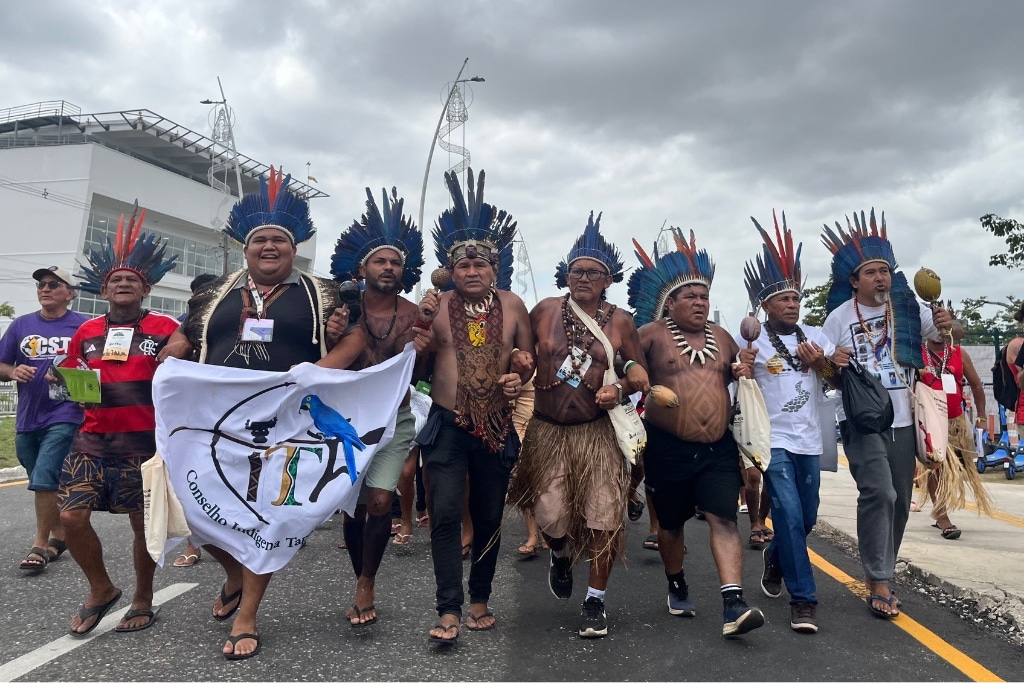
Three days after the storming of the venue, Jairo and dozens of other CITA representatives marched down the blocked roads once more, their arms linked, chanting, shaking the traditional rattles in their raised fists. They returned to the venue to insist on a meeting with the COP30 President, to advocate for the protection of their territories and rivers, and to demand a seat at the negotiating table. Earlier that day, another Indigenous movement, the Munuruku Ipereg Ayu, had managed to secure a hearing by blocking the entrance of the Blue Zone.
Protesters were met by locked gates, and behind those wait rows of soldiers in full riot gear with machine guns at the ready. The symbolism of heavily armed authorities deployed in front of the COP30 entrance and the UN flag, with Indigenous protesters chanting on the other side of the fence, is almost too on the nose. They did, however, end up securing a meeting with André Corrêa do Lago, the COP30 President, Brazil’s Environment Minister Marina Silva, and Minister for Indigenous Peoples Sonia Guajajara.

A Call for Action
“You are making deals without talking to us,” a representative from the Tapajós region said during the meeting. “If we don’t create pressure, we won’t get heard… Enough of nice words, nice speeches. We are not against the government, but you know our pain.”
Speaker after speaker, Indigenous people detailed the destruction of their territories in the Brazilian Amazon. Like the Madeira and the Tocantins rivers, the Tapajós River is in the process of being privatized. This will allow big corporations to legally exploit its natural resources at the expense of the Indigenous population.
The entire region has been severely affected by mercury pollution from gold mining, which often occurs illegally: “It’s going to kill everything in the river. This is where we get our food from”, explained a member of the Tupinambá, one of several Tupi ethnic groups that inhabit present-day Brazil. “We are already contaminated”, added another speaker.
Especially for children within the communities, the consequences of mercury poisoning are severe: “It’s very painful to see. Children are having lung, skin and breathing problems and many other issues and diseases from the poison that is thrown in the air – and it spreads,” said someone. Mercury is used by miners to separate gold from the soil – the toxic heavy metal is often mixed with sand or mud. Once it reaches waterways, it does not degrade on its own and instead accumulates in plants, animals, and everyone above them in the food chain.
Indigenous land defenders had another demand: to be included in the decision-making process, so that solutions can be found together: “We don’t want a COP that is only paper and theory. We want a COP that hears the forest and answers the forest. We don’t want our Amazon to be swallowed by greed,” said one of them.
What they got, however, was familiar bureaucracy: reassurances, praise for dialogue, vague commitments.
“You people from the Tapajós are our highest priority,” said Joênia Wapixana, President of FUNAI, the Ministry for Indigenous Peoples. She went on to explain that FUNAI is severely underfunded and understaffed, with some protective land processes facing decade-long delays.
When Corrêa do Lago took the microphone, he downplayed the link between global climate negotiations and Indigenous territorial rights: “Be assured that there is no threat”, he said, disregarding the fact that the number of fossil fuel lobbyists at the UN event outnumbered every country’s delegation except Brazil’s, and that the Amazon region is especially vulnerable to the consequences of climate change. Later, he admitted that perhaps the government “should have consulted more” with the Indigenous community.
The meeting concluded after two hours without real commitments being made. “It was cheap talk, superficial. I didn’t feel included,” Jairo told Earth.Org.
The following day, the Brazilian government announced that it will advance in the demarcation of 10 Indigenous lands and territories. Within these territories, the environment as well as Indigenous cultures will fall under the protection of Brazilian law. While it might seem like a win for Indigenous communities, the actual protection lies in the enforcement of these demarcations. Whether the demarcation of these territories will actually bring relief to the affected communities remains to be seen.

Safety Concerns
Threats and violence against Indigenous defenders are not uncommon in South America. By defending their territories and rights, Indigenous people often get in the way of powerful players within criminal networks, agrobusiness, economy, and politics.
Only Colombia surpasses Brazil as the deadliest country for land defenders, especially for those of Indigenous background. A recent event is yet another testament of this shameful legacy: on November 16, Vicente Fernandes Vilhalva, a Guarani Kaiowá Leader in the South of Brazil, was murdered in a brutal attack by private security personnel on his community.
Three days after our interview, Jairo and the other frontline defenders from the Lower Tapajós experienced this threat first-hand. Due to severe concerns for their safety in Belém, which Earth.Org was asked not to disclose, they were forced to leave the city as negotiations entered a second week.
Although they were forced to leave prematurely, Jairo and other Indigenous activists managed to take a clearer stance at COP30 than any minister or head of state. By physically entering this enclosed space where their livelihoods were being negotiated without them, they caught the world’s attention.
Negotiators have failed to provide concrete roadmaps for a fossil fuel phase out and the protection of tropical forests. Paradoxically, the summit can still be considered a breakthrough: unlike any other COP before, it brought together the voices of Indigenous groups, civil society organisations, and activist movements from all over the world. For the entire two weeks of negotiations, the streets of Belém erupted with mass mobilizations, civil society conferences like the People’s Summit and several actions inside and outside the Blue Zone. Each of these events resisted false solutions, empty promises, and political inaction. Even though this year’s COP has failed us like the ones before, it has made one thing clear: people power is rising, and it is becoming impossible to ignore.
Featured image: Anderson Coelho.
—
About the author: Evke Bakker is a freelance journalist based in Germany. She mainly reports on environmental and climate issues and has a knack for social justice topics. Evke started out in local journalism and has previously worked for an environmental NGO.
This story is funded by readers like you
Our non-profit newsroom provides climate coverage free of charge and advertising. Your one-off or monthly donations play a crucial role in supporting our operations, expanding our reach, and maintaining our editorial independence.
About EO | Mission Statement | Impact & Reach | Write for us