

Hong Kong is waging a war on single-use plastics – from local cafes to five-star hotels – as the city tries to curb waste piling up each day in its landfills and seas. Residents dump around 2,000 tonnes of plastic a day, with barely 17% recycled.
—
Additional reporting by Daisy Wu, Felice Liang, Molly Liu, Yannie Huang
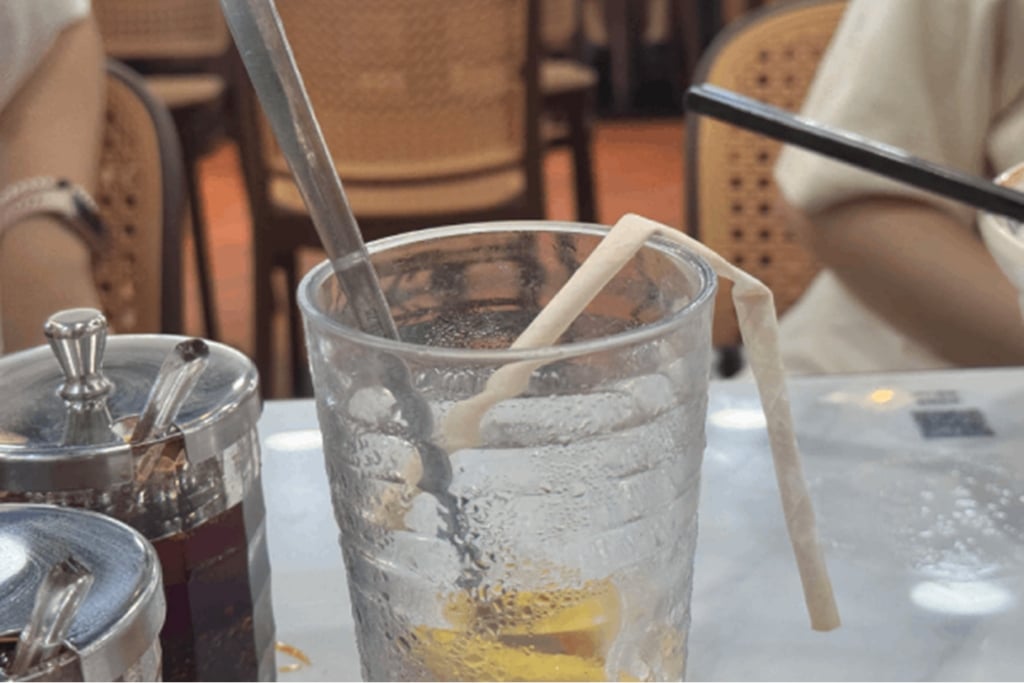
On a summer afternoon in Causeway Bay, retiree Jiahua Wong sat in Milk Café swirling her iced lemon tea until the paper straw collapsed, making it impossible to stir or sip. Like millions in Hong Kong, she is adjusting to the city’s new ban on single-use plastics.
“Paper alternatives are a good idea in general,” 73-year-old Wong told Earth.Org. “But when you’re drinking, the paper straws get soggy too fast. It ruins the experience.”
Since April 2024, restaurants, retailers and hotels have been barred from handing out plastic tableware such as straws, stirrers and cutlery. The move targets growing waste in a city of 7.5 million people, where residents dine out or buy takeaway meals several times a week, a survey showed.
In 2019 alone, each resident threw away 1,940 pieces of plastic cutlery, contributing to a daily dump of around 2,000 tons of plastic waste – roughly the weight of six jumbo jets. Barely 17% is recycled, leaving most plastic to languish in landfills for hundreds of years or break into microplastics in the city’s coastal waters.
A Big Shift in a Takeaway City
Hong Kong is now trying to catch up with its Asian neighbors. Taiwan began phasing out disposables in 2002 and plans a full ban by 2030. South Korea banned plastic and paper cups in 2018, with a decade-long roadmap to reduce waste. Both have enforced waste charging, regulated packaging and pushed reusables for years – measures Hong Kong is still only discussing.
The catering sector worried about higher costs and a drop in business from a ban, said Simon Wong, President of the Hong Kong Federation of Restaurant and Related Trades. “But people have got used to it,” said Wong. “Since the ban, restaurant operators use less plastic, save costs and even some customers bring their own food containers.”
Hong Kong-style cafés like cha chaan tengs, chain stores and snack shops have switched en masse to compostable or “sustainable” single-use alternatives. Officials said in April that caterers cut disposable cutlery use by 30 million sets, and estimated the ban could reduce twice that amount every year. Meanwhile, hotels slashed single-use plastics like water bottles and toiletries by over 80%. Major chains said that 80% of customers refused takeaway cutlery and nearly a third of outlets have stopped offering them.
Yet there are holdouts. By April, inspectors had visited 48,000 premises and issued 144 warnings. Twenty-one were “persistently incompliant” and fined. Retiree Wong said some “might be too busy to hear you and ignore your request, still putting utensils in the bag.” She brings them home and reuses them.
For small restaurant owners, compliance comes at a price. At Ho Lo Kee, a Chinese eatery in Shek Tong Tsui, 38-year-old owner Leo Ho has watched costs rise by HK$2 to HK$3 per meal set after switching to alternatives like paper, bamboo and plant fiber – a sign that the cost is passed on to customers.

The switch also tests patience: paper bowls leak hot soup, paper straws collapse and wooden cutlery splinters. “Paper straws get mushy and taste like paper,” said 14-year-old student Morgan Choi.
Gary Zhou, an Assistant Professor at the University of Hong Kong, likes eating porridge and soupy noodles but says the alternatives for hot and liquid foods aren’t convenient. “I often find that the sauce has seeped out by the time I get home, which leads to food waste,” he told Earth.Org.
To help, the government has set up a green tableware platform where suppliers have risen from 60 to 196, offering thousands of alternative products. But the marketplace is still settling. “Some eco-friendly alternatives just aren’t up to standard yet,” shop owner Ho said.
The Case For Reuse
Swapping one kind of single-use disposable for another misses the point, said Greenpeace Campaigner Leanne Tam. Recycling small items like straws is difficult and most single-use plastic alternatives cannot be recycled in Hong Kong. “Recycling is outdated,” she said.
Instead, Tam is urging the government to invest in reusables and centralized cleaning systems, and to offer subsidies for small businesses to move away from disposables. Greenpeace’s “Borrow and Return Cup” program, launched three years ago, lets customers borrow reusable cups for dine-in or takeaway – an idea Tam says could scale citywide.
Similarly, Muuse, a Hong Kong company that partners with malls like Cityplaza and Taikoo Place, claims it has saved over 140,000 single-use cups and avoided 18,000 kilograms of carbon emissions through its reuse system. Customers borrow cups at cafes and return them for professional cleaning.
Reuse is not mandated or common in Hong Kong, but some people are already making the shift. Wong’s son brings his own tableware to work. At Ming Beef Noodle Shop, more customers bring their own steel stainless straws, “which helps save resources,” according to staffer Kelly Gong.

Simon Wong agrees that reusables are a good idea. “We don’t want to put all the waste to landfill, it’s a waste of land and costly for the environment,” he said, adding the city needs to move closer to its 2050 carbon neutral goals.
Authorities say reusables are key and since 2019 have told restaurants on its premises not to give disposables to dine-in customers. The government has also launched a free reusable program for big events, started a bring-your-own container scheme at 470 eateries and a food container rental scheme on Hong Kong island, and created an app that rewards people who skip plastic takeaway items.
Still, cost remains a hurdle. Cleaning each cup can cost up to $4, said Natasha Chawla, Hong Kong Director of Muuse. Ensuring proper hygiene is a challenge for some organizations Earth.Org spoke to exploring reusables. “Unless it scales, it will stay expensive. And until it stays expensive, nobody wants to do it,” said Chawla. “The government has to step up, provide warehouses, washing facilities and just enable it.”
Looking Out For the Next Phase
The next phase of the ban, targeting plastic takeaways cups and boxes, was slated for this year but has yet to materialize. Officials have not given a timeline, though the 2025 Policy Address promised a review of alternatives and better designs to reach the city’s “zero landfill” goal. The government said it would partner with chain restaurants to test and review alternatives in 2025.
Timing matters, Wong said, because the community needs to learn why plastics are harmful, businesses need cheaper and better alternatives, and the government must “offer more incentives for the trade and end user.” Chawla agrees, adding that tax rebates and government adoption of reusables in offices would help.
Meanwhile, environmental groups want clarity. Greenpeace’s Tam is urging authorities to set a clear timeline so businesses and consumers can “get ready”, and to invest in green products and industries, especially reusables. Major venues like the new Kai Tak Sports Park could trial reusable cups, a move Tam says could encourage chain stores and other large venues to follow.

Elsewhere, incentives work. In Canada, where Muuse also operates, a waste charging scheme makes reuse cost-effective for events and businesses. “If the government’s not able to take the stick route, how about carrots? How about recognizing the companies that are doing the right thing?” said Chawla.
Business owners say they need practical alternatives for the second stage. “This isn’t just about one store – it applies to all of Hong Kong,” said shop owner Ho. “If the government says we can’t use something, they need to give us a solution.”
Featured image: Earth.Org.
This story is funded by readers like you
Our non-profit newsroom provides climate coverage free of charge and advertising. Your one-off or monthly donations play a crucial role in supporting our operations, expanding our reach, and maintaining our editorial independence.
About EO | Mission Statement | Impact & Reach | Write for us