


Last year, a municipality in Peru granted Amazon stingless bees legal rights, the first time in the world that insects have been recognized as legal subjects. Earth.Org spoke with biologists and lawyers to understand why these tiny pollinators matter so much, and what could change for these bees, both within their immediate surroundings and globally.
—
In October 2025, a municipality in Peru made legal history. The municipal government of Satipo granted Amazon stingless bees the status of subjects of legal rights – in other words, it recognized that the stingless bees, native to the Peruvian Amazon, now have the right to exist and flourish. The move, resulting from a collaborative effort between scientists, Indigenous communities, and environmental lawyers, marked the first time insects have received such recognition anywhere in the world.
The new municipal law, Ordinance No. 33, does not single out the protection of one species – in this case stingless bees. Instead, it recognizes their close-knit relationship with local Indigenous communities, particularly the Asháninka, as well as with the Amazon ecosystem as a whole. These legal recognitions reflect both the build-up and parallel processes behind these advocacy efforts and underscore the interconnectedness between stingless bees, Amazonian biodiversity, and the ancestral beekeeping practices and sustainable economic development of Indigenous communities.
Chemical biologist Rosa Vásquez Espinoza of Amazon Research Internacional (ARI), who is also a National Geographic Explorer and advocate for biodiversity research and conservation in the Amazon rainforest, was the leading player in this conservation battle, aided by legal experts from the Earth Law Center. Earth.Org spoke with them about their journey to ensure the protection of Amazon stingless bees, why Indigenous leadership became central to the project, and what impact their initiative is already having, both locally and globally.
The Bees and the People
Stingless bees, or meliponines, are a diverse species of bees, characterised by the lack of a functioning stinger. There are more than 600 different species of stingless bees living across tropical and subtropical regions worldwide, of which at least 175 have been found in the Amazon. Unlike their European cousins, the honey-making bee (Apis mellifera), which was brought to the Americas by settlers in the 1800s, stingless bees are native to the Americas and perform critical ecosystem services there.
In these lush, remote parts of the Amazon rainforest in Peru, Indigenous communities like the Asháninka and Kukama-Kukamiria have lived alongside the Amazon stingless bees for millennia. For these communities, as well as many other Indigenous communities of the Amazon, stingless bees are not just part of their immediate surroundings. “They are part of our family and our ancestors,” said César Ramos, President of EcoAsháninka, an organization representing 25 Indigenous communities in Peru.
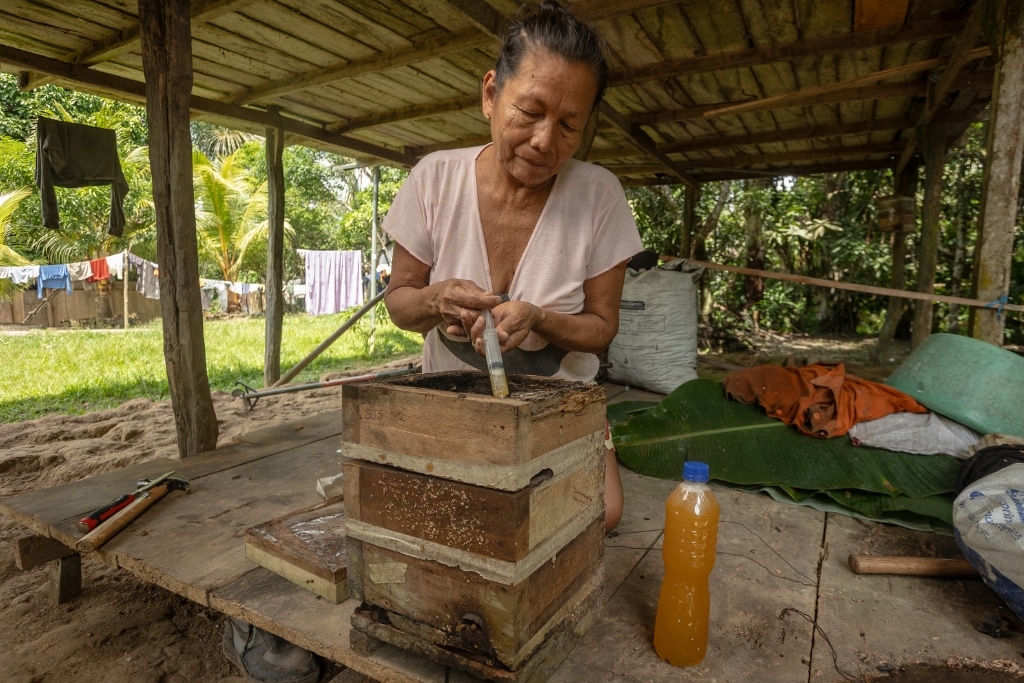
Through ancestral knowledge passed down through generations, these communities have learned how to care for the bees and collect their honey, which is said to contain magical properties, earning them the nickname “angelitas” (English for “little angels”). Some learned how to locate wild hives in the rainforest – in itself a very intricate endeavor – while others carried tree trunks with the hives home, keeping them behind their houses, in a rustic beekeeping set-up. This close-knit relationship not only mutually aided them but also benefited the ecosystem as a whole, as these angelitas represent an absolutely vital link in the local habitat, pollinating more than 73% of cultivated and native edible plants in the Amazon.
As climate and environmental pressures continue to grow, wild stingless bees are, however, becoming increasingly difficult to find, even for the Asháninka. According to local Indigenous rangers of the Asháninka Communal Reserve, spotting a wild hive, which used to take up to 30 minutes, can now take hours – and it is not always a guarantee. Because meliponines are key indicators of ecosystem health, their gradual disappearance reflects the wider deforestation and drying of the Amazon.
First Steps
In 2020, Rosa Vásquez Espinoza was in the midst of her PhD research in chemical biology in the US when the Covid-19 pandemic hit. At the time, her colleagues in Peru informed her that Indigenous communities were using stingless bees’ honey to treat the virus’ symptoms. Together with her colleague Cesar Delgado, a Kukama-Kukamiria scientist from the Instituto de Investigaciones de la Amazonia Peruana (IIAP), they set out on an expedition to sample the bees’ honey. The results of their research were astounding, revealing the honey’s truly remarkable qualities, including antibacterial, antiseptic, and even anticarcinogenic properties.
However, the more they researched the stingless bees and their natural habitat, the more they realized it wasn’t just the honey that was special. During a visit to the Asháninka and Kukama-Kukamiria communities during their expeditions to collect honey, they grasped just how important these bees are to human health and to the cultural heritage of the Indigenous communities.

Espinoza, in particular, was intrigued by this cultural and social element. As a young Peruvian woman, she received a lot of attention from women and children in the communities they visited. “I think since I looked similar, myself being a young woman, they weren’t as intimidated by me,” she told Earth.Org. She was fascinated to discover how happy the women and children were when taking care of the bees, as well as the positive economic impact it had on their lives. When gender equality came into view, Espinoza realized her science project could have a huge socio-ecological impact.
‘The Bees Are Disappearing’
When their scientific work with the meliponines in Asháninka Communal Reserve began, one of the very first observations they gathered from community members was the fear that the bees would die out. “The bees are disappearing, they are almost gone. We cannot find them anymore,” Espinoza recalled an Asháninka member telling her. “You cannot replace the bees for them. They have a cultural and a human rights perspective, as this is also the main source of medicine for the community.”

The main factors threatening the meliponines’ existence and diminishing their populations have been identified as changes in land use, particularly the conversion of natural habitats for livestock, mining, logging, and agriculture. Additional threats, including the use of chemical pesticides and competition with invasive European and African honey bees, are further driving the bees’ disappearance.
Considering the ecological, social, and economic roles of meliponines, their preservation in the Amazon is crucial to overall conservation efforts, said Espinoza. Supporting Indigenous beekeeping, she realized, would help protect declining bee populations, preserve ancestral traditions, and strengthen local Indigenous economies. In turn, this would help regenerate the Amazon itself, as stingless bees contribute to the health of the entire ecosystem, down to the soil.
The decision was made in that instant. She established the Amazon Research Internacional – a science-backed organization that specializes in conservation through and by Indigenous leadership, marking the beginning of their work with the Amazon stingless bees in the Peruvian Amazon. The project they started and led together with Delgado shows that sustainable meliponine beekeeping is successfully reforesting the previously depleted Amazon jungle.
Policy Prompted By Frustration
Starting out as a socio-ecological project, the policy aspect entered the story through sheer frustration, Espinoza recalled. When researching where to get the funding, and how to start national projects for stingless bee conservation, she stumbled across a shocking revelation: most authorities and individuals she spoke with had never even heard of the species. Only one national law in Peru mentioned bees, although not of Amazon stingless bees.
Through conversations, Espinoza discovered that the original legislative committee that worked on and passed the law in 1993 was, at the time, only aware of the existence of their cousins, the European and African honey-makers. “There was also this undeniable productivity factor that connects the two species,” she said. Both were introduced into Peru by settlers and then took over the agricultural sector. Economically, the honey-making bees were more profitable and thus protected. “The lack of any mention, and thus protection, however, over time played a part in the decline of the native species.”
The absence of a national policy basis for the protection of the meliponines tied the hands of the few eager to help, as there were no official grounds for funding or projects, let alone inclusion in national conservation programs.
Environmental Lawyers Join the Mission
A team of environmental lawyers from the Earth Law Center (ELC), a US-based law firm specializing in avant-garde environmental and animal protection, joined Espinoza’s project to help guide the advocacy and policy aspects of the mission. Inspired by the global Rights of Nature movement, the law firm advises in creating “ecocentric” laws that protect the environment and animals due to their own intrinsic value, granting them their rights as legal subjects, rather than objects of human ownership and exploitation.
Their first order of business was to amend National Law No. 32235 to include the Amazon stingless bees. They achieved that goal in January 2025, when an amendment to the law was adopted by the Congress, designating the native species as a matter of national interest. Even though the nature of law is declaratory – and thus does not grant singless bees new rights but only recognizes their intrinsic rights – it can influence national plans of action that need to be implemented by the ministries, explained Constanza Prieto Figelist, Latin America Legal Director at the ELC. “Now the national plans need to promote Amazon stingless bees as well, allocate resources and stimulate scientific research.”

Invigorated by their first win, the team started to think bigger. “As the meliponines are disappearing due to a myriad of mostly anthropocentric threats, we wondered whether we could find a way to legally protect them and their national habitat,” said Espinoza. “If you want to research and study a certain species, you need to have that species alive in its natural habitat in the first place.”
With the ELC having extensive expertise on the topic, they set the following objective: translating Indigenous knowledge and observations into legal rights for meliponines, and attaching sanctions to actions that breach those rights. The Asháninka were crucial during this phase, not only because they hold the most knowledge and first-hand observations of the bees and their changing habitat, but also because they stand on the frontlines of their protection and are therefore best positioned to monitor the law’s implementation.
Indigenous-Backed Action
To start collecting suggestions and observations, ELC lawyers Javier Ruiz and Bastian Nuñez held workshops with the Indigenous communities. “What factors have you observed harming stingless bees in the Asháninka Communal Reserve?” was one of the questions asked to a classroom full of interested participants. Slowly, hands began to rise: “Climate change!”, “Logging and land use!”. Participants would be asked to write their answers on the blackboard. This was repeated across different communities in the municipality of Satipo, gathering more than 200 participants, Ruiz explained.
The lawyers then took those answers and drafted a declaration – a non-binding legal document which summed up the issues and presented potential legal and practical solutions in a broader manner. The text was taken back to the communities, who were asked whether they agreed with it and whether it fairly represented their opinion, giving everyone a chance to voice their opinion. The document was well received, and with the declaration finalized, the ELC lawyers turned to the next obstacle: converting it into binding municipal law in Satipo, home of the Asháninka Communal Reserve.

To facilitate this, the ELC lawyers also worked to foster collaboration between Indigenous communities and the wider population of Satipo. “We fostered the idea of building an alliance between the Indigenous communities and the Satipo municipality, helping them work together, rather than framing the issue of stingless bees as a point of contention,” said Ruiz. This was going to be helpful not only with the passing of the law but also its implementation and enforcement.
Another Win for the Rights of Nature Movement
On October 21, 2025, the provincial municipality of Satipo, Peru, approved Ordinance No. 33, recognizing Amazon stingless bees as subjects of legal rights. The ordinance establishes that the Amazonian stingless bees hold intrinsic rights, such as the right to exist, to maintain healthy populations, to live in a healthy environment, to conserve and regenerate their habitat, and links their protection to the comprehensive conservation of the Amazon. The law further promotes interdisciplinary research, integrating scientific knowledge with Indigenous knowledge in the conservation of Amazonian stingless bees.
What began as a small project to collect and analyze stingless bee honey in 2020 ultimately led to an important and innovative precedent for the Rights of Nature movement five years later, sending ripples around the globe.
But what exactly makes this law so innovative? Previously, animals, nature, or parts of nature were protected only if damage done to them caused detrimental effects to humans. Their protection, which therefore occurred as a side effect rather than the main prerogative, was solely due to the protection of human benefit and not because of an animal’s or nature’s intrinsic value. On the contrary, Ordinance No. 33 today protects the Amazon stingless bees as subjects of rights, and if a certain activity harms them, the damage is calculated based on the direct harm inflicted upon the meliponines.

In practical terms, the ordinance requires municipal decision-makers in Satipo to consider the bees’ rights when making any decision that could potentially harm them, either when deciding on permits or authorizations or when enforcing sanctions against those who violate their obligations under the ordinance. The municipal environmental controls and standards that now need to be applied are thus stricter and solely focus on the well-being of the stingless bees.
Never before had any insect been granted such recognition and protection.
What Does the Future Hold?
Espinoza and ELC’s actions have since grown beyond their local constraints and gained nationwide attention. The ordinance inspired similar action across Peru. The municipality of Nauta adopted its own version in December 2025, while a global petition was launched to adopt the substance of Satipo’s Ordinance No. 33 at the national level. To date, the petition has garnered more than 390,000 signatures, and promises that, with enough signatures (500,000 was set as the goal), Indigenous allies will deliver the petition and its demands directly to Peru’s lawmakers.
In the meantime, Delgado and Espinoza have continued in their mission to work with Indigenous communities to train those interested in stingless beekeeping. Their next step is to establish a fair-trade economic system that will benefit both communities and the ecosystems they help protect. This way, the relationship between stingless bees and their keepers has taken on a new meaning: a reminder that science, Indigenous knowledge, and law can work together to safeguard both nature and the people who live alongside it.
Featured image: Luis Garcia Solsol.
You might also like: Should Nature Have Rights? A Critical Analysis of Ecocentrism and the Future of Water Protection
This story is funded by readers like you
Our non-profit newsroom provides climate coverage free of charge and advertising. Your one-off or monthly donations play a crucial role in supporting our operations, expanding our reach, and maintaining our editorial independence.
About EO | Mission Statement | Impact & Reach | Write for us