Western Europe is sweltering under record heat this week, with red alerts in place in the UK, Germany, Austria, Switzerland, Italy, Spain and France.
—
France saw its hottest day ever recorded on Wednesday as the national average temperature, which averages day and night temperatures, reached 30C. It broke the record set only a day earlier.
Temperatures climbed as high as 42C in Nantes, a major metropolitan city in western France, as millions of people across the country continue to grapple with one of the most intense and long-lasting heatwaves the country has ever seen. The unprecedented temperatures prompted a record 58 of 96 mainland departments to be placed under red heatwave alerts – the highest warning level – on Wednesday. Conditions are expected to worsen further on Thursday, when a historic 72 departments will be under red alert.
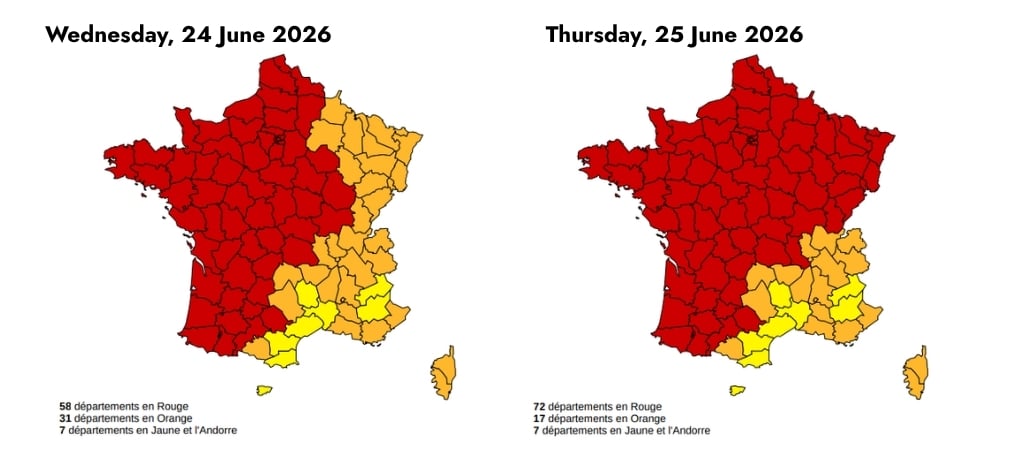
Year after year, the pattern repeats – each iteration more severe than the last. Wildfires, warped rail lines, shuttered schools, and a climbing death toll are no longer freak occurrences; they are the definitive markers of the modern European summer.
During an emergency crisis meeting with other government officials on Tuesday, Prime Minister Sébastien Lecornu said that since June 18, at least 40 people have drowned while swimming in unsupervised areas such as lakes or canals, noting that “most of the victims are young people.” He called the drownings “a tragic scourge.”
Lecornu also described the heatwave as an “episode of exceptional intensity.” Yet the word “exceptional” seems somewhat inappropriate. This is France’s – and Western Europe’s – second heatwave in a month, and the national forecaster is already predicting a “high probability” of extreme heat returning in the second week of July.
France is also one of the world’s most popular tourist destinations, welcoming more than 100 million visitors in 2025, many of them during the peak summer season. As temperatures soared this week, major tourist attractions such as the Eiffel Tower and the Louvre were forced to close temporarily and shorten their opening hours.
Louvre officials said that “although parts of its historic building are naturally resilient, the museum remains vulnerable and is not sufficiently adapted to climate change,” according to the Associated Press. They added that “heat buildup is greatest toward the end of the day and intensified by high visitor numbers.”

Europe Swelters
The case of France is in no way an isolated incident. Most of Western Europe also faces punishing temperatures as a result of a heat dome – where warm air from Northern Africa is trapped under a high-pressure system over the continent, lingering for days. It works like a lid on a pot, trapping hot air underneath.
But scientists say heatwaves like this one are becoming more frequent and intense as the planet continues to warm and that the connection between greenhouse emmissions and extreme heat is “indisputable.”
The UK recorded its hottest June day on record on Wednesday, with temperatures reaching 36.1C in Gosport, Hampshire. It broke the nation’s 50-year-old record high of 35.6C set in 1976. The Met Office issued its second extreme-heat weather warning in history earlier this week, forcing hundreds of schools to close.
In Italy, the health minister declared a red heatwave alert in 16 cities including Florence, Milan and Rome, while spikes in air-conditioning use led to blackouts in Milan and Turin. In Parma, health officials said that over 1,000 people had been admitted to emergency services since June 20 due to heat-related conditions.
German officials reported six drowning deaths over the weekend as the country struggled to mitigate the effects of the ongoing heatwave. At the same time, concerns are growing over worsening drought conditions in regions such as Brandenburg and North Rhine-Westphalia, where officials have urged residents to conserve water, the BBC reported. Meanwhile, the German Weather Service has forecasted temperatures exceeding 30C across much of the country and approaching 40C in some western and southern areas on Thursday.
The Netherlands, Switzerland and Spain are facing similar challenges. On Monday, 101 of the 828 weather stations across Spain recorded temperatures of 40C or higher. Nearly all of the country was under a heat alert on Tuesday, with warnings of extraordinary danger issued for areas surrounding Córdoba and parts of Cantabria. In the southeastern province of Almería, nighttime temperatures remained above 30C for three consecutive nights. Even in the historically cooler city of San Sebastián in northern Spain, temperatures this week are set to reach 40C, Al Jazeera reported.
Tedros Adhanom Ghebreyesus, Director-General of the World Health Organization, urged European leaders to “prioritize investment in climate-resilient health systems and accelerate climate action.” Heat is extremely dangerous for the human body and heat-related illnesses can be deadly if not promptly treated.
Yet the challenge facing policymakers is no longer whether action is needed, but what form that action should take. As Europe continues to warm faster than any other continent, governments are being forced to confront a reality for which much of the continent’s infrastructure and public health systems were never designed.
The recent heated political debate in France over expanding access to air conditioning illustrates the broader issue of how societies should adapt to increasingly extreme temperatures while addressing the underlying causes of climate change. There is no evident or easy solution. What is clear, however, is that the cost of inaction is becoming increasingly difficult to ignore.
More on the topic: UK Climate Adviser Calls for Rapid Expansion of Air Conditioning As Climate Crisis Intensifies
💡How to stay safe in extreme heat
- 💧Stay hydrated: Drink around two liters of water per day, or about eight glasses. In heat conditions, experts recommend drinking throughout the day and urinating around six to seven times a day, or every two to three hours.
- 🍉Eat nutritious food: Stick to hydrating, fresh food such as watermelon, peaches, berries, grapes, and oranges, vegetables that can be juiced, as well as liquid meals such as soups. Avoid spicy foods, known to make the body sweat. Avoid cooking at home, and opt for the microwave instead of the oven if you have to.
- 💦Exercise responsibly: If you exercise outdoors, take breaks in the shade or indoors to allow your body to cool down faster. Wear sensible attire, such as lightweight, loose-fitting clothing made of breathable fabrics, such as cotton, linen, bamboo, polyester, nylon and microfiber. Hydrate well before a workout and drinking throughout every 15-20 minutes, especially when the physical activity lasts longer than an hour.
- 🌡️Follow local weather services: Check local meteorological services or news channels regularly, as they provide real-time updates and alerts about heat advisories and warnings. Local governments and emergency management agencies often post timely updates on social media platforms as well so keep them monitored.
- 📱Use weather apps: Download reputable weather apps that provide notifications about extreme heat conditions. Many of these apps allow users to set alerts for specific weather events in their area.
- ❗Sign up for emergency alerts: Many cities have rolled out local emergency notification systems or community alert programs that citizens can easily enroll in. These services often send text or email alerts directly to residents during extreme weather events, including heatwaves.
For more tips, check out our article on this topic. To learn more about the risks of extreme heat and how the world is adapting, you can read our 3-part series on extreme heat.
This story is funded by readers like you
Our non-profit newsroom provides climate coverage free of charge and advertising. Your one-off or monthly donations play a crucial role in supporting our operations, expanding our reach, and maintaining our editorial independence.
About EO | Mission Statement | Impact & Reach | Write for us