Delegates from nearly 200 nations failed to agree on the final draft of the COP31 agreement as they clashed over the inclusion of any mention of fossil fuels.
—
COP31 talks collapsed Sunday as European and climate-vulnerable nations, including many Pacific Island Nations, rejected a draft agreement after Saudi Arabia, Russia and other petro-states blocked any mention of the leading cause of the climate crisis: fossil fuels.
The two-week summit in the Turkish city of Antalya marks the third time the UN climate talks failed to reach an agreement. It only ever happened at COP15 Copenhagen in 2009 and at COP6 in The Hague in 2000.
This year’s talks came at what commentators have described as a “low point” for global multilateralism and cooperation. The outcome “may be more about the nature of the modern world community” than the failure of the COP31 Presidency, the BBC said.
Follow Earth.Org as we gather reactions from around the world.
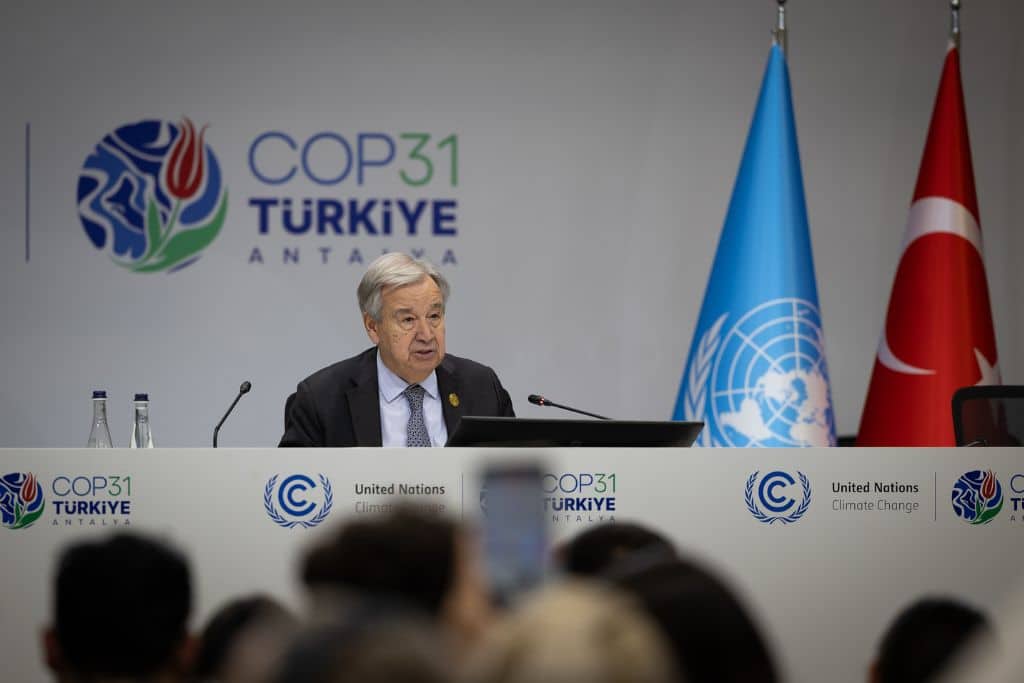
António Guterres, Secretary-General of the United Nations
I share the very profound frustration of all those who expected governments to rise to the moment the climate crisis demands. But this setback does not change the facts. There may be no consensus in the negotiating room. There is no ambiguity in the science.
Temperatures keep shattering records. Climate extremes keep intensifying. Emissions remain far too high. And every delay makes our task harder and more costly. The world is now poised to exceed the globally-agreed limit of a 1.5 degree temperature rise. The window to keep that overshoot as short and shallow as possible is rapidly closing.
The take-home message from COP31 is clear: the world must do much more to confront the climate crisis – and it must do it now.
UN Secretary-General António Guterres holds his final press conference at COP31. Photo: UN Climate Change/Kiara Worth via Flickr.
Amina J Mohammed, Deputy Secretary-General of the United Nations
People paying the highest price for a crisis they did the least to cause looked to #COP31 for leadership to act to address the climate crisis that is costing lives, destroying homes and economies, and threatening the future of generations to come. As the Secretary-General has said, there is no ambiguity in the science. Climate change is a reality experienced by communities across our planet, and no country or region will be spared its dire consequences. Today we lost a battle, but we must continue to fight for climate justice and the promise of Paris, lest we all suffer the inevitable consequences.
Simon Stiell, United Nations Climate Change Executive Secretary
I share the deep disappointment of many: COP31 has been unable to agree on issues related to both Presidency’s led decisions. Our process must follow the science and meet the challenge. At this COP, key negotiating decisions have been made including on a Just Transition. Fairness and inclusion in the climate fight is absolutely essential.
But climate impacts are worsening the world over… fossil fuel costs are driving inflation through every economy… and 1.5 overshoot is approaching: The world cannot afford a repeat of this moment. Our process – including the rulebook and precedents – are designed to bring almost 200 countries together.
As we have seen repeatedly over the past decade, that delivers results. Agreeing temperature targets, new climate finance goals, to transition away from fossil fuels, in a just, orderly, and equitable manner. And a global goal on adaptation, there are lessons that must be learned.
This process belongs to 194 Parties. Consensus works best from the ground up. With full transparency, taking time to listen to all views, always building on what came before. Clearly there is also scope to improve, modernise, and reform. But not only because of what happened here. But also, because we must evolve, in this era of implementation.
We must also recognise that this COP process has two tracks. And across the Action Agenda, COP31 has delivered real progress and concrete results. Landing solutions across its six axes: From transforming agriculture and food systems to building resilience for cities and infrastructure. Through individual country pledges and the Leaders’ Summit, COP31 has shown that around half the global economy is accelerating electrification. The COP31 Electrification Delivery Package also made important real-economy progress.
Together, these advances should lead to more innovation and investment.
UN Climate Change Executive Secretary Simon Stiell speaks during the closing plenary. Photo: UN Climate Change/Kiara Worth via Flickr.
Murat Kurum, Turkey’s COP31 President
Climate change is not waiting for the negotiation schedule, disasters are not waiting, and the world is not waiting.
As Türkiye, we pushed every possibility for consensus in Antalya. Today we closed the COP31 session, but we have not wavered in our determination to work and fight for our shared future.
We will continue working toward a more livable future.
Murat Kurum, COP31 President. Photo: UN Climate Change/Kiara Worth via Flickr.
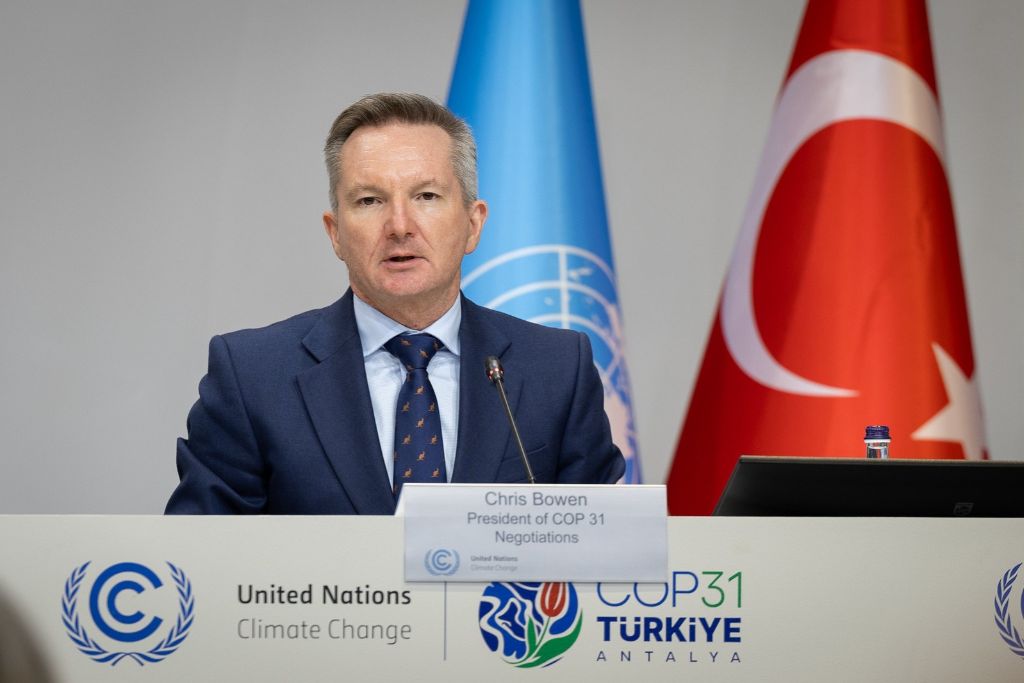
Chris Bowen, President of Negotiations
A lot of good things happened this COP. A lot of events which told the clean energy story. A lot of commitments made — like the more than 90 countries that signed the electrification pledge, for example. And all that is good work and a great thing. But not enough when it comes to climate action. And unfortunately, we were unable to reach agreement on a cover decision, as you know. And that’s disappointing. Very disappointing.
An obvious issue is the transition away from fossil fuels, where some parties insisted that must be mentioned, other parties insisted that if it was mentioned they would veto.
Chris Bowen, the COP31 Presidencies hold a press conference on the state of negotiations. UN Climate Change/Kiara Worth via Flickr.
Countries’ Delegations
Li Gao, Vice Minister of China’s Ministry of Ecology and Environment and Head of Delegation
Yes we’re disappointed we failed to reach consensus on the cover decision. It is very important. Since we failed to reach consensus on the cover decision, in fact, we missed lots of things that a lot of developing countries want. We cannot see this as a failure of this multilateral process. We believe that it reminds us we need to try to further the multilateral process to get the consensus.
Final moments of COP31 Photo: UN Climate Change/Kiara Worth via Flickr.
Liliam Chagas, Brazil Negotiator
On the cover decision the president proposed to us, we believe that we needed a space to address overshoot, to enhance science, the tripling of adaptation finance, more ambition on regional climate finance, to welcome a restructured action agenda, to care for the vulnerable people.
Kenya Delegation
We reaffirm our commitment to multilateralism, but multilateralism must deliver. Honesty also requires us to say what this decision does not do. First of all, Africa is not named. The decision rightly speaks of least developed countries and small island states, but not once of Africa’s special needs and circumstances.
Those who took the lead in emissions must take the lead in support. We ask our partners to bring the finance that makes this ambition possible. Kenya stands with the Africa Group to make COP32 Africa’s COP — the COP of delivery.
Philippines Delegation
Our differences must not stop us from acting together.
Climate finance must be fully mobilised to drive (the) needed scale and speed in mitigation, adaptation, technology transfer, capacity building and loss and damage.
A target without means is a promise without a pathway.
Nepal Delegation
We came to Antalya with some hope and aspirations… It is not good to go back home without a cover decision, not for Nepal but for all parties.
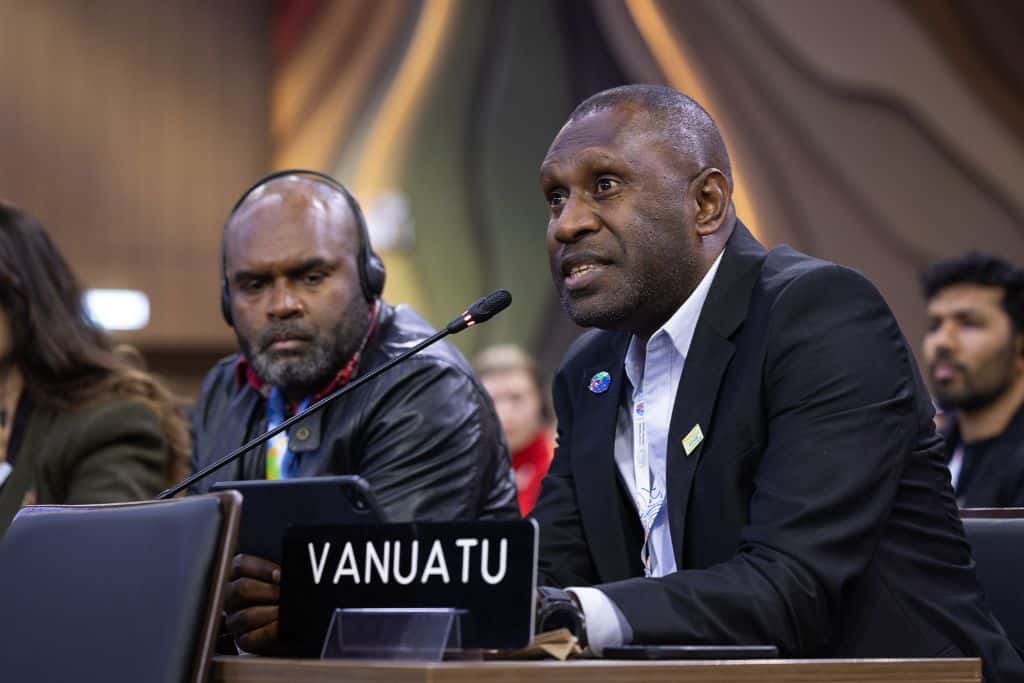
Vanuatu Delegation
This text falls short of what international law requires, what science demands, and what our vulnerable communities urgently need. We cannot accept language that weakens the 1.5 degrees call or normalises overshoot without a credible pathway to return below 1.5 degrees [Celsius of warming (2.7 degrees Fahrenheit)] as rapidly as possible.
It is unacceptable that this decision remains silent on fossil fuels, the principal driver of (the) climate crisis. Consensus must never come at the expense of our people’s survival, sovereignty, and future generations.
Final moments of COP31. Photo: UN Climate Change/Kiara Worth via Flickr.
Wopke Hoekstra, European Commissioner for Climate, Net Zero and Clean Growth
I’m just back from COP31, following a devastating summer across Europe and the world. Science is clear: much more is needed. We came to Antalya for action, not just words. Limiting the magnitude and duration of the 1.5°C overshoot is imperative.
Unfortunately, the final text fell short of what is needed. It represented a step backwards on science and ambition. It failed to recognise the need to transition away from fossil fuels and their central role in global warming.
When an outcome falls so far short, there is always a temptation to muddle through. But our assessment was clear: both in the short and long term, climate action required us to draw a line in the sand.
Final moments of COP31. Photo: UN Climate Change/Kiara Worth via Flickr.
Kate Hughes, UK Lead Climate Negotiator
We have worked until the very end for a balanced and credible result, but what is before us is not commensurate with the urgency of overshoot, the scale of the climate crisis, or the impacts already being felt by the most vulnerable people and communities around the world.
It moves us backwards on the science when we must accelerate implementation. It is a lowest common denominator, where it should have been instead presenting bold, collective ambition on climate action.
Sigrun Gjerlow Aasland, Norway Climate Minister
The draft at hand takes us backwards from agreements that we have previously made.
Norway remains committed to continuing our joint and accelerated energy transition, and Norway remains committed to accelerating finance, to adaptation, and we look forward to continuing the work on these important tasks going forward, but we cannot accept the two decisions as proposed by the president, and we object to their adoption.
Marshall Islands Delegation
We have been let down on all sides. We were presented with the worst possible response to overshoot, a response to enhance oil and gas. We will not be forced to accept false solutions. We will not compromise our future to benefit fossil fuel interests. We will not accept an outcome that undermines our security and threatens our future.
Sergei Kononuchenko, Russia Delegate
If supply (of oil and gas) shrinks faster than demand, the result will be not a reduction of emissions, but deficit, price shock and a switch to dirtier types of fuel and energy poverty … and the first to suffer would be the poorest. For that reason, we cannot agree to any formulation on fossil fuel.
Saudi Arabia Delegation
We believe that climate change requires all solutions on the table. It makes no sense that solutions, concrete solutions… will be taken off the table.
Organizations and Green Groups
Ani Dasgupta, President and CEO of World Resources Institute
The hollow outcome at COP31 was a failure of political leadership, not a failure of the Paris Agreement. When narrow national interests override collective responsibility to confront the climate crisis, the entire world pays the price. Climate summits are not stages for posturing; they require every country to roll up their sleeves and do the hard work of finding ambitious common ground.
Members of civil society demonstrate before the start of the closing plenary. Photo: UN Climate Change/Kiara Worth via Flickr.
Climate Action Network International
COP31 closed against a backdrop of escalating climate devastation, genocide, war and deepening inequality. Governments had a chance to show that international cooperation can still deliver for people. Instead, the world’s wealthiest countries spent two weeks dismantling the very commitments that offered some hope of protection.
Climate Action Network came to Antalya fighting for a justice package: establishing a Belém-Antalya Mechanism (BAM) for Just Transition, a delivery plan for tripling adaptation finance, a Climate Finance Work Programme focused on public finance, and the continuation of a strengthened Mitigation Work Programme.
Developed countries, led by the European Union, stood in the way on every major negotiating track. The Implementation COP became a battle to defend commitments governments had already made. Meanwhile, the Turkish and Australian presidencies failed to take their responsibilities seriously or provide the leadership needed. They pursued vanity projects, neglected their duty to steer the negotiations towards meaningful outcomes and allowed corporate interests to hijack the talks. Their sprawling cover decision, announced at the Pre-COP and introduced in the first week, diverted political attention from the core negotiations while opening the door to carbon capture and carbon dioxide removal.
After a succession of COPs dominated by fossil fuel interests, an African COP in Addis Ababa offers hope of a fundamental change of direction.
The governments that failed us at this COP must not be allowed to destroy the very space in which we can hold them accountable. The COP31 Presidencies should take responsibility for cleaning up the mess they have created before COP32 in Addis Ababa. We look to an African COP to break this cycle of corporate capture and bring the negotiations back to what matters: real protection and safety for people and the planet.
We will defend multilateralism. We will fight for the promises made in Belém. And we will bring the power of African and global movements to fight for real action to protect people and the planet in Addis Ababa.
Clare Shakya, Global Managing Director for Climate, The Nature Conservancy
History will record that COP31 ended in no-deal. But whereas for certain rich nations ‘no-deal’ typically sustains lucrative business-as-usual, for the most vulnerable countries and communities it means consequences that are felt with ever-increasing ferocity, from extreme weather events to collapsing food systems.
While the final, abortive text acknowledged we’re on the cusp of breaching the Paris Agreement’s ‘safe’ +1.5C limit and notes the impacts of the strongest El Niño on record, it failed to reaffirm or advance the kind of concrete targets needed to bring us back from the brink. References to goals around electrification made the cut – alongside the necessary language around clean energy and grid upgrades – but were largely toothless in this context.
Worse still, hard-won commitments to phasing-out fossil fuels – the root cause of the climate crisis – and tripling renewables achieved at previous COPs were only referenced vaguely and without firm timescales. More specifics were proposed around largely unproven carbon capture technologies in a case of unwarranted, irresponsible optimism. Large portions of the proposed text were also based on reaffirming items that were already agreed in years past, without adding anything new.
At least greater specificity was finally forthcoming on climate finance, including a new ‘Antalya to Addis’ process designed to drive clarity around COP30’s commitment to tripling adaptation finance. Growing momentum around parallel initiatives like the Tropical Forest Forever Facility (TFFF) and Transitioning Away from Fossil Fuels (TAFF) movement also gave cause for optimism. We should also commend the fact countries that might have felt forced into accepting a weakened text in years past chose to speak out and then walk out this time around.
“For those countries that are least to blame but closest to the frontlines of climate breakdown, COP31’s lack of meaningful outcome feels like much too little. And before long, for millions of people in those places and far beyond, it threatens to be much too late.
Mohamed Adow, Founder and Director, Power Shift Africa
The COP Presidents want to tell us this has been a great COP. Well, I can tell you without any doubt that this has been the worst COP ever.
Overseeing a failing COP is bad enough, but trying to sell it as a success rubs salt into the wounds of those people who need it to deliver. If all we’re doing is repeating the decisions made in Belém and renegotiating the delicate balance agreed in Paris 11 years ago, why did we bring everyone here for two weeks? Communities living in drought, floods and failed harvests were promised action. They cannot survive on an annual renewal of promises.
Rich countries have an enormous responsibility for this failure. They demand action from developing countries, then block public finance, block Just Transition, block climate finance, and they expect ambition. You cannot keep your foot on the brake and complain that countries are not moving fast enough.
Trump and the US may not be here, but the rest of the rich world are doing his dirty work, facilitated and enabled by the two co-Presidents. I’ve been following these negotiations for 15 years, and I haven’t attended a worse COP than this one.”
Türkiye and Australia should stop preparing their victory speeches and start examining what they would do to rescue this corpse and deliver what the people and the planet require. We haven’t come here to ask for anything more than the delivery of the promises made in Belém, and that is what they’re backtracking on.
Avantika Goswami, Program Manager, Climate Change and Green Economy, Centre for Science and Environment, India
What we have seen consistently across the negotiating rooms is developed countries, particularly the Member States of the European Union and the EU as a bloc, blocking discussions of substance on many critical issues. These are the parties that posture the most in the media. But they’ve shown here today and over the past two weeks that they only posture with empty statements and rhetoric. When the time comes to show up and enable all of the moving pieces that will help us avert the climate crisis, that’s when they act in bad faith and play destructive games. We see them and the games they’ve played, and we will not stand for it.
Developed countries, particularly the European Union, have in a way taken on the mantle the US has left, the vacuum of the blocker that the US was. We expected them to be leaders, but they have disappointed us.
Others
Christiana Figueres, former Executive Secretary of the UN Framework Convention on Climate Change
Honestly, in my book, it’s better to not have a political decision rather than to have a political decision that pulls us back from where we are now. It does reflect the geopolitical situation that we’re all living and, from a procedural perspective, there was no decision adopted. The fact is that from the progress perspective, in the real economy, a lot was achieved at the COP.
We are so used and so trained to only look at only the political decision. The fact is there were many tactical decisions that were adopted, and timely, and important. And the negotiated text, which is only one by-product, stalled for sure. But here’s the point: the economy did not. More than 150 countries plus the EU, representing well over two thirds of the global GDP, joined the COP31’a electrification delivery package. Those two realities are sitting side by side. We have to say what happened from a political perspective at the COP is very painful, absolutely very painful.
Al Gore, former Vice President of the United States
The failure of COP31 is an outrage — it is outrageous that a handful of petrostates have veto power over any mention of fossil fuels. They want you to believe that the climate crisis is a problem that the world is unwilling to solve. But the outcome at COP31 shows the opposite. World leaders no longer want to settle for the lowest common denominator. They want real action to implement and finance a just transition away from fossil fuels. And where national governments have moved slowly, progress at the local level and in the private sector continues to accelerate.
It has been clear for years that the COP process is in need of significant reform. The vast majority of countries came together in Antalya over the past two weeks to negotiate and move forward in good faith. It’s time that we empower those leaders with a reinvigorated multilateral process that reflects the latest science and represents the will of the majority of the world.
Featured image: UN Climate Change/Kiara Worth via Flickr.
Get the best of Earth.Org
Get focused newsletters especially designed to be concise and easy to digest.
Cookie Consent
We use cookies to improve your experience on our site. By using our site, you consent to cookies.
Cookie Preferences
Manage your cookie preferences below:
Essential cookies enable basic functions and are necessary for the proper function of the website.
Name
Description
Duration
Geolocation Config
This cookie is used to store the consent settings based on the visitor's location.
30 days
Cookie Preferences
This cookie is used to store the user's cookie consent preferences.
30 days
Google Tag Manager simplifies the management of marketing tags on your website without code changes.
Name
Description
Duration
cookiePreferences
Registers cookie preferences of a user
2 years
td
Registers statistical data on users' behaviour on the website. Used for internal analytics by the website operator.
session
Statistics cookies help us understand visits, return visits and responses to invitations. Where analytics is enabled, limited browsing and campaign context can be linked to a form submission. The Earth.Org journey cookie lasts up to 90 days; our on-site event totals are kept for 30 days. You can turn Statistics off at any time.
Name
Description
Duration
Earth.Org audience journey
First-party analytics context for the adult Earth.Org site: the first public page and campaign source, approximate return visits, and the latest participation invitation. Helps relate permitted browsing to a submitted enquiry. Contains no name, email address or new browser identifier. Removed when Statistics is turned off. Does not link Kids.Earth.Org browsing.
Up to 90 days from first capture
Google Analytics is a powerful tool that tracks and analyzes website traffic for informed marketing decisions.
ID used to identify users for 24 hours after last activity
24 hours
_gat
Used to monitor number of Google Analytics server requests when using Google Tag Manager
1 minute
_gac_
Contains information related to marketing campaigns of the user. These are shared with Google AdWords / Google Ads when the Google Ads and Google Analytics accounts are linked together.
90 days
__utma
ID used to identify users and sessions
2 years after last activity
__utmt
Used to monitor number of Google Analytics server requests
10 minutes
__utmb
Used to distinguish new sessions and visits. This cookie is set when the GA.js javascript library is loaded and there is no existing __utmb cookie. The cookie is updated every time data is sent to the Google Analytics server.
30 minutes after last activity
__utmc
Used only with old Urchin versions of Google Analytics and not with GA.js. Was used to distinguish between new sessions and visits at the end of a session.
End of session (browser)
__utmz
Contains information about the traffic source or campaign that directed user to the website. The cookie is set when the GA.js javascript is loaded and updated when data is sent to the Google Anaytics server
6 months after last activity
__utmv
Contains custom information set by the web developer via the _setCustomVar method in Google Analytics. This cookie is updated every time new data is sent to the Google Analytics server.
2 years after last activity
__utmx
Used to determine whether a user is included in an A / B or Multivariate test.
18 months
_ga
ID used to identify users
2 years
_gali
Used by Google Analytics to determine which links on a page are being clicked
30 seconds
You can find more information in our Cookie Policy and .