
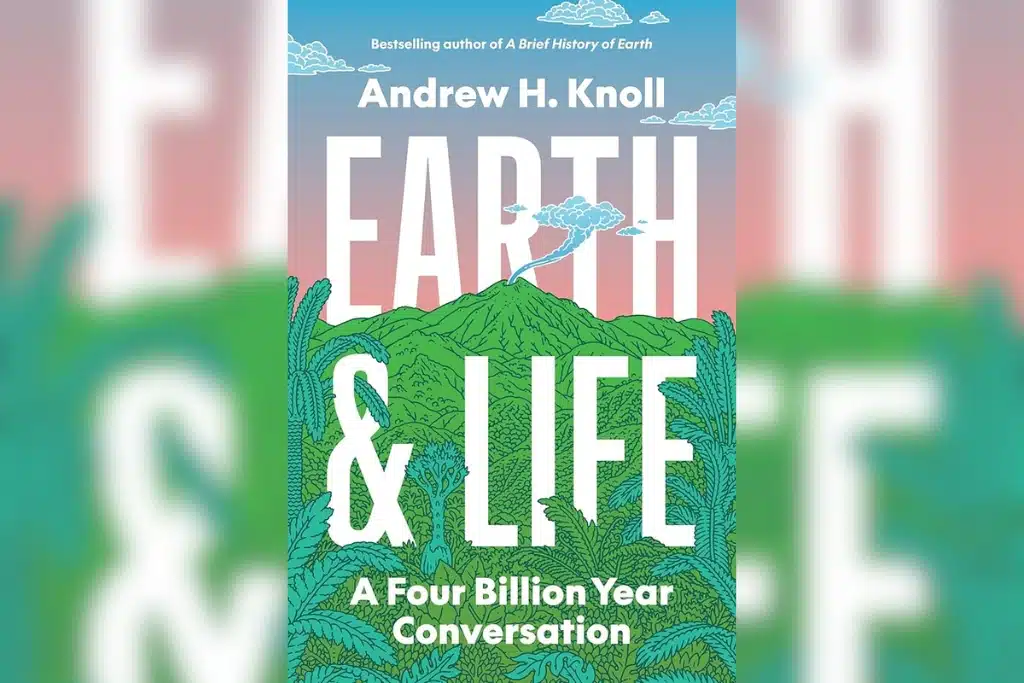
In this delightful work, out on March 31, Harvard Professor Andrew H. Knoll takes on nothing less than the history of our planet and everything on it.
—
Designed for the intelligent, inquisitive general reader (even the bibliography includes helpful asterisks that designate “particularly accessible works”), Earth and Life is fundamentally a popular science book. But it is rigorous in its descriptions of the eons-long back-and-forth between the geology of our planet and the living things that have inhabited it for at least the past three and a half billion years. While it could be seen as a survey course in the field, its core message is that life impacts the Earth as much as the Earth impacts life.
The first several chapters of the book focus on the chemistry of Earth and life. They are structured around the essential elements that make up the crust and mantle of our planet, as well as its living organisms. Beginning with a section on carbon, they cycle through nitrogen, phosphorus, sulfur, and trace elements. The next several chapters explore the origins of life on the planet, and are followed by three chapters that dwell on the fundamental role of oxygen – “The Story of O”, in Knoll’s whimsical designation – and the Great Oxygenation Event, or GOE.
The GOE, which profoundly changed the character of the planet and its atmosphere, is the biggest event on Earth that most people have never heard of. Before cyanobacteria began to produce O2 in such enormous quantities, about 2.4 billion years ago, the Earth was a very different place – with an atmosphere and ocean hostile to most modern creatures. Knoll goes into some detail exploring different hypotheses for its origin and processes, and showcasing the parallel development of the eukaryotic organisms that ultimately led to us.
The oxygen chapters also create a transition from Knoll’s opening overview of Earth’s elements to a more chronological story of how life developed overall in “conversation” with the planet’s geological processes. He traces how plants, animals, and fungi arose, and how they impacted the atmosphere (and vice versa). There is relatively less detail about the most recent few million years of Earth’s history, but a short discursion on the nature and impact of predation is well worth the time. After offering a glimpse of plant and animal life on Earth, he does a deep dive into the multiple times cataclysms almost wiped them out.
Interestingly, the chapter that covers the various climactic phases the Earth has entered and left does not include anthropogenic, or human-caused, climate change – he leaves this for the end, along with a series of speculations about what might be possible for humans on other planets.
This is far from Knoll’s first work on the subject: he has already published multiple geobiology texts, both academic or specialist works as well as mass-market overviews such as the bestselling A Brief History of Earth. But as the newest, it includes a wide range of updates to the field that will surprise anyone who hasn’t paid much attention to biology since high school.
Indeed, Knoll’s long experience as a teacher – most recently, as the Fisher Professor of Natural History at Harvard University – is evident in every page of the book, both in his delight in the subject matter and his desire to share his joy with others. As well as being informative, it is also introspective, humorous, and at times personal. Earth and Life is well worth reading for anyone who wants to know how we got here – and what might come next.
Earth and Life: A Four Billion Year Conversation
Andrew H. Knoll
2026, Princeton University Press, 328pp
—
Check out more Earth.Org book and film reviews here.
This story is funded by readers like you
Our non-profit newsroom provides climate coverage free of charge and advertising. Your one-off or monthly donations play a crucial role in supporting our operations, expanding our reach, and maintaining our editorial independence.
About EO | Mission Statement | Impact & Reach | Write for us
Earth.Org
Free, non-profit and independent environmental journalism.