

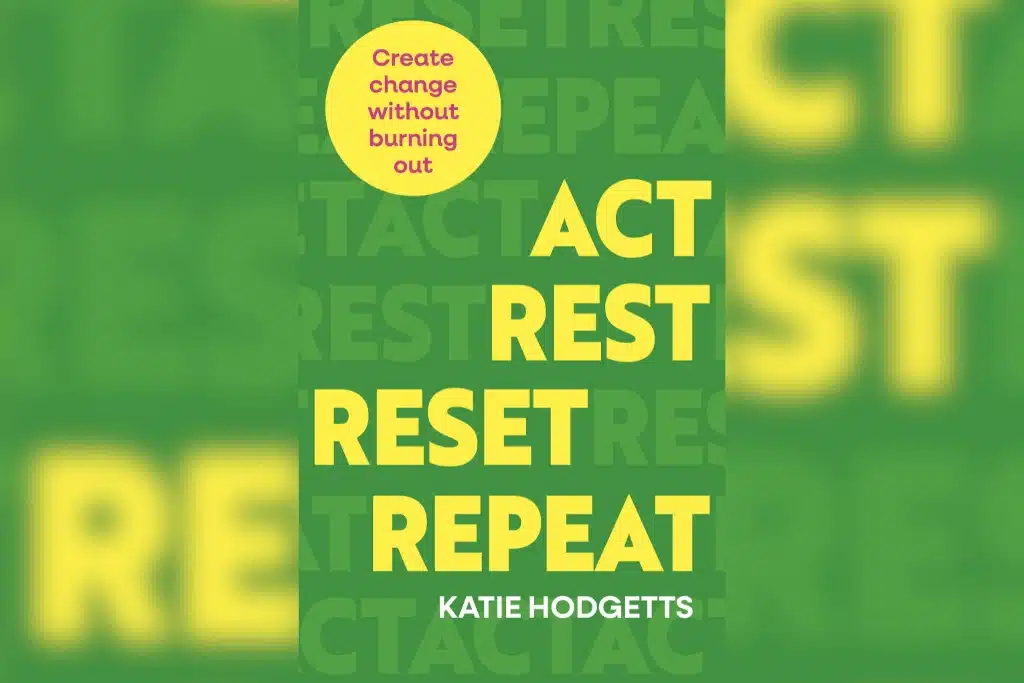
In the face of overwhelming challenges to the climate movement, burnout is a real danger. In this self-help manual for the overwhelmed activist, youth climate icon Katie Hodgetts shares strategies for how to keep going.
—
Activism is, by its nature, a draining, all-consuming business: nobody organizes a climate protest just for the fun of it. For this reason, defeat and paralysis, while normal, can seem all the more unfair. Hodgetts asks activists to confront this reality and to put it into perspective. “Getting your butt kicked is an inevitability, but it’s not the whole story,” the activist says.
She speaks from experience. In her teens and early twenties, Hodgetts founded the Bristol Youth Strike 4 Climate, coordinated multiple mass-climate mobilizations, shared the stage with Greta Thunberg, and spoke to CEOs and heads of state. Then, at the age of 24, she was derailed by burnout. This inspired her to set up The Resilience Project, aiming to empower young people to become resilient changemakers. The initiative has engaged over 60,000 people since its inception.
Drawing on research with Imperial College and Stanford University, as well as her own story of burnout and recovery, the book outlines a framework that aims to break cycles of escalation and toxic narratives of perfectionism, productivity, and self-sacrifice in activist culture.
It opens with an acknowledgement of our current state of “permacrisis”, where one shock lands before we have processed the last. This continuous crisis builds a stress level that cannot be addressed with deep breathing exercises alone. Instead, the author calls for a new kind of change-making, built on resilience, reflection and renewal.

In the first part of the book, Hodgetts describes her personal journey in detail, including a poignant section on her battle with stress-induced bulimia. She then sets out her main thesis, which she calls “inner-tersectional changemaking”, recognizing both the systemic and inner-led components to change, and explores its implications.
The second part of the book is structured around the eight “guideposts” of her framework, such as how we can reframe our concept of activists as humans first, rather than only changemakers; how to recognize the signs of burnout; and how to practice gratitude without bypassing the very human emotions of anger and grief.
Recognizing our humanity is an important recurring theme. “I see great changemakers and movements, but I still see ego, career-hunger, vanity, cliques, jealousy and tearing each other down when we don’t meet the unrealistic standards we ask of one another,” she remarks. She also focuses on the need to “flip the script” by “identifying narratives that can be damaging to ourselves, our relationships and our campaign work and reimagining an alternative.”
“For example, if you carry the narrative ‘I’m not doing enough’, you can begin to challenge this by acknowledging and appreciating the actions you have taken, however small they may seem. By doing so, you create a new story,” she writes.
The author’s sincerity is clear and the value of the book’s exercises is evident. For those who benefit from self-help books, this is an excellent how-to manual. The exercises in particular are clear, practical, and highly relevant.
At the same time, it does occasionally stray into New Age territory. Writing about a workshop, she describes the scene: “I was accompanied by a pianist during the talk, who started softly playing music as strangers reshuffled to pair up and begin an eye-gazing exercise: staring into each other’s eyes for a few minutes in the hope they could really start seeing each other.”
Ultimately, the most important thing about this book may be its existence. For the thousands of activists and campaigners who are confronting the gap between the idealized versions of themselves and their causes, versus the reality that surrounds them, it will play an important role: to help them feel seen, to acknowledge their humanity, and to continue their struggle.
Act, Rest, Reset, Repeat: Create Change Without Burning Out
Katie Hodgetts
2026, Waterstones, 224pp
—
Check out more Earth.Org book reviews here.
One-time
Show your support.
A one-time donation is a powerful way to show your appreciation for our work and commitment to protecting the planet. Every contribution helps us continue raising awareness and inspiring change.
Monthly
Make a lasting impact.
Monthly donations sustain and expand our efforts. By becoming a recurring supporter, you help us grow our website, reach more people, and amplify our mission for a better planet.