

The call came at the end of a three-day meeting of the highest ambition coalition pushing for an equitable global fossil fuel phase out in the coal port city of Santa Marta, Colombia.
—
It is time for world leaders to “chart a journey away from fossil fuel production,” according to a coalition of “highest ambition” countries currently participating in the world’s first conference to speed up the transition to cleaner energy in the Colombian city of Santa Marta.
At COP30 in Brazil last November, Colombia announced “the first international conference on phasing out fossil fuels,” with the initial support of 24 other nations. The UN climate summit culminated in an agreement that did not contain any mention of fossil fuels, the primary cause of climate change, despite 82 countries calling for a phase out fossil fuels and despite countries pledging to “transition away from fossil fuels” at COP28 two years earlier.

The Santa Marta conference, which is led by Colombia and the Netherlands and is set to end on Tuesday, attracted 53 countries, including Australia, Mexico, the UK, and many Small Developing Island States, as well as the European Union. Turkey and Australia, which are co-hosting COP31 this November, are also in attendance. The US was not invited.
‘Ready to Act’
Monday marked the end of a three-day meeting of the “highest ambition coalition” in Santa Marta, pushing for an equitable global fossil fuel phase out. The coalition, made up of ministers and heads of delegations from Africa, Asia, the Caribbean, Latin America and the Pacific, called on the Santa Marta Conference to formally recognize the need to negotiate a new international instrument on a fair transition away from planet-warming fossil fuels.
The legal instrument must include “binding supply-side obligations, close major governance gaps left by existing frameworks, and create the financial and legal architecture necessary for a globally just transition away from coal, oil, and gas,” according to a press release by the Fossil Fuel Treaty initiative.
“Colombia is honoured to host this historic moment, where a coalition of countries ready to act are making it clear that a transition away from fossil fuels is more urgent than ever, and that the countries of the Global South must not pay the price of a crisis they did not cause,” said Irene Vélez Torres, Minister of Environment of Colombia and co-host of the Santa Marta Conference.
Torres, who chaired the coalition’s meeting, said the treaty must be anchored in equity and address “much-needed transition finance.” Global climate finance commitments have so far been unambitious and far lower than what is truly needed. Experts estimate that climate-vulnerable developing nations alone need some $1.3 trillions to deal with the consequences of climate change.

The summit is taking place against the backdrop of the US-Israeli war on Iran, which has unleashed the worst energy crisis the world has ever seen, strengthening calls for a fossil fuel phase out and a rapid transition to cleaner energy forms.
Illegal Act
Last year, the International Court of Justice, the world’s top court, ruled in an advisory opinion that fossil fuel production, consumption, exploration, and subsidies may constitute internationally wrongful acts. This only reinforced the case for a fossil fuel treaty, according to Vanuatu’s Minister for Climate Change and Environment Ralph Regenvanu, who was instrumental in getting the court to issue an advisory opinion on climate change.
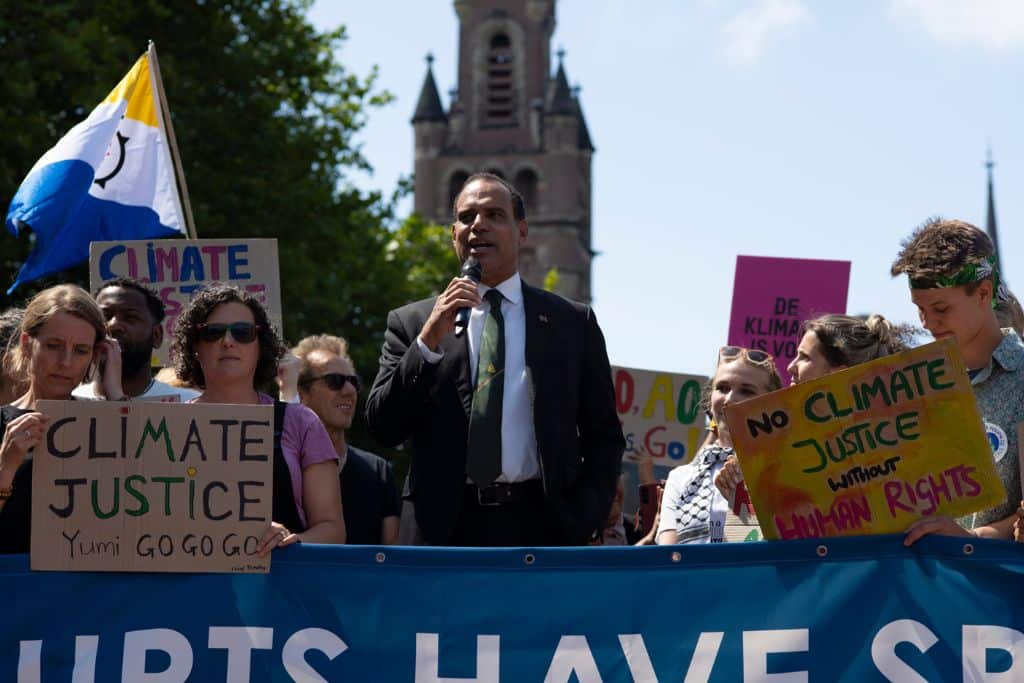
“From the International Court of Justice, to the UN General Assembly, Vanuatu has championed the legal obligation to phase out fossil fuel production, and we are here in Santa Marta to continue that work with a coalition of countries committed to lead,” Regenvanu said.
“A Fossil Fuel Treaty gives us a binding framework to implement our shared legal obligations into real action: moratoriums on expansion, equitable phase-out timelines, finance mechanisms, and the removal of the legal barriers that trap countries in fossil fuel dependency.”
Featured image: UN Climate Change/Diego Herculano via Flickr.
This story is funded by readers like you
Our non-profit newsroom provides climate coverage free of charge and advertising. Your one-off or monthly donations play a crucial role in supporting our operations, expanding our reach, and maintaining our editorial independence.
About EO | Mission Statement | Impact & Reach | Write for us