
Sign Up
  • Earth.Org Newsletters

    Sign up to our weekly and monthly, easy-to-digest recap of climate news from around the world.

  • This field is for validation purposes and should be left unchanged.
Earth.Org PAST · PRESENT · FUTURE
Environmental News, Data Analysis, Research & Policy Solutions. Read Our Mission Statement

New research has shown that early humans were far more widespread than previously thought, urging a re-definition of our historical relationship with nature and biodiversity. The evidence suggests that humans are not implicitly harmful to the natural environment, and rather it is the intensification of land use that has induced the current crisis. 

A new study from an international team of archeologists, ecologists and geographers suggests that the key to solving the present environmental crisis is to look to indigenous practices that fostered sustainable biodiversity for over 12,000 years. 

This new research shows that for the last 12 millenia, people have inhabited a much larger proportion of the earth’s terrestrial land than previously thought, all while managing it responsibly and sustainably.

Using the most up-to-date reconstruction tools of historical human population and land use better understand the timeline and geography of human expansion, and thus characterize humanity’s historical relationship with nature. The results of the reconstruction are in line with contemporary global assessments: 80% of the earth’s land surface has been transformed by human activity, with 51% classified as ‘Intensive’ and 30% as ‘cultured’, while only 19% is wildland. However, historical observations were widely different from prior historical reconstructions, in which Wildlands covered 82% of land surface in 6,000 before CE. They report: “even 12,000 years ago, nearly three-quarters of terrestrial nature was inhabited, used and shaped by people,” suggesting it is more than mere human presence that harms biodiversity. 

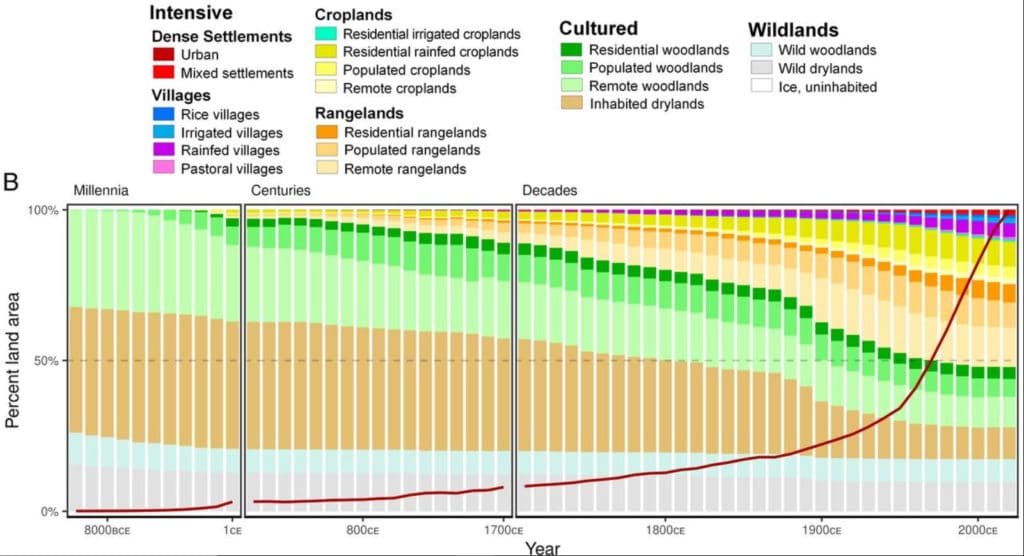
Indeed, a lingering paradigm in anthropological and natural sciences is that human colonization of wildlands is inherently damaging, and that the bulk of it is relatively recent. The findings described of this study challenge that paradigm, suggesting that humans are perfectly able to live in harmony with their surroundings, and even help biodiversity thrive. In the graph, you will see three main categories: wildlands, uninhabited by humans; cultured, inhabited with less than 20%  intensive land use; and intensive, with over 20% intensive land use.
indigenous lands and biodiversity hhuman occupied land for 12,000 12000 years

Global changes in anthromes and populations 10,000 BCE to 2017 CE. (B) Global changes in anthrome areas, with population changes indicated by red line. Anthromes are classified using population densities and dominant intensive land use. Source: Ellis et al. 2021.

We see that cultured land, in green and brown, comprised most of the inhabitable land during the last era (Holocene). From around 1700 common era (CE) onward, intensive land began its exponential rise into the present day, and does so entirely at the expense of cultured land. 

You’ll notice the acceleration is concurrent with that of the human population curve in red, although not quite as drastic. 

Orange grabs the eye in the latter part of the timeline, carving out a large space for itself and hardly slowing – these are cattle grazing lands. Without getting into a debate over whether we should be eating meat, it is a lot of our planet’s available space and resources to give to a single thing, especially one that can be lived without. 

Moving on, the analysis revealed another interesting point: earlier humans  may have actually helped biodiversity thrive, increasing species richness in their environment. However, the positive effect seems to disappear after 1500 CE, indicating a shift in our relationship with nature after European colonial expansion. Based on the conclusion that intensive land use leads to biodiversity loss, this could mean that the Europeans’ technology transfer to many less developed areas of the world might be the cause. 

Of course, we couldn’t roll back global development to a pre-industrial or even pre-agricultural lifestyle even if we wanted to, so what is the takeaway? The most obvious one is how beneficial indigenous land protection can be, as it turns out that humans ready and willing to live outside of the globalized, urbanized world actually do more good than harm to the planet. 

The second is that the amount of uninhabited land has been very stable throughout the Holocene, meaning there is a good reason humans never occupied those areas. We therefore colonized all the desirable land very fast, and since then have only been changing the way we exploit it for the worst, mostly to accommodate our exponential population growth. Since this is expected to continue until 2064, when we are expected to hit 9.7 billion. Growing energy, food and living area demand will chew through a lot of the remaining space if we don’t rethink our land usage portfolio, and no more biodiversity is very bad news. 

The authors said: “Efforts to achieve ambitious global conservation and restoration agendas will not succeed without more explicitly recognizing, embracing, and restoring these deep cultural and societal connections with the biodiversity they aim to sustain.” We’ve long known how to nurture our environment, but the knowledge was put aside for profit and, in some cases, unnecessary development. We have more than we need; poor distribution of the resources is humanity’s next problem to solve. 

This article was written by Lola Robinson and Owen Mulhern. Cover photo by Stéfano Girardelli on Unsplash.

You might also like: Melbourne Air Pollution


References:
  • Erle C. Ellis, Nicolas Gauthier, Kees Klein Goldewijk, Rebecca Bliege Bird, Nicole Boivin, Sandra Díaz, Dorian Q. Fuller, Jacquelyn L. Gill, Jed O. Kaplan, Naomi Kingston, Harvey Locke, Crystal N. H. McMichael, Darren Ranco, Torben C. Rick, M. Rebecca Shaw, Lucas Stephens, Jens-Christian Svenning, James E. M. Watson. People have shaped most of terrestrial nature for at least 12,000 years. Proceedings of the National Academy of Sciences, 2021; 118 (17): e2023483118 DOI: 10.1073/pnas.2023483118

In our effort to keep you up to date on the most interesting climate solutions, bring you an overview of aquaplastic, a bacterial biofilm-based plastic alternative that has shown encouraging results.

Plastic is both one of the best and worst discoveries human-kind has ever made. Never has a material had so many applications, from household wares and recipients to parts in engineering. Unfortunately, its durability means it degrades by breaking down into progressively smaller pieces, until it is invisible to the naked eye (nanoplastics). Found on land, in water, and even floating in the air, plastic has even made it near the top of Mount Everest.

While the extent of our planet’s plastification may be somewhat surprising, it isn’t really a shock. We knew. Or at least assumed, and many of the world’s greatest minds have been hard at work trying to find a solution. First and most obvious would be improving our recycling systems, but this is an incredibly complicated task in a world governed by economics when it is cheaper to make new plastic than to recycle it. 

The alternative is, well, plastic alternatives. Bioplastics in particular gained some traction, some even advertised as compostable, though studies have shown that the claims may not be true. 

A potentially great step forward has been made by a team of scientists from Northeastern University, Harvard and Johns Hopkins, who say they’ve created a water-processable, biodegradable “aquaplastic” derived from E. coli, a notorious gut bacteria. 

You may have  few questions here, so let’s work through this. First, E. coli is a bacterium naturally found in the gut, but when ingested through contaminated food it can land you in the hospital. They can aggregate to form what is called a biofilm, a type of bacterial slime that grants resilience and coats surfaces. 

The researchers ingeniously used this property to create a E. coli-based hydrogel called aquaplastic, which can be healed and welded to form 3D structures, essentially living emulation of plastic.

aquaplastic plastic alternative e. coli innovative solution

Source: Duraj-Thatte et al. 2021.

The technology is part of an emerging field called “engineered living materials,” where we harness natural processes from living organisms to produce new substances.

In fact, micro-organisms are a wonderful source of solutions, from plastic degradation to greenhouse gas capture, but these are usually hard to scale up.

Indeed, aquaplastic is still being studied and its transition into a commercial product is rather uncertain at the moment, the researchers saying it may depend on securing more funding. Right now, they make it one flask at a time, meaning they are far from the industrial-scale production needed to replace plastic. Further, aquaplastic still has issues, including the fact that it is permeable to water, making it inadequate for food packaging and other uses. 

Still, any plastic alternatives with this potential should be noticed and supported given that plastic demand has doubled since 2000 and shows no signs of slowing. 

plastic production worldwide global

While we are happy to keep bringing you news of innovative solutions for climate change and environmental degradation, we haven’t yet reached the next big breakthrough. Please do what you can to reduce the amount of plastic you use, it makes a difference. 


This article was written by Owen Mulhern.

You might also like: Delhi Air Pollution


The Earth’s  climate is like a complex web within which every, or nearly every element interacts, either directly or indirectly. You may not have thought of this, but melting ice seems to be affecting ocean-wide currents that in turn regulate Western European weather. Here, we walk you through the relationship between climate change and the Gulf Stream. 

On a solid icescape with no other soul for miles, the silence deafening except for the random bursts of a shrill icy wind keeping the shoulders tucked around the ears. A faint sound of a river flowing deep beneath the ice; James Balog and two crew members march what appears to be aimless across the rapidly receding frozen glacier of Greenland. Suddenly the continent of ice gives way to a massive crevasse punctuated with a single hole burrowed all but depthless, swallowing the gushing river of ice melt like some sort of giant porcelain bathtub. James, filmed by the “Chasing Ice” documentary crew, begins the treacherous descent down the crevasse. His destination: a thin snow and ice outcropping just a few meters above the water falling into the abyss. He flattens out his body almost hugging this illusion of safety praying to not hear a crack. Skull dragging his outstretched body, he dangles camera and head over the razor-thin edge; looking for that perfect shot as literal tons of ice-cold blue water roar by like continuous thunder. James is documenting the disappearance of the world’s land ice. 

Through miles of lightless tunnels carved deep below the surface; the water, not unlike any other river, rushes toward the ocean. This is glacier runoff winding its way toward the ocean  putting its thumb on the scale and potentially accelerating the rate of global climate change.

While there are several ways in which glacier melt is having an impact on our climate, this article focuses on its relation to the Gulf Stream… Many reading this may not know that ice melt influences the Gulf stream quite heavily, so let’s explore how this powerful ocean current came to be.  

The Gulf Stream is actually one segment of the global ocean current; known as the Thermohaline cycle (THC). The THC is generated by the ocean’s temperature and saltwater density, or salinity.

Gulf stream ocena current climate change

Ocean water is heated at the equator due to the direct angle it receives sun radiation at those latitudes. The air is humid and saturated with moisture, along the northern coast of Brazil’s Rain Forest. As the water flows northward it dips west into the Gulf of Mexico before hugging the east coast of the Americas and heading back out to sea. This section is what we know as the Gulf Stream. 

gulf stream temperature map

Source: NOAA.

Interestingly this ocean current generated from the edge of South America is the primary cause for those famous European Summers. How? Water takes longer to heat up than air or dry land, that’s why it can be 100°F outside but the pool is only 75-80°F. However, it also retains heat longer. The Gulf Stream essentially sunbathes and takes in all that heat along the equator and up the coastlines, and retains most of it as it ricochets out to sea and toward Western Europe. The air cools and dries, as it makes its way north; sucking moisture and heat from the ocean into the atmosphere, heating the air that the winds carry over Europe. Northern Canada, though at a similar latitude does have this luxury as there is no warm current headed toward Canada’s coastline. 

gulf stream currents ocean current

The current is steadily cooling and evaporating as it migrates north. When it finally arrives off the Southern tip of Iceland the current is cold and the salinity is high because much of the water has evaporated on its long journey, leaving the salt behind. At this point, the cold dense current plunges deep into the northern ocean and begins traveling southwest, along Greenland’s coast. Here James and his crew are witnessing once mighty glaciers reduced to rivers of water now dumping into the ocean and the THC. According to NASA Greenland’s ice melt could raise the global sea level by 2 feet and has accelerated in melt rate 7 fold since 1992. That’s 234 billion tons of run-off added to the THC every year as of 2018 with projections to increase.

All of this runoff dilutes the dense saltwater in the current as it flows southward, not allowing the water to sink, causing the THC to slow down, and dissipate. 

So what would it look like if the THC and with it the Gulf stream slowed dramatically or possibly even stopped entirely? 

Well, Geographic and Climate Scientists may already have some idea. Nearly 11,000 years ago a similar event is believed to have happened. At the time there was a massive glacier extending from the north pole across the entirety of modern Canada and half of the United States. With changes in the earth’s climate, the glaciers began to melt and recede northward. Once it had receded to the Great Lakes on the border of the two countries the runoff was so immense it pushed its way through the landscape, broke through an ice dam, and began dumping into the ocean. With such a shift in the salinity, it triggered a collapse of the THC. This plunged Europe into a mini Ice age for 1,000 years.

If this were to happen again, it could trigger massive extinctions, famine, and the collapse of oceanic ecosystems and the fishing industry in the northern hemisphere causing major economic uncertainty. Scientists worry about whether we will have the ability to essentially jump-start the THC in the event this does happen; somehow engineering a way to pull copious amounts of freshwater out of the ocean meanwhile trying to curb greenhouse gas emissions on an even tighter timeline than previously conceived. 

The THC creates oceanic upwelling: where that cold deep current eventually surfaces to begin the cycle again. Upwelling is a critical keystone in the oceans ability to capture CO2 from our atmosphere; providing “fresh” water with the capacity to absorb more CO2, than the older surface water that is mostly saturated. Without the THC we could very likely begin to see a cascading effect in our global climate. While the ocean would possibly be less acidic with the inability to absorb CO2, that would also mean more of this greenhouse gas would be in our atmosphere, thereby increasing global temperatures and increasing the melt rate of land and sea ice. With the disappearance of sea ice, we increase what’s known as dark water. Simply put, when water is in ice or snow form, it reflects heat back into space whereas its darker, liquid forms are some of the most heat absorbent surfaces on Earth.

One could write a lengthy book on the repercussions we would experience in the wake of a THC collapse, but suffice it to say it’s worth doing something about. 

The good news, while surface melt is increasing, scientists believe we have some time to adapt as a global society to potentially mitigate this catastrophe; as the slowing of the THC and the Gulf Stream is a slow process.

Adaptation and mitigation is a big economic shift and investment however, it is a drop in the bucket compared to the cost of doing nothing. 

To successfully navigate this challenge will need government action. 

If you would like to help, reach out to your representatives; advocate for green legislation. Look for ways to get involved with environmental advocacy groups like Ocean ConservancyClimate Action NetworkSea Shepherd, or Citizens Climate Lobby

Knowing as much as we can about climate change, its potential effects on the planet and its inhabitants are vitally important. However, it means little if we do not act. No, one is demanding that you tie yourself to a tree or chain yourself to a bulldozer. Your advocacy can look like whatever you want it to. Consider being a sustaining donor to your favorite environmental non-profit, volunteer 2 hours a month, or a day, pick up the phone, or write a letter to your congressman, organize a march or a book club. The most important thing, DO something and don’t stop. 

This article was written by Sean Porter.

You might also like: Delhi Air Pollution

Who knew chasing down the future of the Earth’s climate could be so much like Sherlock Holmes or a CSI Miami episode; hunting down perpetrators. That’s essentially what Sebastian Sippel and his colleagues have done. Using the latest modeling software to sift through the global data network and find clues and fingerprints, the have shown that we can detect climate change from nearly any single day’s data since 2000.

The network that brings us our weather reports and climate averages consists of over 22,500 data collection sites worldwide according to the World Meteorological Organization (WMO). These collection sites record many details of our atmosphere and surface conditions such as greenhouse gas concentrations (GHGs), precipitation, humidity, wind direction and speed, high, and low air pressure, temperature. Etc. While this information is vital to the understanding of our environment; It also creates a lot of data to sift through to find those clues. Think of it as those detectives looking for criminal’s prints in a taxicab, there are likely 100’s of people’s fingerprints in the taxi; It creates interference for those dusting for prints. This interference or white noise as it’s referred to by Sippel and colleagues is one of the major hurdles they had to overcome to solve the question; Can a single day of global weather patterns be used to detect climate change?

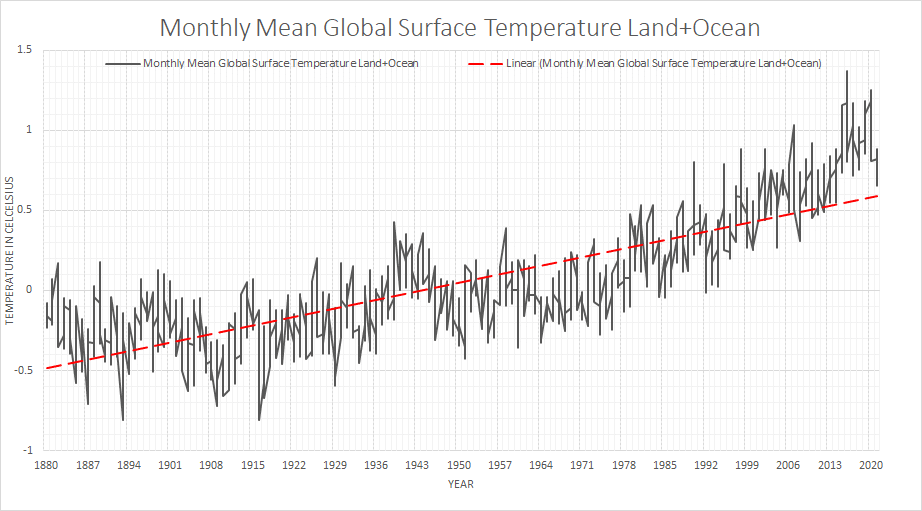
Climate is the average weather pattern observed in a given area for a minimum of 30 years. Weather is the atmospheric conditions we experience from day to day. For a visual, the graph below was compiled using Nasa’s collection of global surface temperature averages for the last 140 years. The black line is essentially global weather, the red line is climate.

collection of global surface temperatures (NASA), detect climate change

Collection of average global surface temperatures. Source: NASA.

It’s why when we see snowballs it doesn’t disprove global warming.  

republican holding snowball climate change denier

On Feb. 26, 2015, U.S. Sen. James Inhofe (R-OK) brought a snowball to the Senate floor.

We are like frogs in hot water; if it weren’t for the global network collecting gobs of data, then the steady increase in temperature, decrease in precipitation, and other telltale signs of a changing climate might easily be ignored by many outside the scientific community, and the marginalized groups where climate change is a fight for survival.

 It begs the question; how then would it be possible to detect and extract the appropriate data or “fingerprints” in a single day when these climate projection models are based on millions of data points over a time scale of 30 years? 

To answer this, we turn to the study of Detection and Attribution; basically, the individuals that try to identify factors of “external climate forcing.” External climate forcers are elements independent of climate that contribute to its change (mostly human-driven) such as fossil fuel extraction and combustion, deforestation, and reduction in the Earth’s surface reflectivity or albedo. 

Sippel and his colleagues wanted to determine if these external forces could be detected on smaller time scales compared to that 30-year average. First, they had to determine the physical scale of the study: local weather patterns suffer from extreme variability depending on the region, sometimes going against the global trend (e.g. breaking cold records when the world as a whole is warming). Looking at things from a global perspective cancels out extremes into a planet-wide average, giving a more accurate picture of the situation. 

Next come the monitored variables: external climate forcers are exerting pressure on many of our climate’s components (e.g. wind speed, season lengths, humidity, etc), but to simplify the search for a visibly enforced change, or a “fingerprint”, the authors of the study chose to look at daily temperature and humidity anomaly patterns.

To test whether these could be used to detect climate change, they chose to start with a larger collection of daily anomalies over two separate time scales before scaling down to a single day. The first time scale, 1951-1980 (grey bars), and the second from 2009-2018 (orange bars). 

local and global average temperatures, two time period comparisons, detect climate change

Figure 1. The distribution of local (a,c) and global (b,d) daily temperatures in two different datasets: the NCEP 1 reanalysis dataset (a,b) and in the CMIP5 multi-model archive (c,d). Source: Sippel et al. (2021)

Notice the bulk of local temperature anomalies swing between 5 and -5°C but low differentiation between time periods. Conversely, the global anomalies only range from 1 to -1°C but have a clear shift demonstrating the effect of climate change during the interval. 

The question was could they detect climate change this way again, but with only a single day of data?

To do this, they ignored the averages of global weather because it masks the more extreme peaks that characterize climate change. Using multi-model platforms, they modelled the range of natural variability using past data and compared it to the range of observed variability on a single day since 2000; if the day’s extreme is greater than natural variability that proves climate change is driving the shift. The results were astonishing – a large majority of days in the past two decades showed clear fingerprints of enforced climate change, with temperatures and humidity levels going beyond their natural ranges. 

While Sippel and his colleagues have completed a stunning achievement, this should also serve as a wake-up call for us. Humans are the biggest external climate force. We are on a train headed for a wall and many leading countries are choosing to lean on the accelerator rather than implement significant policy changes. One of the biggest ways this is being played out is in fossil fuel extraction and combustion. Below is a visual taken from C-ROADS; it’s an interactive website that allows you to experiment with different policy adjustments and see how regional and global shifts can change our climate future. 

C ROADS temperature records, predicted temperatures, CO2

We see the global CO2 emissions record from 1900 to the present day (red), the global temperature correlation from 2000 projected into the future (purple), and the projected temperature increase for the end of the century.

Notice the increase in CO2 starts to ramp up around 1975, There is a delay from climate forcing factors to the impact we see and feel. According to NASA, CO2 lingers in our atmosphere from 300-1,000 years. In a sense the year 2000 was a climactic tipping point, where we put enough CO2 and other GHGs in our atmosphere to cause radical acceleration in global temperature increase, and climate change. 

Climate scientists admit they are behind on their understanding of the full repercussions of climate change. Frankly, climate change is out-pacing researchers; studies take time, interest, and money. The responsibility of the scientific community is to discover and to educate. The responsibility of our governments and the rest of us is to act; if not, down the line when future generations look for the cause of the planetary detriment it will be our fingerprints they find. 

This article was written by Sean Porter.

You might also like: Air Pollution in Shanghai

A new study published last month shows in great detail how the Antarctic ice shelves could recede as global warming continues. The warming scenario we choose to experience in the next few years will determine how much of it remains intact. 

Researchers have been studying and modeling how Antarctica might fare against climate change for decades now but forecasts have been limited in detail. This new study, from scientists at the University of Reading and the University of Liège in Belgium, shows how the ice shelves lining the Antarctic coast may melt away under different degrees of global warming. 

An important thing to understand is that all the ice we see in polar region photographs is not the same. There are glaciers, ice sheets, ice shelves, icebergs, and sea ice, all different in form and behavior. 

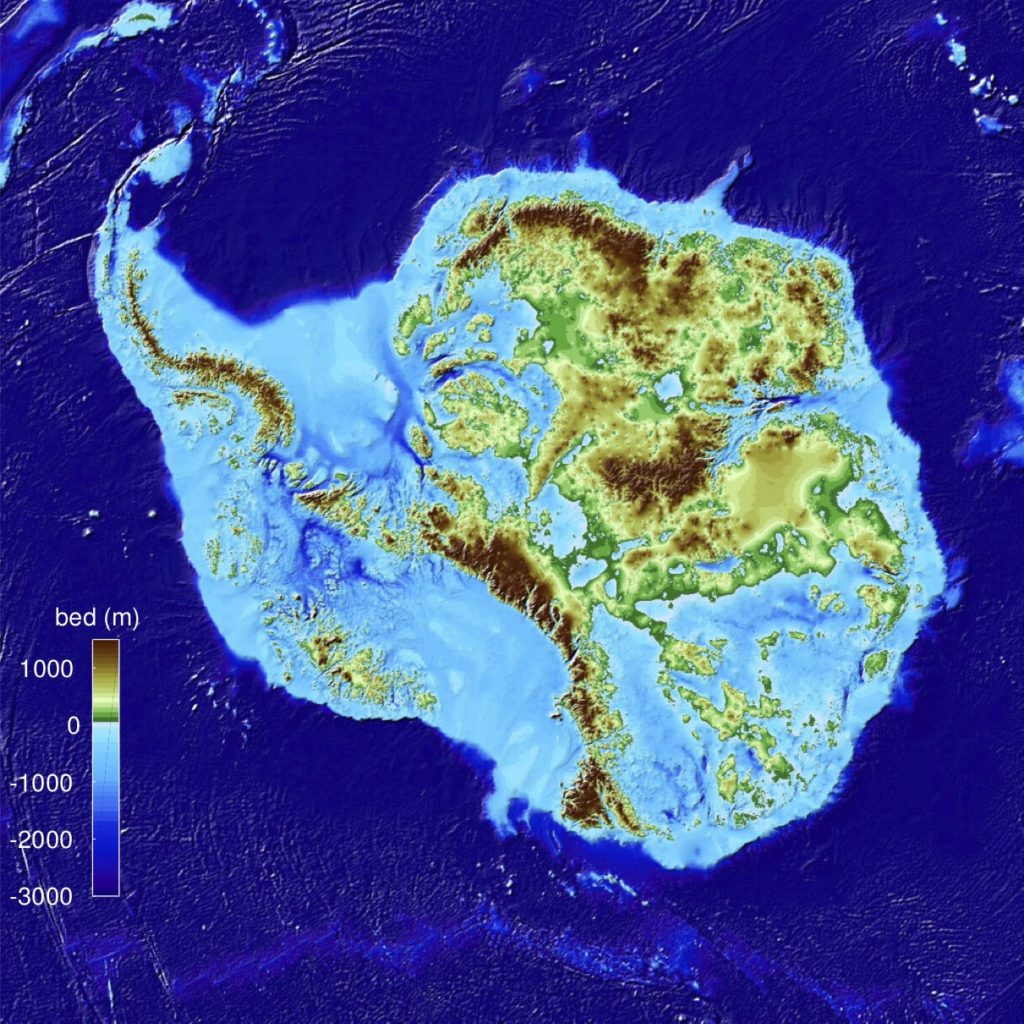
The researchers here focused on ice shelves, floating platforms of freshwater ice that slide off the landmass onto the ocean and remain frozen on the cold waters, often looking like part of the continent itself. (Antarctica on a map would look very different if its ice shelves weren’t included.)

antarctica without its ice shelves

Source: Mathieu Morlighem, UCI

When ice shelves melt or break into pieces and float away they allow glaciers and ice sheets, both of which sit on land, to move into the ocean at a faster pace. The shelves essentially act like bottlenecks to keep ice and meltwater from flowing too fast, by bumping into them or helping re-freeze the water. The process keeps ice loss at a rate that is normally balanced by the accumulation of more land ice through the buildup of snow.

It’s this accelerated movement from glaciers and ice sheets that causes concern, as this would directly cause sea levels to rise (the melting ice shelves themselves don’t raise sea levels as they were already floating on the water).   

Some research has estimated that without ice shelves, the glaciers they used to block may move towards the ocean up to five times faster.  

This study found that if current global warming continues until we’re at 4°C above pre-industrial levels, more than a third of Antarctica’s ice shelves could disintegrate. That’s 190,000 square miles of ice, about two times the size of the United Kingdom. If warming can be halted at 2°C, the increasingly difficult target of the 2015 Paris Agreement, only half as much would be vulnerable.

Many of Antarctica’s ice shelves are on its Western side, such as on the Antarctic Peninsula that points up towards South America. Out of the four ice shelves identified as most at-risk, three are in that region: Larsen C, Wilkins, and Pine Island (just south of Abbott); the Shackleton ice shelf on the east coast is the fourth.  

antarctica ice shelves

Source: Ted Scambos, NSIDC 

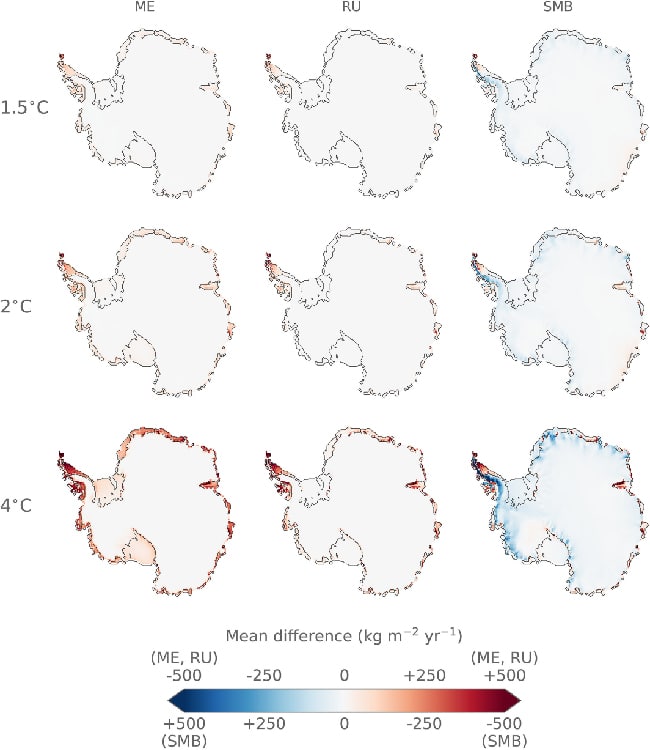
The study modeled meltwater, runoff, and surface mass balance (a measure of total ice) under warming scenarios of 1.5°C, 2°C, and 4°C. In the visualization below, red indicates increases in meltwater and runoff and decreases in surface mass balance (note the legend). 

antarctica warming trends past 30 years

Source: Gilbert and Kittel, Geophysical Research Letters, 2021

The study also explained how exactly ice shelves melt to the point of collapse. It’s a process termed ‘hydrofracturing’ whereby excessive, pooled meltwater on the shelf’s surface moves in between cracks in the ice and weakens it. In cooler temperatures that meltwater would refreeze or be so little that it mainly remains on the shelf’s top.  

The Antarctic Peninsula is one of the fastest warming places on Earth, already on average 2.5°C warmer than what it was in 1950. In the past 30 years or so researchers have observed its ice shelves breaking apart at an unprecedented rate. In 2017 the Larsen C ice shelf made the news when it lost a piece the size of Delaware. 

It all sounds bad, and it could be, but what’s key is that so much future ice melt will only happen if we let those warming scenarios happen. 

Some climate scientists see a 3°C world as most probable now, more than the ideal 2°C but less than the potentially catastrophic 4°C. Time will tell how much studies like these, with their reason and forewarning, move our societies to act on global warming mitigation. 

This article was written by Debbie Sanchez.

You might also like: Air Pollution in Shanghai

Coral reefs protects land from coastal erosion, are vibrant biodiverity hotspots and important carbon sinks; sadly, rising ocean temperatures are causing them to die. Attracting new fish to degraded reefs could help them bounce back, and scientists have found a new way to do so. Here, we cover how acoustic enrichment could help restore dying coral reefs around them world. 

Up to half of the world’s coral reefs have been already lost or severely degraded due to climate change, pollution, recreational tourism and overfishing. By 2050, almost all coral reefs in the world will be affected and up to 75% could face high to critical threat levels. 

There is no doubt that the biggest threat to coral reefs is climate change.  According to the National Oceanic and Atmospheric Association, between 2014 and 2017 around 75% of the world’s tropical coral reefs experienced heat-stress severe enough to trigger bleaching. The impacts of climate change could significantly alter the ecosystem of coral reefs so that the environmental conditions are no longer suitable for the survival of corals. For example, increasing sea surface temperatures, increasing ocean acidity and more ice meltwater could all result in severe coral degradation. 

Current coral reef conservation efforts are focused on establishing Marine Protected Areas (MPAs) and fishery management. These measures help but they don’t help restore reef systems that have already been degraded. A healthy coral reef buzzes with animal sounds, it is full of crackling, popping and grunting coming from fishes and other organisms that live there. In contrast, degraded coral reefs are almost silent which deters fishes away from the reef. Using a technique called “acoustic enrichment”, scientists were able to make the environment more attractive and bring new life to these ecosystems.

How does acoustic enrichment work? 

In a study published in nature communications, a group of international scientists from the UK and Australia have found that broadcasting the sounds of a healthy coral reef enhances fish community development in degraded coral reefs.

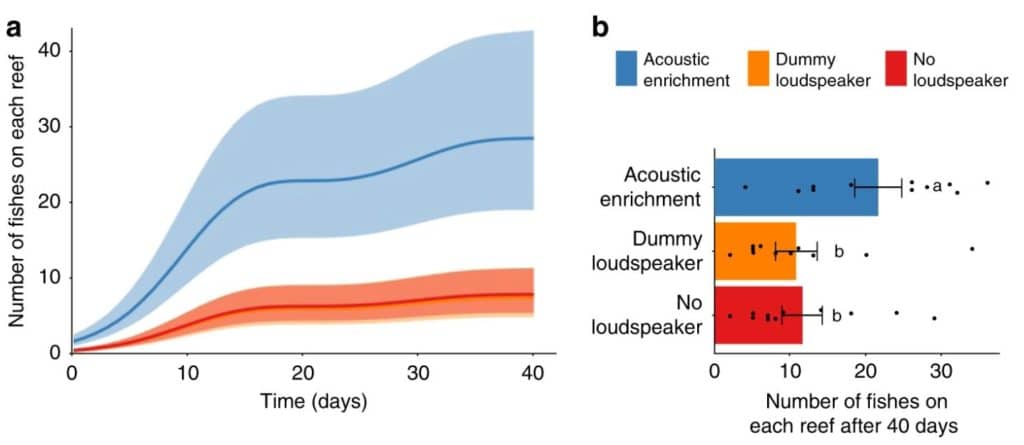
The study was carried out in the lagoon southwest of the lizard island in Australia where 60% of live corals were bleached due to a severe mass bleaching event leading to widespread ecosystem change. Each experimental reef was assigned one of three experimental treatments: no loudspeaker, a dummy loudspeaker system or a real loudspeaker system (acoustic enrichment). The experiment is then proceeded by playing sounds from healthy coral reefs in the experimental reefs for the entire night and measuring the number of fishes in each reef throughout the process.

acoustic enrichment coral reefs

Source: Gordon, T.A.C., Radford, A.N., Davidson, I.K. et al. Figure a. Number of fishes per reef over time. Figure b. Raw count data of the number of fishes per reef.

After 40 days of acoustic enrichment, there was a great increase in juvenile fish communities in the reef (blue curve). Damselfish, in particular, proliferated. These are common inhabitants in coral reefs and they largely rely on corals for the protection of their eggs before they hatch; the ammonium they excrete in turn stimulates coral growth.

Why is biodiversity important in coral reefs?

Generally, a highly biodiverse ecosystem inhabiting many different species is more resilient to changing environmental conditions and can better withstand significant disturbances (eg. climate change, pollution etc). Every species has its own niche, which is how a species contributes and interacts in its own ecosystem. When a coral reef inhabits a large number of species, it can imply some levels of functional redundancy where multiple species have similar niches so that if one species is lost, they can substitute for one another. In other words, the loss of one species will have a smaller effect in a diverse system compared to an ecosystem with limited species. To put a number on this, studies have shown that the productivity of low diversity systems decreased 50% more than highly diverse systems during extreme climatic events.

As climate change continues to exacerbate in the coming years, solutions like acoustic enrichment could become crucial to help restore degraded ecosystems. It goes to show that there are many strange, interesting and cost-effective ways to help our suffering biodiversity. 

This article was written by Rachel Yan. Cover photo by Hiroko Yoshii on Unsplash 

You might also like: Global Emissions To Bounce Back in 2021

The Maldives are a small archipelago in South Asia, located in the Indian Ocean 700 kilometres southwest of Sri Lanka and India. Around 80% of its land area is under 1 meter above sea level, meaning it will be one of the first nations to be entirely engulfed by the steadily swelling seas. NASA satellite imagery allows us to get a bird’s eye view at how the Maldives are adapting their islands to stave off sea level rise. 


Sea level rise has massively accelerated over the past century, going from ~1.5 mm per year in 1900, to 4.8 mm per year today. With no signs of relent, one study predicts that low-lying islands will become uninhabitable by 2050 before full submersion, driven by frequent flooding and freshwater scarcity. If we expand our scope to the end of the century, things become more uncertain: low end estimates put sea level rise at half a meter, while the high end stands at 2 meters. 

In the worst case scenario, the world’s coastal geography would undergo serious change, forcing us to massively invest in adaptation. The lower estimates still imply a necessary rethinking of where and how we live, with 680 million people living in low coastal areas and a US $6 trillion ocean-based economy. 

Facing forced displacement, the Maldives government is exploring plans to purchase safer land in other countries, but most of their efforts have been in enhancing resilience in their home-state. Hulhumalé is a newly constructed artificial island just northeast of the capital, Malé, built up by pumping sand from the sea floor. Officially inaugurated in 2004, it is 4 km2 in area and houses a population of 50,000, expected to grow to 200,000 in the upcoming years. Twice as high as Malé, it can provide refuge from both typhoons and the slow oceanic rise.

maldives satellite sea level rise nasa earth observatory

The Maldives, February 3, 1997. Iimaged by the NASA Earth Observatory’s Lauren Dauphin, using Landsat data from the U.S. Geological Survey.

Maldives sea level rise satellite imagery 2020 nasa earth observatory

The Maldives, February 19, 2020. Iimaged by the NASA Earth Observatory’s Lauren Dauphin, using Landsat data from the U.S. Geological Survey.

Hulhumalé is far from being the only Maldivian land reclamation project; Thilafushi is a lagoon to the west that has become a large landfill and a common location for trash fires (see the southwestern smoke plume in the 2020 image), and Gulhifalhuea houses another project meant to create space for manufacturing and industrial activity. 

One thing to bear in mind is that islands like the Maldives are constantly being reshaped by ocean currents and sediments flux. Coastal erosion usually compounds sea level rise, enhancing land area loss. However, the Maldives’ healthy coral reef system provides a natural defence against erosion, and it has even been suggested that offshore sediments may be building up the archipelago. 

Unfortunately, built up land can rarely benefit from these natural solutions as seawalls stop sediments from grafting more land area onto the island. Overall, it may have more time than initially predicted, but current sea level rise rates mean it will largely disappear within a century. 

This article was written by Owen Mulhern. 

You might also like: Shifting Baselines and the Elusiveness of Climate Change


Vaquitas are a rare type of cetacean found off the coast of Mexico that often illegal fishing has nearly driven to extinction. 2021 has been announced a critical year for the animal, as their existence hangs on to whether we make decisive push for their sake.

In 2019, Richard Ladkani released the stressful but inspiring documentary Sea of Shadows, which enlightened audiences to the plight of the vaquita. It revealed just how dire the vaquita’s situation was, and the monetary causes fuelling its endangerment. At the time, there were an estimated 19 individuals left, and the film stressed just how key the next year was going to be in the vaquita’s survival. What has happened since?

The vaquita is a small porpoise endemic to the Sea of Cortez in the Upper Gulf of California in Mexico. It is estimated that there are now fewer than 10 vaquitas left, with a total population decline of 98.6% since 2011

Vaquita population counts 2020

From Jaramillo-Legoretta et al. (2020). Vaquita population decline over time. Number of individuals estimated based on recorded click sounds (their method of communication). Circle sizes indicate duration of sampling in days, color is the number of clicks recorded.

They are the unfortunate victims of the totoaba swim bladder trade. The totoaba is a critically endangered fish whose swim bladders are sold primarily in China for their medicinal purposes, despite there being no scientific evidence to back up its purported virtues. These bladders have been dubbed the “cocaine of the sea” and can fetch up to $46,000 USD per kilo on the black market. They are caught in gillnets, or “walls of death”, which is a curtain of netting that hangs in water and catches anything and everything that gets caught up in it, including vaquitas, who can get tangled up and drowned.

In an attempt to save both the vaquita and totoaba, the Mexican government permanently banned gillnet fishing in 2017. But this ban is hard to enforce and gillnet fishing remains a very common practice. Sea Shepherd, working with the Mexican government, have successfully removed over 1,200 illegal gillnets from the habitat since 2015, and have attempted to ward off illegal fishermen. But saving the vaquita will require a crackdown on the illegal totoaba swim bladder trade, and this will need effective law enforcement, but also support for local people who rely on fishing for their livelihood. 

In 2015, the Mexican government began paying fishermen from the nearby fishing town, San Felipe, to halt activities whilst vaquita populations recovered. However, the situation did not improve and the compensation ended by 2018, which has only forced more local people, with few other options to earn a living, to resort to illegal fishing. The US has now expanded a law that bans the importation of any seafood captured in that area, which only encouraged more illegal activity. Crackdowns against illegal traders have yield results, which is encouraging for biodiversity health, yet leaves people in the area with little. 

The Chinese government has also increased their involvement in recent years. Since 2015, 300 million yuan worth of contraband has been seized. Enforcement on the demand side could make a huge difference to the trade – when 444 kg of swim bladders worth $26 million were confiscated by China in October 2018, the totoaba swim bladder trade instantly plummeted. However, sources have said that it is still incredibly easy to buy totoaba swim bladders in China.

Although there are improvements, this next year will be crucial to determining the survival of the vaquita and it is kicking off with bad news. In January 2021, there was a collision between a Sea Shepherd boat and a smaller panga fishing boat. One fisherman, Mario Garcia Toledo, died. Sea Shepherd maintains they were deliberately attacked, and the man’s family maintains his boat was intentionally rammed. Rising tension between Sea Shepherd and local fishermen, put a lot of pressure on the Mexican government to provide support. They are now considering reducing the protected vaquita area, which would allow more gillnet use and worsen things again. With Sea Shepherd gone, observers have claimed that illegal gillnets are being blatantly placed in the water, with buoys clearly labelling them.  

Amidst the turmoil, a new study has investigated the genetics of the vaquita and says there is still hope for the species. Usually, small populations can be at risk of being “doomed to extinction”, due to loss of genetic diversity and inbreeding. However, the study suggests that the Vaquita has survived in small population numbers for at least 250,000 years, having reached “genetic equilibrium”, with less diversity than any other known mammal, yet a perfectly healthy genepool. In 2019, three healthy calves were spotted, a sign that the population can and will recover if given the respite it needs. If Sea Shepherd and local authorities come together on the issue, we could save a unique and beautiful species from imminent extinction. 

This article was written by Cara Burke.

You might also like: Global Emissions To Bounce Back in 2021

One of the latest advancements in cutting-edge clean energy technology is no more complicated than what makes apples fall from trees. Energy start-ups around the world have begun using gravity as an alternative form of clean energy storage. It may help mitigate the disadvantages of other energy storage techniques, some of which have become environmental issues in themselves despite all being part of the shift away from fossil fuels.  

The Rise In Renewable Energy 

Despite the prevailing dominance of the fossil fuel industry, renewable energy is already here, and the sector is growing fast. Last year saw record lows in various countries for coal and natural gas electricity generation, including in the EU and the US, and 2021 is expected to show similar data as pandemic-delayed projects get the green light to go ahead.  

USA energy trends


EU Renewables energy storage

One of the main challenges for renewables has always been how to store the power generated, and then how to employ it reliably on command. Hence today’s energy storage boom as cleaner technologies gain traction.  

How It Works 

In gravity energy storage, quite literally, heavy things are dropped, they spin turbines as they fall, and that generates electricity.  

Physicists everywhere will be quick to point out that gravity is not generating electricity but providing the force that releases the energy that then generates electricity. 

Recall your high school physics for just a moment: when something heavy is up on a high place, it holds potential energy. When that thing falls, that potential energy is released as kinetic energy, i.e. the energy of moving objects. 

Taking it one step further back, that potential energy only got there by some other energy source putting the thing up high in the first place. In these systems, that initial energy is excess electricity from other clean sources, like solar panels or wind turbines. Hence this all being a way to store energy, not create it. 

(Any energy ‘source,’ for that matter, is not actually sourcing energy, just transferring it from one thing to another in a way that’s useful for us. So goes one of the most fundamental laws of science, the first law of thermodynamics: energy is never created or destroyed; it only changes form). 

Prototypes are already moving into more advanced stages. A start-up in Edinburgh, Gravitricity, plans to use abandoned mine shafts and weights totaling 12,000 tons to generate electricity that’ll power 63,000 homes per hour. In Switzerland, the company Energy Vault uses high towers with cranes and precisely timed concentric ring drops. Both companies plan to build commercial plants within the next couple of years and to expand internationally.    

In Comparison To Other Storage Technologies 

The idea to harness gravity in this way is really the same concept as hydropower, currently the most common form of long-term clean energy storage: water goes from a high place to a lower place and spins turbines as it falls. Lifting water back up to a high place takes energy just the same, either naturally, by the sun through evaporation and the rest of the water cycle, or by machines, when it’s pumped uphill to be stored hydro.  

Pumping, storing and then releasing large amounts of water is not too difficult, but there can be problems, like disrupted habitats and water quality downstream. Dropping heavy slabs of rock or concrete doesn’t have these downsides. 

Another existing alternative is compressed air energy storage, a rather promising technology, but air gets very hot when compressed to such high pressures, and like with stored hydropower there are limited available geological locations.  

The most ubiquitous way to store energy is currently lithium-ion batteries, popular for their high energy density, light weight, low maintenance, and declining cost. 

Lithium is a type of metal that needs to be mined, though, and as demand for these batteries rises so does the strain on the ecosystems and communities wherein those mines are operated. In Tibetan towns and parts of Bolivia, Chile, and Argentina, lithium mines have led to toxic leaks into local water supplies and are highly resource-intensive. Li-ion batteries are a force in the transition to clean energy, but the more alternatives to them the better. 

More Pros Than Cons (For Now)

Gravity energy storage is getting noticed by investors and governors in large part for being so simple – all one needs are heavy objects, winding gear, and either a high tower or a very deep drop. There are minimal raw material requirements, a small land footprint per kWh, no harmful chemicals, low operational costs and high round-trip efficiency (about 80%). 

Energy Storage Efficiencies _(Data Source_ The World Energy Council 2019)

Source: The World Energy Council, 2019.

Perhaps most crucially, the investment and charging costs are far lower than those of other technologies – up to 50% cheaper than battery storage and only about a third of pumped hydro. 

The cons are at the moment apparently few, mostly to do with design optimizations, but as these systems are new it’ll take time to see what other issues come up and need sorting. 

No energy technology will ever be perfect, as both the laws of physics and economics ensure, but new innovations mean new momentum and more options in the increasingly imperative clean energy transition.  

This article was written by Debbie Sanchez.

You might also like: Air Pollution in Paris

The world is well aware of its plastic problem, and viable solutions haven’t seem to have surfaced yet. Bioplastic sounds like something we could endorse, but what is it really?

Earth.Org takes a closer look.

You may recall a time recently when you picked up a plastic utensil and thought the texture was a little off or perhaps looked a little different than the one you remember being paired with that slice of birthday cake a few years ago. It’s a good chance that utensil was made of bioplastic. Bioplastics are derived from more naturally acquired ingredients with names we recognize and can usually pronounce like sugar cane, corn, potato, and other vegetable starches.  This compared to conventional plastic which comes from a blend of petroleum and other various oil products according to the Energy Information Administration or EIA. 

Bioplastics have been experiencing a rapid increase in demand. Even before COVID-19  all but forced the United States and much of the world back over to single-use materials as a health precaution; The bioplastics industry reported a market value of 8.3 billion dollars in 2019 and expects to grow by another 16.1% in the next 7 years according to the Grand View Researcher’s Market Analysis Report. That’s roughly the same market value as the NFL’s New England Patriots and the NBA’s Los Angeles Lakers market values combined. Bioplastics are in more than most of us realize. From more well-known products like the utensil mentioned earlier, plastic food wraps, to lesser-known items such as internal surgical tools like sutures according to an article out of MIT.  

bioplastic bioplastics inudstry market value

 Conventional plastics come from feedstock; a pipeline of fossil fuels consisting of crude oil, and natural gas.  The IEA admits they cannot accurately track the origin or amounts of each kind of petroleum and oil-based product that are siphoned into current plastic production. Bioplastics come from agricultural monocropping, traditionally cultivated with a high level of fertilizer. Agriculture dedicated to bioplastic production varies between sources; however, most estimates average the range to be in the 100,000s of hectares annually for the United States, and China significantly more. Fertilizer runoff, when crop soil becomes oversaturated with fertilizer. Those chemicals run off the surface of the land with irrigation and rainwater, and enter local tributaries, rivers, and eventually our oceans. According to the Environmental Protection Agency (EPA) This leads to harmful algae blooms, hypoxia or dead zones, acid rain, and air pollution. 

Not all bioplastics are created equal. When many of us think “Bio” we think biodegradable, or compostable. When in fact not all bioplastics biodegrade. Petroleum products are made up of complex molecular strains that are hard if not near impossible to break down in nature leading to environmentally devastating microplastic.  Bioplastics are designed to mimic conventional plastics down to the molecular structure, leaving only a small portion of bioplastics biodegradable. Another important aspect to consider is how long this degradation takes. In short, it depends. According to a ScienceDirect article in 2019, plastic bags can fully biodegrade in less than a year where utensils can take almost 6 years. Where the plastic ends up also changes the rate of decomposition. On average bioplastics break down faster in maritime environments compared to soil environments. Unfortunately, this still leaves plenty of time for bioplastics to make their way into our waterways and oceans. Rayon, a biodegradable bioplastic commonly found in clothing, and derived from cellulose was found to make up 58% of the overall microplastic extracted from ocean birds in a 2015 study conducted by the United Nations. Rayon is an example of how misleading the term bioplastic can be; a fact the fashion industry is keenly aware of. According to an article published by “EDGE”, a fashion information platform, rayon takes anywhere from 20-200 years to fully biodegrade. While better than conventional petroleum-based plastics which can take 1,000’s of years to fully breakdown, it’s a long way from ecologically ethical.

bioplastics bioplastic animal harm degradation

Source: NPR.

You may be wondering, “can it be recycled?” 

It’s true some conventional plastics can be recycled. However,  that number is far more limited than many of us realize. There has been a serious lobby on behalf of the industry to include that little recycling triangle on nearly every type of plastic even if it’s nearly impossible to recycle that product according to NPR and Eco-Watch. 

plastic recycling label

Source: Boredom Therapy.

In reality, America recycles less than 10% of its plastic. Bioplastic actually actively works against this already small percentage. Many of us blindly throw plastic into our bins with the best of intentions or leave it to the recycling factory to sort it out at the plant. However, on such a large scale it’s impossible to separate every type of plastic. Bioplastics end up being one of the worst contaminators of recycling because so few programs recycle it due to the lack of economic viability.

Bioplastics, while a novel, are far from ideal. It’s important as consumers that we be aware of the real impact bioplastics have on our environment. Actions are too often curbed by assumptions, but it is our responsibility to educate ourselves and not become complacent.

As for ways by which you can take action, the most obvious is to avoid plastic when possible and stick to reusable options. Bring your own utensils and plate to the next BBQ or potluck. It’s a great conversation starter, and you can take the opportunity to share what you know, perhaps swaying others to do the same. You can ask your local cafe to make more ecologically ethical choices about the cutlery they use. When plastic is unavoidable try to only use the types that can be recycled in your area. By far the best thing you can do is talk to your friends and family. Educate them on the importance of being mindful of the products they use. It really does make all the difference. 

This article was written by Sean Porter.

You might also like: Arctic Lightning Strikes Have Tripled


Subscribe to our newsletters

The best environmental stories of the week and month, handpicked by our Editor. Make sure you're on top of what's new in the climate.

SUBSCRIBE
Instagram @earthorg Follow Us