


May continued the streak of extreme global warmth seen in recent months, with December, January, and February each ranking as the fifth-warmest for their respective months, March as the fourth-warmest March globally, and April as the third-warmest April on record.
—
Last month was the joint second-warmest May on record, with temperatures 1.42C above pre-industrial levels, the European Union’s Earth Observation program Copernicus has said.
An exceptionally strong heatwave scorched much of Western Europe in the second half of May after cooler-than-average conditions affected the continent in the middle of the month. It was “one of the most intense heatwaves ever observed this early in the year” in the region, the forecaster said in its monthly bulletin.
A ClimaMeter study attributed the unusual heat baking Western Europe to human-driven climate change. Researchers described the meteorological conditions behind the heatwave as a “rare” occurrence once mainly associated with autumn months but now also occurring in late spring.
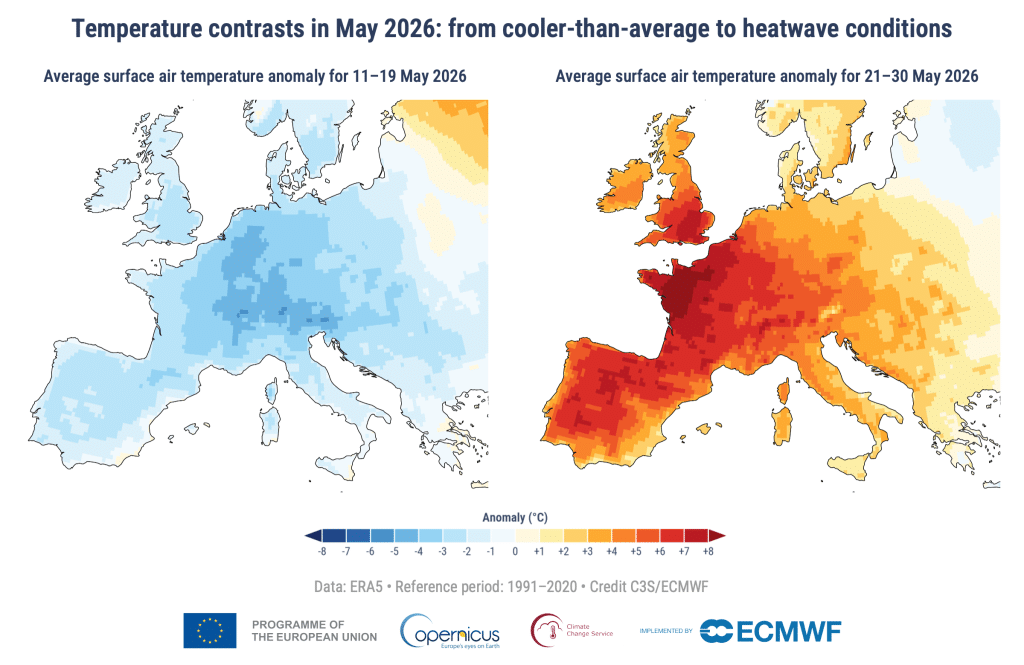
May continued the streak of extreme global warmth seen in recent months, with December, January, and February each ranking as the fifth-warmest for their respective months, March as the fourth-warmest March globally, and April as the third-warmest April on record. Amid this sustained global heat, scientists say it is “virtually certain” that 2026 will rank among the 10 warmest years ever recorded, with the year also on pace to finish among the top five warmest on record.
Sea surface temperatures were at their second-highest level globally and “exceptionally high” in the tropical Pacific, the forecaster also said. High sea surface temperatures are fueling El Niño, a global climatic phenomenon typically raising global temperatures and bringing erratic weather patterns. Last week, the World Meteorological Organization warned that El Niño could arrive as early as this month.
The past two such events – in 2014-16 and 2023-24 – brought record heat around the world that fueled further global temperature increase. 2024 went down as the hottest year on record due to a combination of long-term human-caused climate change and a strong El Niño weather pattern.
In a video statement published Tuesday, UN Secretary-General António Guterres urged the world to treat El Niño “as the urgent climate warning it is.”
“Impacts will hit even harder, travel even farther, and cross borders with devastating speed,” Guterres said as he called on countries to accelerate the shift toward clean energy sources, protect the most vulnerable, and deliver early warning systems for all.
Featured image: Kyle Lam/hongkongfp.com
This story is funded by readers like you
Our non-profit newsroom provides climate coverage free of charge and advertising. Your one-off or monthly donations play a crucial role in supporting our operations, expanding our reach, and maintaining our editorial independence.
About EO | Mission Statement | Impact & Reach | Write for us